


Book reviewed by Kathlyn Ronaldson, April 2026
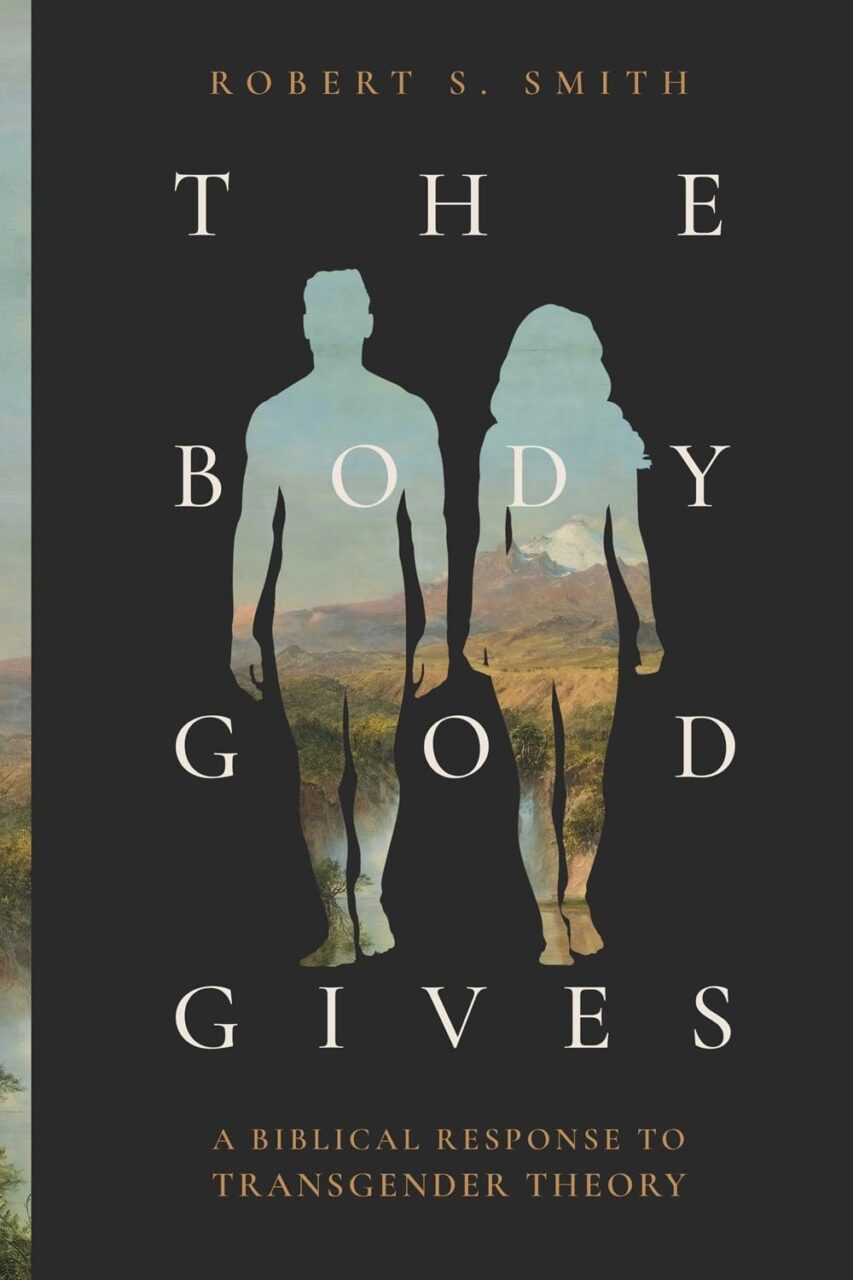
The Body God Gives: A Biblical Response to Transgender Theory
by Robert S. Smith
Bellingham, WA: Lexham Academic, 2025; 446 pages
ISBN 9781683598121, first edition, paperback
AU$55
The great controlling myth of our time has been the belief that within each of us there is a real, inner, private “self”, long buried beneath layers of socialisation and attempted cultural and religious control, and needing to be rediscovered if we are to live authentic lives.
Tom Wright, Creation, Power and Truth (quoted in Smith, p. 211)
This book is unquestionably an academic work, but those non-academics who have a serious interest in biblical material relevant to gender issues could well gain from reading it.
The author, Dr Robert Smith, is a lecturer in theology, ethics, and music ministry at Sydney Missionary and Bible College and has written other works on gender. This book has the appearance of a comprehensive and exhaustive review of all material that addresses gender theory from feminist, queer, transgender, liberal, and evangelical, both orthodox and heterodox, perspectives.
The stated primary purpose of the book is “to evaluate the central and ontological claim of transgender theory: that the sexed body does not determine the gendered self” (p. 3). The book is not pastoral in its purpose, but it is not judgemental, and Smith acknowledges the very real difficulties some have in living with their natal sex.
After an introduction (“The Contemporary Sex and Gender Crisis”) in which he describes the current situation and how it developed, Smith reviews evangelical contributions (“Evangelicals and Transgender Questions”) and finds that not all are orthodox and most are lacking in depth. He then notes the “Evangelical Theological Method” with its tradition of dependence on divine revelation and emphasis on the primacy of knowledge of God.
He observes at the beginning of Chapter 4, “Creation and Construction of Sex,” that since the 1950s, in a departure from its grammatical use (masculine and feminine words), gender began to be understood as the social epiphenomenon while sex was the physical manifestation. In this chapter, Smith argues that intersex individuals are not examples of a third sex (or many additional sexes), since they manifest only features associated with maleness or femaleness, although these features may be poorly developed. Chapter 5, “The Invention and Subversion of Gender,” addresses the work of John Money who treated children with intersex conditions and who claimed that sexual identity is learned not innate, based on bodily characteristics.
Chapter 6, “Reclaiming Sex and Rescuing Gender,” reviews various views of sex and gender, including those of Judith Butler, the influential gender studies philosopher who asserted that not only gender but also sex was a social construct. Having charted the evolution in Butler’s thinking and inconsistencies with physical reality, he concludes that “because the sexed body determines the gendered self, it is sex that should ground gender identity, govern gender roles, and guide gender expression” (p. 168, Smith’s italics).
With Chapter 7, “Male and Female in the Beginning,” Smith moves to consider biblical material including three chapters of careful exegesis of Genesis 1 and 2. The imago Dei is a divine gift not removed by gender dysphoria or reassignment surgery. Some, even the fourth century Gregory of Nyssa, have claimed that the first man was androgynous. However, Smith notes that the grammar and structure of the three-line poem of Genesis 1:27 clearly indicates that God created humans male and female from the beginning. Some have seen in Genesis 1 a basis for justifying the presence of gradations between male and female, since dawn emerges slowly from the night and dusk from day. In response to this, Smith observes that the command to be fruitful and multiply in 1:28 does not allow this interpretation. Thus, the sexed body is crucial for the imago Dei.
In “The Making of Man and Woman” (Chapter 8), Smith makes the crucial observation that Adam’s body was formed first and then God breathed into his nostrils and he became a living creature. The sex of the body determined the gender of the soul. The Hebrew word “adam” refers to the man before and after the formation of Eve, indicating that the first human was sexed, and not androgynous.
In contrast to the conventional view that marriage is a picture of Christ and the church in retrospective fashion, Smith suggests that in fact Paul in Ephesians 5:32 is saying that God’s institution of marriage in Genesis 2 was prospectively anticipating Christ and the church (Chapter 9, ”The Meaning and Mystery of Marriage”). Here Smith deals with all kinds of confusion around this metaphor, observing that nowhere is an individual Christian said to be the bride of Christ; there is no homosexual marriage here.
In Chapter 10 (“Sex and Gender Outside of Eden”), Smith takes the reader on a trajectory of grace beginning with the problem of the exclusion of a man with crushed testicles from the worshipping congregation of Israel (Deuteronomy 23:1). As he points out, Isaiah 56:4–5 anticipates the inclusion of eunuchs, Jesus implies acceptance (Matthew 19:12) and nothing hinders the Ethiopian eunuch from being baptised (Acts 8:36). Crucially then, even those who have undergone gender reassignment surgery are welcome in the Kingdom of God, provided they are observing the conditions outlined in Isaiah 56 which Smith believes includes ceasing cross-sex hormone therapy and living in harmony with their God-given sex.
In the final chapter before the conclusion (“Sex and Gender in the End”), Smith embarks on a mission to determine what scripture imparts about the sexual nature of our resurrection bodies. First, Jesus in heaven is described as a physical man (1 Timothy 2:5). Second, Jesus in responding to the Sadducees, observed not that people will be unsexed in heaven but that “people will neither marry [men] nor be given in marriage [women]” (Matthew 22:30). Third, 1 Corinthians 15 gives no indication of the elimination of sex. Surprisingly, he did not explicitly link this argument back to Genesis 1:27 where being made the imago Dei was to be made male and female, a more persuasive point in my view. Nevertheless, he states “our sex is not only revelatory of the particular gift given [alluding to the book’s title] to each of us but is fundamental to our personal identity” (p. 364, his italics), and envisages that in the resurrection fallen gender stereotypes will disappear, and our sexed identities will reach their fulfilment.
This book is truly a tour de force and I envisage it being a reference work in evangelical gender studies in years to come, and a blessing to many. It is a timely counter to the obsessive search for authenticity through introspection, referred to in the Tom Wright quotation which leads this review.