


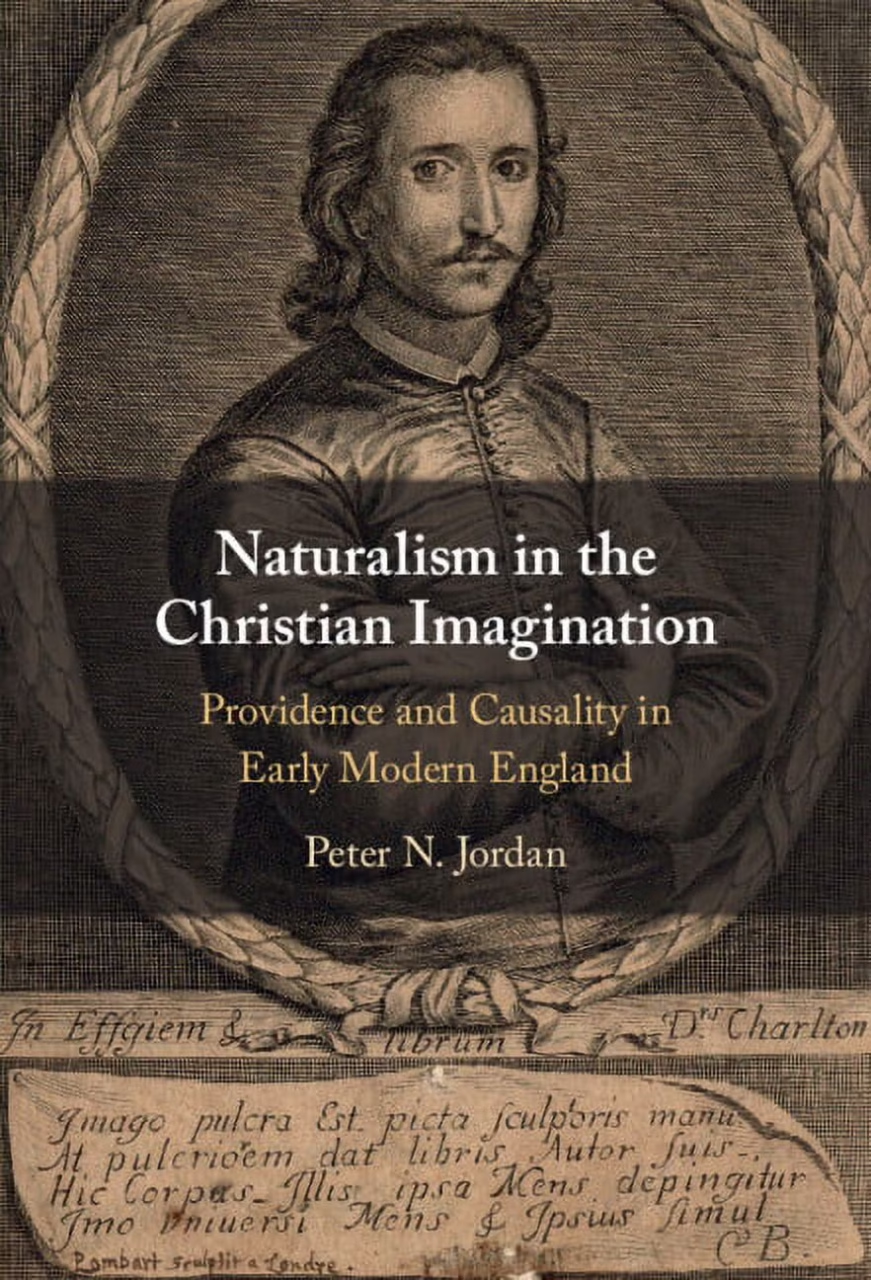
Book reviewed by Antonios Kaldas, June 2026
Naturalism in the Christian Imagination: Providence and Causality in Early Modern England
by Peter N. Jordan
Cambridge: Cambridge University Press, 2022; 218 pages
ISBN 9781009211987, first edition, hardcover
AU$146
There are reverent minds who ceaselessly scan the fields of Nature and the books of Science in search of gaps — gaps which they will fill up with God. As if God lived in the gaps?
This observation by Henry Drummond in The Ascent of Man (New York, 1894, p. 333) beautifully sums up a key theme in Jordan’s rich and masterly treatment of early modern reactions to the emergence of that powerful epistemic approach we now call “modern science.” This is a book dealing with an important phase of Western thought on what things about the world can be explained without invoking God. The roots of our modern view of the world lie chiefly in this early modern period.
Peter N. Jordan is a biologist with credentials in studies of religion, currently researching the relationship between science and religion at Oxford. The book derives from a thesis he completed under Peter Harrison’s project of recovering a more sustainable approach to science that does not rule out immaterial reality out of hand (for example, Peter Harrison, The Territories of Science and Religion [University of Chicago Press, 2015]). Jordan clearly continues and deepens this project by adding a finer grain to the picture in this historical period and place.
This book will appeal not only to philosophers of science and of religion and historians of religion, but also to general readers interested in deeper questions: in understanding why we see the world as we do, and in alternatives. For those with faith the book offers a guided tour of the pros and cons of involving God in nature. For the sceptic it offers a valuable guide to the strengths and weaknesses of such an involvement.
The book paints a picture of English scholars of the seventeenth and early eighteenth centuries who grappled with questions like “What is a miracle?” (chapter 4) or “Is there a natural explanation for Noah’s Flood?” (chapter 6). These were men who assumed the existence of God as Creator and Sustainer of all but sought to reconcile this faith with the emerging scientific understanding of nature as an enclosed system governed by immutable natural laws. It is important to keep in mind that all the historical views and positions considered in this book refer only to phenomena in the world, and whether such phenomena can be caused by direct intervention by God in a way that goes against the characteristic patterns of natural behaviour. Importantly, the existence of God as such is not part of their purview—it is a given. Thus, the reader must bracket out the kinds of atheistic claims made in our own times—such modern debates were not what motivated the thinkers Jordan treats.
Others have convincingly mapped out the story of how modern science arose both within and from religious faith (for example, James Hannam, The Genesis of Science: How the Christian Middle Ages Launched the Scientific Revolution [Regnery Publishing, 2011]). What is new in Jordan’s book is a deep dive into the very mechanics of an important phase of this story. He presents several case studies of thinkers who strove to unpick what can be attributed to “nature”—a term becoming increasingly devoid of the supernatural or preternatural at this time—and what remains to be attributed to divine action, or providence. In so doing, Jordan focuses on three common themes: the boundary between the natural and the miraculous; God’s communication with us through nature (and how so?); and the ethical ramifications of the study of nature (pp. 13–14).
The result is what he terms “providential naturalism” (pp. 6–9)—roughly the view that while naturalism can explain much about the universe, it is an insufficient explanation by itself, without divine providence being involved in some way or other. That “some way or other” has taken a variety of historical forms, many of which he explores in the book in some detail.
But this view itself raises a bevy of other questions. A couple of examples will give the reader a taste: Are human beings truly free participants alongside divine providence in what happens in the world? If so, what does this mean for how we ought to live (pp. 39–44)? Is there such a thing as genuine chance, or are all events determined, whether by God or the laws of nature? What does this tell us about the ethics of gambling, or even of the biblical instances of casting lots (chapter 3)? And does God use prodigies (miracles) to communicate with us (pp. 77–82)? Does nature more generally play a communicative role?
Jordan’s copious footnotes provide a rich source for further investigation of almost every substantive point he makes in the book. Also, readers who delight in quaint Olde English quotes will not be disappointed—Jordan is generous in providing original excerpts from the early modern authors he explores. For example, this quote from Richard Sibbes: “Wee find by experience, that when our wills are so subdued [to the will of God], that wee delight to doe, what God would have us doe, and to be what God would have us be, that then sweet peace presently riseth to the soule” (p. 41).
My one caution (rather than criticism) might be that in reading this beautifully written account of early modern thinkers flexing their newfound rational and empirical muscles and bringing them to bear on the question of God’s relationship with the natural creation, the reader may need to be reminded that traditionally Christianity has relied upon the principle that if God is who Christians think he is, he cannot be grasped with the mind. “Si enim comprehendis, non est Deus” (“if you understand, it is not God”; Augustine, Sermon 117.5, in Sermons (94A–147A) on the New Testament, trans. Edmund Hill, vol. III/4 of The Works of Saint Augustine: A Translation for the 21st Century [New City Press, 1992], p. 211). The god that emerges, then, from this place and time, may be interesting, but it can never be the God who is. Those who truly wish to grow closer to divine reality must beware the trap of getting so involved in these kinds of debates that they lose their connection to the daily reality of God. Of course, it might be responded that these thinkers were dealing not so much with the nature of God as with the nature of nature—a perfectly valid subject of human investigation.