


Abstract: Over recent decades there have been several studies presenting evidence for the date of Jesus’ birth. The problem is important because many scholars dispute the traditional 2–3 BC date of the Nativity claimed by the early Church Fathers, and instead suggest dates as early as 6–7 BC or as late as AD 6–7. This is a serious problem for the scientific credibility of the Gospels, because it undermines their claim to present reliable eyewitness accounts of the life of Jesus. To address these problems I present a thorough review of evidence for the date of Jesus’ birth. The evidence relates to several aspects of the birth accounts of Matthew and Luke, including the meaning of the census decree of Augustus, the nature of the governorship of Quirinius, the events associated with the death of Herod, and the celestial meaning of the star of Bethlehem. Some scholars have presented “conclusive” evidence against the traditional 2–3 BC date for Jesus’ birth, but this evidence turns out to be weaker than previously admitted. When approached with scientific objectivity, I believe the evidence continues to support the traditional 2–3 BC date for the Nativity. If this date is accepted, the Star of Bethlehem is best interpreted as a series of close conjunctions involving the planet Jupiter, with astrological implications that were understood by the Magi. The series of celestial interactions ended with a very close Jupiter–Venus conjunction that created a super-bright single star.
Of the four Gospels, Luke’s has the clearest historiological statement (Luke 1:1-4), where it claims to be an “orderly” account of eyewitness observations about the life of Jesus; and yet many scholars consider Luke’s account of the Nativity to be flawed or even fabricated. Similar objections are given to the birth account in Matthew’s Gospel, which is widely believed to be rhetorical rather than historical in its approach. These are serious problems for the credibility of the Gospels, especially for scientific apologists who claim their reliability as accurate histories of the life of Jesus.
A comprehensive analysis presenting a large body of evidence in support of the traditional 2–3 BC date of the Nativity was presented by Ernest Martin in his 1996 book, The Star That Astonished the World.[1] This study brought together much detailed astronomical and historical evidence, but is now out of print. It has also been weakened by subsequent work that contested Martin’s evidence. For example, a 2015 conference volume proposed a different date and a different star.[2]
In the field of faith and science, these questions were examined in two separate papers, one by James Nollet, who assessed the date of the Nativity in relation to Herod’s death,[3] and one by Dwight Hutchison, who focussed only on the star of Bethlehem.[4] However, their arguments do not fit clearly together. Therefore, it seems desirable to bring all of the evidence into one accessible analysis. This examination should begin by discussing why the traditional date of the Nativity was believed to be 2–3 BC, rather than the year zero.
The “Year of Our Lord”
The idea of dating historical events relative to the birth of Christ (Anno Domini) is attributed to Dionysius Exiguus, an Eastern Roman (Byzantine) monk who was born in present-day Romania but lived in Rome during the first half of the sixth century.[5] At the time, historical events were typically dated either from the creation of Adam, the founding of Rome, or the reign of Diocletian.[6] However, the date of Adam’s creation was widely disputed, and the date of Rome’s foundation was not precisely known. Therefore, for practical purposes, the reign of Diocletian (AD 284–305) was most widely used to date public events in the later Roman Empire. However, Dionysius objected to the continued use of this convention, since Diocletian was one of the most anti-Christian of the pagan emperors. Therefore, Dionysius conceived the idea of replacing the Anno Diocletiani with Anno Domini, based on dating events from the birth of Christ.[7] The idea caught on gradually in Italy, and major boosts were its adoption by Charlemagne (born in AD 742), and by the papal chancery a couple of hundred years later.[8]
Unfortunately, it is universally agreed by scholars that Dionysius’ date for the Nativity is wrong. In fact, this is probably the only thing that most scholars discussing this question have agreed upon. However, Georges Declercq has given a reasonable explanation of how this error occurred, based on original proposals by Gustave Oppert.[9]
Dionysius determined a date for Jesus’ crucifixion (equivalent to AD 31) based on the yearly variations of the date of Easter.[10] However, he based his date for the Nativity on a one-year duration of Jesus’ public ministry, which is now rejected, but was supported by some of the early Church Fathers such as Clement of Alexandria. This was caused by a misinterpretation of Luke 4:19 to imply that Jesus’ ministry could only last a single year, in contradiction to the minimum of two years described in John’s Gospel.[11] Based on Luke’s claim (3:23) that Jesus was about thirty years old when he began his work, a one-year public ministry led Dionysius to determine December in 1 BC as the date of Jesus’s birth. There could be no year “zero” since this concept did not exist in the Roman world.
If we accept the principles of the Dionysian dating method, we can recalculate the date of the Nativity using better age estimates. Firstly, we use a new date of AD 33 for the crucifixion, based on calculations of the exact date of the Passover in each of the possible years of Jesus’ death.[12] Secondly, the duration of Jesus’ ministry is revised to 3½ years, based on the mention of three Passovers in John’s Gospel (John 2:13, 6:4 and 11.55), along with evidence for another year between John chapters 4 and 5.[13] Thus we place the beginning of Jesus’ ministry in late AD 29, consistent with the claim in Luke 3:1 that John the Baptist began his own public ministry in that year (the fifteenth year of the reign of Tiberius Caesar). Then, based on Luke’s claim that Jesus was “about thirty years old” when he began his ministry, we obtain a date for the Nativity of about 2 BC, which is the date given by most of the early Church Fathers.
Beginning around AD 200, the Church Fathers dated Jesus’ birth relative to the reign of Augustus Caesar, which we can reliably convert to years BC. Augustus (Gaius Octavius Caesar) began his reign after the assassination of his adoptive father Julius Caesar in 44 BC, and was recognised as one of a ruling triumvirate the following year. He took sole power after the suicide of Anthony and Cleopatra in 30 BC, following their loss of the Battle of Actium in 31 BC, but was not given the title “Augustus” until 27 BC. The birth of Jesus was quoted relative to the reign of Augustus beginning in either 44 or 30 BC. This variation introduces some complexity, but can also be regarded as a strength, because it suggests that these dating schemes were somewhat independent calculations.
The earliest such source is Irenaeus of Lyons, who dated Jesus’ birth to “about the forty-first year of Augustus.” This is recorded in his Against All Heresies,[14] which was itself written between AD 170 and 184, based on the quoted names of serving bishops. Assuming Irenaeus is dating the beginning of Augustus’ reign from 44 BC, this implies Jesus’ birth in “about” 3 BC. Similarly, Hippolytus of Rome, in his Commentary on Daniel (ca AD 202–211) dates Jesus’ birth to the forty-second year of Augustus, implying a date of 2 BC. Hippolytus is also the first person to place Jesus’ birth on 25 December, although historical evidence for this date is lacking.
Two other early sources date Jesus’ birth relative to the beginning of Octavian Augustus’ sole rule. For example, Tertullian of Carthage in his Answer to the Jews (written in AD 198) dates Jesus’ birth to 28 years after the death of Cleopatra.[15] By explicitly dating relative to Cleopatra’s suicide, Tertullian avoids ambiguity and thus clearly dates Jesus’ birth to 2 BC (other statements by Tertullian will be considered below). A similar date, in the twenty-eighth year of Augustus, is claimed by Clement of Alexandria in his Stromata, written around AD 200.[16] Clement’s date is more ambiguous, since he does not mention the death of Cleopatra. On the other hand, Clement explicitly mentions that Jesus was born at the time of the first census in the reign of Augustus, which will be discussed further below.
The Birth Narratives of Matthew and Luke
The sources quoted above agree about the date of the Nativity to within a year or two. Unfortunately, this is not the case when we try to use historical information to constrain the birth narratives of Matthew and Luke, which can lead to dates for Jesus’ birth up to twelve years apart. Specifically, Matthew implies that Jesus was born about two years before the death of Herod the Great, normally dated to 4 BC, whereas Luke links Jesus’ birth to the census of Quirinius, normally dated to AD 6.
This discrepancy between the historical reference points used in these Gospels is clearly problematical for their treatment as historical documents, a role which Luke at least seems specifically to claim at the start of his Gospel. But even more seriously, the discrepancy calls into question the motives of the two Gospel writers. In both cases it seems that the Gospel writer was primarily concerned to validate Jesus’ birth as a fulfilment of Old Testament prophecy. But if this validation was achieved by distorting historical facts, this is a major problem for their credibility as reliable historical witnesses.
This situation is rendered even more problematical by evidence from Matthew’s Gospel showing conclusively that he did misquote Old Testament scriptures in order to achieve theological objectives. This misquotation occurs when Matthew 1 summarises the genealogy of Jesus in three major segments (Abraham to David, David to the Exile, and the Exile to Christ), but leaves out four generations in the line of descent from David to Jehoiachin. These omissions might seem like an oversight, but Matthew follows his genealogy with a pointed observation about the number of generations in each segment: “Thus there were fourteen generations in all from Abraham to David, fourteen from David to the exile to Babylon, and fourteen from the exile to the Christ” (Matthew 1:17, NIV).
It has been argued that Matthew made this assertion because the number 14 is a summation of the numerological values of the Hebrew letters that make up David’s name.[17] Therefore, Matthew’s observations were apparently intended to emphasise to his Jewish audience that Jesus really was a descendant of King David, and was therefore the promised Messiah. Matthew evidently regarded this theological message as more important than genealogical accuracy. However, this is a concept that most modern readers find very strange, and is likely to jeopardise the reliability of Matthew’s Gospel in their eyes as a source of chronological information. That said, establishing the chronology of Jesus’ birth was probably not Matthew’s intention.
Luke also gives a genealogy of Jesus at the beginning of his Gospel, but this is almost completely different from the genealogy of Matthew, and doubtless reflects different motives. The two genealogies agree in the segment from Abraham to David, but Luke’s line of descent is then traced through Nathan, brother of Solomon (1 Chronicles 3:5). This line of descent also ends with a different father of Joseph (husband of Mary). However, the latter issue has been widely attributed to one of Joseph’s fathers being a step-parent.[18] The overall purpose of Luke’s genealogy is evidently to link Jesus with Adam, rather than Abraham, in order to highlight the identity of Jesus as “son of God” (Luke 3:38). This was a title used by Jesus to describe his identity and mission, but one also used by Augustus Caesar. Such a comparison may therefore have been intended by Luke in his account of Jesus’ birth.
The Decree of Augustus
The way that Luke describes the birth of Jesus implies greater attention to historical detail than by Matthew. In fact, Luke seems to give almost an excess of historical reference points for Jesus’ birth. However, this turns out to be a problem, because some of these references seem to contradict other historical evidence. One of the main issues is Luke’s claim of a worldwide census decreed by Augustus, as described in Luke 2:1–3. This is often translated as in the NIV: “In those days Caesar Augustus issued a decree that a census should be taken of the entire Roman world. (This was the first census that took place while Quirinius was governor of Syria.) And everyone went to his own town to register.”
It has been widely argued that this account is erroneous, exaggerated, or largely fictitious.[19] For example, a major problem is Luke’s claim that everyone had to go to their own town to register, which was not a normal requirement of taxation censuses in the Roman Empire.[20] It has been suggested that Luke “engineered” this account in order to fulfil the prophecy that the Messiah would be born in Bethlehem,[21] in contrast to the well-established tradition that Jesus spent most of his life in Nazareth (hence his title, “Jesus of Nazareth”).
Whether or not Luke felt any pressure to engineer such a birth tradition, it seems clear that Jesus did not. The Pharisees were apparently very mindful of the contradiction that Jesus came from Nazareth, whereas the Messiah should be from Bethlehem (John 7:42 and 52). However, there is no evidence that Jesus made any attempt to explain the mystery of his birth. Apparently, Jesus felt that faith must be tested by some apparent contradictions. In contrast, Luke specifically claims in the preface to his Gospel (Luke 1:3) that he “carefully investigated everything from the beginning.” This should encourage us at least to consider that Luke might have known what he was talking about.
Such consideration is warranted, because a careful reading of the Greek text of Luke 2:1 shows several ways in which translators and scholars have misunderstood Luke’s intentions. For example, Anthony Giambrone argued that by emphasising the decree of Augustus as the cause of the census, Luke is correctly tracing the census back to its imperial origins, even if the actual enumeration process had provincial variations.[22] As noted above, Luke probably wanted to make a comparison between Jesus’ identification as “Son of God” and the Augustan identification in census oaths as “son of Zeus” (as discussed further below).
But if Luke’s claim of an Augustan census decree is accurate, why did this decree receive so little documentation by Roman historians (including Augustus’ own biographical inscription, Res Gestae)?[23] Giambrone argues that this lack of emphasis was due to the potentially dictatorial implications of such a decree.[24] After his initial reign of terror to gain complete control of the army, Octavian was very circumspect in his assumption of the official trappings of power.[25] He refused the Senate’s offer of the title of Dictator,[26] and instead assumed the official role of Censor, which gave him almost unlimited power to raise money.
Giambrone suggests that Octavian’s observation of the fate of Julius Caesar impressed on him the need for circumspection, even in his quest for the power of Censor, which could itself be seen as dictatorial. In fact, Plutarch described this post as the highest office of the Roman Republic.[27] Hence, in Res Gestae, Augustus frames his three major censuses of Roman citizens, in 28 BC, 8 BC, and AD 14, as traditionally mandated religious duties rather than political acts.[28] The claim of a religious obligation justified another traditional aspect of the Censor’s duties, which was not only to register the population for taxation but to verify public morality.
In fact, the Roman census had always involved the swearing of an oath of allegiance. This is clearly demonstrated in the Egyptian papyri, of which P.Mil I 3 records an oath sworn in the name of Caesar Augustus, son of God: “I, Harthotes, the aforewritten, swear verily by Caesar Imperator Eleutherios, son of the god Zeus Augustus that I have submitted the previous declaration salutarily and truthfully, reserving nothing.”[29] Although this oath dates to the Egyptian census of AD 3, papyrological studies have revealed an earlier Egyptian census in “year 27 of Caesar” (3–4 BC). This census is preserved in Michigan papyrus 4406a.[30] A specific basis for demanding an oath of allegiance in 3 BC would have been as preparation for the proclamation of Augustus as Pater Patriae on 5 February in the twenty-fifth year of being awarded the title Augustus (2 BC).[31] This year was also reputedly the 750th anniversary of the founding of Rome.
It has been objected that Egypt in the time of Augustus was clearly a Roman province (following the suicide of Cleopatra), whereas Judea was ruled by Herod. In contrast, the well-known census of AD 6 in Judea followed its complete annexation by Rome (see below). However, a few years before the end of his reign, Herod lost the “friendship” of Augustus, and was reduced to the status of a vassal.[32] Hence, under these circumstances it is perfectly reasonable that Herod should have been forced to conduct a Roman census. Nevertheless, the oversight of the census by Herod can explain the unusual demand that Jews must go to their ancestral home to be registered. Ramsay argued that such a procedure was in keeping with Jewish traditions of the retention of land under family ownership, and may therefore have been intended to placate Jewish religious objections to the census (unsuccessfully it turns out, as discussed below).[33]
The Governorship of Quirinius
The parenthesis in Luke 2:2 claims that the census decreed by Augustus was held during the oversight of Quirinius. But this small sentence has caused immense difficulties, not least because its translation in the AV introduced several errors that have clouded its meaning: “And it came to pass in those days, that there went out a decree from Caesar Augustus, that all the world should be taxed. (And this taxing was first made when Cyrenius was governor of Syria.)”
Apart from the misleading inference that the registration was only about taxation, the AV mistranslates the Greek in the parenthesis by claiming that the census of Jesus’ birth was held while Cyrenius (Quirinius) was Governor of Syria, whereas the Greek says that he was governing Syria. This might seem like a small point, but the distinction is important, because a Roman provincial governor (legatus) was a specific office that is not implied by the Greek participle hegemoneuontos (governing). Here, the earlier English translations of the New Testament bear some blame, since they all render the word as a noun, although Wycliffe and Tyndale mitigate the problem by using the more general offices “Justice” and “Leftenant,” while it is the Geneva Bible that introduces the word “Governor.” The error is then perpetuated in the RSV and NIV. It is corrected in the NKJV, which nevertheless perpetuates another error in the AV discussed below.
Why would Luke choose to use the general expression “was governing” rather than the specific “Governor of Syria”? The inference is that while Quirinius was Governor of Syria during the “second” AD 6 census, he was not Governor of Syria but some other functionary during the “first” census. Matthew uses the related noun (hegemoni) to refer to Pilate (Matthew 27:2), and this is almost always translated “governor” in English, even though Pilate was a procurator or prefect, and not a provincial governor.
Only if we accept this narrower understanding of Luke’s account do the claims of Tertullian make sense. In his polemical work Against Marcion, written in AD 208, Tertullian says that the census of Jesus’ birth took place while Saturninus was governor of Syria.[34] This supports Josephus, who says that an oath of allegiance to Caesar was demanded in Judea while Saturninus was governor.[35] He says this oath was refused by 6000 Pharisees, who were therefore fined, but their fines were paid by Herod’s sister-in-law (presumably to avoid conflict with Rome). Given that Tertullian (quoted earlier) said that Jesus was born in 2 BC, it would be logical to assume that the oath of allegiance reported by Josephus was one and the same as the registration of Luke 2.
There are good reasons why Quirinius might have been performing administrative functions in Syria during the governorship of Saturninus. Tacitus records that Quirinius commanded the Roman army that conquered the Homonadenses (a tribe in the southern part of modern-day Türkiye, who had revolted and killed the Roman client king, Amyntas).[36] Tacitus says that Quirinius had been awarded a triumph for his victory, which implies that he was probably the consular legate (governor) of Galatia at the time.[37] The most likely date of the Homonadensian war is 8–7 BC, because several mile-posts in the region are dated to 6 BC.[38] These were presumably set up immediately after the war, when Roman possession of the area had been secured. Tacitus also says that Quirinius was advisor to Gaius Caesar during the latter’s command in Armenia, dated to around AD 2–3.[39] In describing the arrival of Quirinius as governor of Syria in AD 6–7, Josephus says that Quirinius had had a long and distinguished career,[40] so it is very reasonable that he held an administrative role in Syria in the period 2–3 BC.
Having mistranslated “governing” the AV compounds its error by merging two censuses into one. Instead of “This was the first census while Quirinius was governing Syria,” the parenthesis in Luke 2:1 becomes “And this taxing was first made when Cyrenius …” by linking “first” (πρώτη, or proteh) as an adverb to the verb “was made” (egeneto). However, a correct reading of the word proteh shows it to be an adjective in the feminine case, and therefore linked to the feminine noun “registration” (apographeh); i.e., the “first census” (as the NIV translates it). This error in the AV is surprising, because the previous major English versions (Wycliffe, Tyndale, and the Geneva Bible) all correctly translate “first” as an adjective. It is also more serious, because it has encouraged an erroneous but widespread belief that Luke was completely mistaken about the date of Jesus’ birth by conflating together two different censuses.
Finally, by inserting the word “And” at the beginning of the parenthesis, the AV further clouded the meaning. The effect was to weaken the active verb in the first phrase (“This first registration took place”), and to merge it with the second and subordinate phrase (“when Quirinius was governing Syria”). This mixing up of the two phrases seems to have encouraged some scholars to argue for a third meaning of proteh, linking it with the participle hegemoneuontos (was governing), but with the meaning “before” rather than “first.”[41] This approach almost exactly reverses the sense of the AV, to yield something like: “This census took place before the time when Quirinius was governor of Syria.”[42]
It is notable that no Bible translator has ever chosen this sense. This is because it is not the straightforward meaning of the Greek, but a translation driven by the need to achieve a certain interpretation. This seems like special pleading, and therefore a rather desperate strategy to rescue Luke from the implications of his Greek. To justify this translation, the Greek of John 1:15 is often claimed as a comparison. There, John the Baptist is speaking about Jesus, and says, protos mou ehn, meaning that even though chronologically Jesus came after John, spiritually “he was before me.” But in that case protos refers to mou (masculine), so the literal sense could be described as “he was first of me.” This sense is completely different from Luke’s Greek sentence in the parenthesis, where the participle (“was governing”) is in a subordinate clause, and therefore separate from the main verb.
If Luke really wanted to say that the census of Jesus’ birth was before the governorship of Quirinius, he could easily have expressed it straightforwardly as such. However, by saying that the census of Jesus’ birth was the “first census” while Quirinius was governing Syria, he evidently wanted to make a comparison with the well-known taxation census that was held in the Province of Syria (including Israel), in AD 6. Luke refers to that census in his second book (Acts of the Apostles), where he quotes a speech by Gamaliel to the Sanhedrin: “Judas the Galilean appeared in the days of the census and led a band of people in revolt. He was killed and all his followers were scattered” (Acts 5:36–37). This quote shows that Luke was fully aware of the census of AD 6, and this is surely the reason why he refers to the census of Jesus’ birth as the “first registration” while Quirinius was governing Syria, specifically in comparison with the later more well-known census, when it is clearly established that Quirinius was Governor of Syria.[43]
The Death of Herod
Josephus describes the oath-taking in Judea as happening only a year or two before Herod’s death, which is also consistent with the Gospel accounts, which situate the birth of Jesus in the last years of King Herod. However, the death of Herod is normally taken to be in 4 BC, which is not consistent with a census at the time of Jesus’ birth in 2–3 BC. This therefore requires us to reexamine the date of Herod’s death.
The last events of Herod’s reign are described in some detail by Josephus (Antiquities 17.6), but unfortunately he does not give the date of Herod’s death relative to the reign of Augustus. Josephus does report the date when Herod was first decreed king by the Romans (40 BC) and the date when Herod captured Jerusalem (37 BC).[44] He also gives the length of Herod’s reign, which should allow his death to be dated, but a precise calculation is problematical.
One reason is uncertainty about whether Josephus used “inclusive” or “actual” dates for the start and duration of Herod’s reign. This refers to how the “part-years” between a given event and the beginning and end of the calendar year are counted, which can add up to dating uncertainties of a couple of years.[45] In addition, there are some numerical discrepancies in different manuscripts of Josephus, which add to the uncertainty. For example, it seems clear that there is an error of ten years in Josephus’ record of Herod’s age at the time when he was first appointed to rule Galilee (Antiquities 14.9.2), because the age of only fifteen years given by Josephus seems very unlikely. The cause of this error is unclear—possibly a later copying error—but there are also other dating inconsistencies in the works of Josephus.[46] This is not really surprising, since the political complexities of the events he describes are quite susceptible to minor dating errors. Josephus’ Antiquities was not completed until the thirteenth year of Emperor Domitian (AD 94), in the 56th year of Josephus’ own life.[47] Therefore, he was not an eyewitness of the death of Herod, and was actually further removed from these events than the Gospel writers.
In contrast to the difficulties of recording exact dates, memories of vivid events are more likely to have been passed down accurately. Therefore, a more reliable constraint on the date of Herod’s death is the claim that it occurred between a lunar eclipse and the Jewish Passover. Furthermore, Josephus describes the sequence of events between the lunar eclipse and Herod’s death in some detail, implying that at least several weeks elapsed between them. Since historical lunar eclipse dates can be precisely calculated, this offers the potential of determining an exact date for Herod’s death. For example, Table 1 shows the lunar eclipses calculated between 5 BC and AD 2.
The most widely accepted date for Herod’s death is 4 BC, based on calculations by Johannes Kepler of the date of the lunar eclipse described by Josephus.[48] The 4 BC eclipse occurred on 13 March, whereas the Passover was on 11 April that year. However, a significant negative factor for the 4 BC eclipse is its low degree of totality, with a maximum shading of the moon’s disc of only 36%. Such a low value does not lead to the red moon seen at totality, and would only amount to a dark smudge over one edge of the full moon. In addition, an even bigger problem is the short period between the eclipse and the Passover (four weeks), which seems highly inadequate to allow for all the events described by Josephus in this interval.[49] Firstly, Josephus makes it clear that Herod suffered a wasting death, during which a treatment was attempted by immersion in the waters of Callirrhoe, on the other side of the Jordan.[50] Then, following Herod’s death, more than a week elapsed until the Passover.[51] So it seems completely impossible that all of these events could have occurred in the space of a month.[52]
Table 1. Dates and conditions of lunar eclipses possibly constraining the death of Herod
| Date BC / AD |
% of totality |
time of max totality |
moon elevation |
duration to Passover |
modern advocates |
| 15 Sept 5 BC | 100 | 22.12 | 54 | 7 months | Barnes |
| 13 Mar 4 BC | 36 | 02.41 | 40 | 4 weeks | Kepler/Shurer |
| 10 Jan 1 BC | 100 | 01.09 | 70 | 3 months | Filmer/Martin |
| 29 Dec 1 BC | 57 | 16.30 | 0 | 3 months | Pratt/Nollet |
| 9 Nov 2 AD | 46 | 00.43 | 67 | 5 months | Fedalto/de Caro |
In contrast, the eclipse of 15 September in 5 BC is a much stronger candidate, as proposed by Timothy Barnes. This event reached totality just after 10 pm, making it a favourable event for observation. It occurred seven months before the Passover of 4 BC, which allows much longer for Josephus’ account of the events preceding Herod’s death. This date will be discussed further below.
There are no calculated lunar eclipses for 3 and 2 BC, so the next possible date is 1 BC, when there were two lunar eclipses. These could have been observed from Jerusalem or Jericho (Herod’s winter palace) but need to be evaluated in terms of the completeness of totality, the time of night, and constraints from other events. The most attractive event is the total eclipse of 10 January in 1 BC. This eclipse occurred at about midnight, reducing the number of spectators who would have seen it with their own eyes. However, as a celestial portent this would not have mattered, since the temple priesthood and court astrologers would have been expected to observe and record such occurrences. The 1 BC date also allows for a more realistic period (three months) between the celestial portent and the relatively slow death of Herod, which occurred before the Jewish Passover.
The partial eclipse in December of 1 BC is of interest because it occurred at sunset and could therefore have been seen by a large fraction of the population (who would be asleep in the middle of the night).[53] However, the maximum totality of 57% would have occurred before the moon rose above even a flat horizon, whereas in the hilly landscape of Jerusalem the Mount of Olives would have hidden the rising moon until the eclipse was nearly over. James Nollet advocated for this event as the eclipse recorded by Josephus, but the lowness of totality, coupled with the lightness of the sky just after sunset, would both have reduced its visual impact.[54] If this was the eclipse described by Josephus, it extends Herod’s reign to AD 1 (which immediately follows after 1 BC). Such a late date is much more problematical for tying the chronology of Herod’s death into the political events of the Roman Empire. Finally, a fifth candidate in AD 1 is also too late for most considerations, and reached only 46% totality.
Before discussing these alternatives further, it should be pointed out that they do not necessarily affect our interpretation of Luke’s Gospel, since the historicity of Luke’s account has been supported by adherents of either the early (Ramsay, Murphy, Pearson, Feher, Oliviera) or late (Martin, Nollet) dates for Herod’s death. However, these alternative dates have major implications for our interpretation of the Star of Bethlehem described in Matthew’s Gospel. Therefore, the subject of the star will be introduced before further discussion of the date of Herod’s death.
The Star of Bethlehem
Within a vast literature, the star of Bethlehem has been attributed to almost every possible celestial phenomenon, whose variety can be attributed to apparently contradictory elements in Matthew’s account. The involvement of the Magi emphasises an astrological component in the story, whereas the description of the behaviour of the star over Bethlehem implies a more miraculous component. These two components are in strong tension, because the account of the star’s behaviour at Bethlehem, after the Magi left Jerusalem, seems at odds with a purely celestial phenomenon: “After they had heard the king, they went on their way, and the star they had seen in the east went ahead of them until it stopped over the place where the child was” (Matthew 2:9, NIV).
The implication that the star “stopped” over a particular place could not have been fulfilled by a non-miraculous celestial phenomenon, because the whole of the night sky is in constant motion due to the rotation of the earth. This is especially true when we consider the route from Jerusalem to Bethlehem, which is largely southwards. In this direction, all stars are moving across the line of sight, and a celestial star certainly cannot “stop” over a specific place. Therefore, any local behaviour of a “star” would have to be miraculous. But this does not fit with the astrological significance of the star implied by the journey of the Magi.[55]
There is also a tension in the functionality of the Star of Bethlehem in Matthew’s Gospel. It signifies God’s validation of the Messiah’s birth, but it also signifies human (scholarly) validation. It is typical of ancient authors that God’s validation is usually marked by miraculous events. Even in Luke’s more historically grounded account, miraculous events are included in the form of the appearance of the heavenly host to the shepherds (Luke 2:13). In Matthew, the miraculous aspect could be represented in the behaviour of the star at Bethlehem (Matthew 2:9). In contrast, the involvement of the Magi implies logical human analysis of the star: Only the scholarly Magi understood the meaning of the star, and even they had to ask for additional information from Herod and his advisors (Matthew 2:1–6).
The Church Fathers generally adopted a miraculous interpretation of the Star of Bethlehem, and rejected the astrological aspect.[56] This can be seen as a response to the general biblical outlawing of astrology and all such Mesopotamian treatments of omens.[57] As a result, these ancient authors were much more comfortable with ad hoc miraculous interpretations of the behaviour of the star.[58] In contrast, modern treatments expect that either the story is entirely allegorical, or that physical phenomena necessary for the observed behaviour of the star should be scientifically consistent. However, these expectations are likely to be disappointed.
To overcome these problems, we need to discern the most important aspects of Matthew’s intended message and how this would have influenced his presentation of the story. For example, which part of the story could be omitted without destroying its fundamental message? Here, I suggest that the answer is clear: The miraculous aspect of the star’s behaviour at Bethlehem can be omitted without endangering the story as a whole, whereas omitting the astrological aspect of the story would remove the participation of the Magi, and hence the main point of the account.
The involvement of the Magi in studying the star has also been interpreted as a fulfilment of the prophecy of Balaam: “The oracle of one who hears the words of God, who has knowledge from the Most High, who sees a vision from the Almighty, who falls prostate and whose eyes are opened: I see him, but not now; I behold him, but not near. A star will come out of Jacob, a sceptre will rise out of Israel” (Numbers 24:16–17). This oracle by Balaam, arguably an early Magus, represents a major Messianic prophesy that validates Jesus as King, based on the appearance of the Star of Bethlehem at his birth.[59]
Following this approach, we can see that the treatment of the Church Fathers was too narrow. A major objective of Matthew’s story is to describe the wider human acceptance of the Messiah, and this depends on the application of astrology. Therefore, the prophetic aspect of astrology (belief that historical events can be foretold in the heavens) can be reconciled with God’s plan, while rejecting the deterministic aspect of astrology (belief that historical events are determined by the heavens).[60]
Astrological signs can be classed in several categories, whose fit to the story must also be carefully considered. Many suggestions have been made that the star was a temporary apparition, such as a comet or nova, but the story of the arrival of the Magi in Jerusalem is a major problem for any explanation that claims the star was an obvious event. For example, Colin Humphreys suggested that the star of Bethlehem was a comet (in 5 BC), as recorded by Chinese astronomers.[61] However, if this comet was a significant celestial event we would expect the Jewish wise men in Jerusalem to have grasped its significance. The fact that they did not do so suggests that it was not an ostentatious phenomenon. In contrast, astrological portents do not depend primarily on ostentatious phenomena but on more complex juxtapositions between celestial objects, including the “fixed” stars, wandering stars (planets), the moon, and the sun.
We would expect that a major event such as the birth of the Messiah should be announced by rare celestial phenomena, such as the close spatial interaction of celestial bodies in a conjunction. The rarest type of interaction is the close conjunction of the brightest planets, although more complex conjunctions involving a planet and the moon in specific zodiacal constellations can also be rare and therefore important. However, a major objection to the idea of the star of Bethlehem as a conjunction is that Matthew only describes the star of Bethlehem in the singular.
In an early scientific analysis of the issue, Kepler attempted to solve the problem of the singleness of the Star of Bethlehem by suggesting that it involved a series of celestial interactions, ending with the appearance of a new star.[62] The first of these proposed events was a triple conjunction of Jupiter and Saturn. By triple conjunction we mean that a close approach of these planets in the night sky occurred three times over a period of a few months. Such repeated conjunctions are caused by the relative motion of the planets that causes them to appear to temporarily double back in their progress across the starry background. This somewhat erratic behaviour is why planets were described by the Greeks as “wandering stars” (planetes). Jupiter–Saturn interactions of the proposed type occurred in 7 BC in the constellation Pisces (Table 2).
Table 2. Interactions involving Jupiter in 7–6 BC
| *The full moon appears about 30 arc minutes wide (half a degree) | |||
| Date | Other object | Closeness* | Zodiacal sign |
|---|---|---|---|
| 29 May 7 BC | Saturn | ca 1 deg | Pisces |
| 30 Sept | Saturn | ca 1 deg | Pisces |
| 5 Dec | Saturn | ca 1 deg | Pisces |
| Feb 6 BC | Saturn, Mars | ca 8 deg | Pisces |
| 20 Mar | Moon | occultation | Aries |
| 17 Apr | Moon | occultation | Aries |
Kepler argued that the triple conjunction was followed the next year by a loose “planetary massing” of Jupiter, Saturn, and Mars. He suggested that the planetary massing of 6 BC actually gave rise to a miraculous new star within the earth’s atmosphere.[63] To the modern mind this is scientifically absurd, and the planetary massing in question, with a separation of about 8 degrees, was not even particularly close.
To avoid these problems, Humphreys proposed that the triple conjunction and the planetary massing historically “heralded” a comet that represented the actual star of Bethlehem (i.e., in a chance association).[64] He argued that the triple conjunction of 7 BC attracted the interest of the Magi, which was then sustained by the “planetary massing.” Supposedly, the repetition of these events in the constellation Pisces signified an association with the nation of Israel, although the evidence for this association seems very weak.[65]
Humphreys argued that it was the sighting of a comet in the constellation Capricorn that provoked the Magi to actually take the journey to Jerusalem. However, there is no astrological link between the Jupiter–Saturn conjunctions and the claimed comet, and therefore no compelling reason for the Magi to have gone to Jerusalem when they did. Only with the benefit of hindsight can the three celestial events be linked to each other and to the birth of Jesus. Also, the failure of the Jewish scholars to have understood these signs further erodes the case for linking them together (and assuming that 6 BC was when Jesus was born).
A more satisfactory astrological basis for Matthew’s singular Star of Bethlehem is that it mainly involved the planet Jupiter, whose name exemplifies its identification as the King of the wandering stars. Based on this principle, Michael Molnar made a strong case for the Star of Bethlehem as a more subtle astrological interaction involving Jupiter.[66] He argued that the interaction of interest was a series of occultations of Jupiter by the moon in 6 BC, whereby Jupiter disappeared behind the moon several times. Occultations of planets by the moon are not rare, and an occultation of Jupiter by the moon is expected about once a year. However, a series of occultations in a particular zodiacal constellation might be astrologically significant. Specifically, Molnar argued that a series of occultations in the constellation Aries were portents of a kingly birth in Judah, because Judah came under the sign Aries according to Ptolemaic astrology.[67] A total of four occultations occurred in 6 BC, but only two of them were visible in the Middle East.[68]
In support of this explanation, Molnar pointed out that several Roman emperors of this period had birth horoscopes similar to his proposal for the Messiah.[69] However, the celestial interactions associated with such horoscopes can only be described as arcane. In reality, they involved obscure and complex celestial observations whose true purpose was to develop a suitable omen for a person who had already come to political power by purely human means.[70] Consistent with such arcane observations, the lunar occultation of Jupiter that Molnar proposed as the centrepiece of the Messiah’s birth horoscope (17 April 6 BC) actually occurred during the day, when it would not have been visible.[71] Molnar argued that good astrologers would have been able to calculate such an occultation, even if it was not actually visible.[72] However, this claim is contradicted by the repeated description in Matthew’s account of visible sightings of the Star of Bethlehem (Matthew 2:2; 2:10).
Molnar’s claim that Aries was associated with the region of Syria in Ptolemaic astrology is validated by the depiction of the ram on Roman coins minted in Antioch.[73] However, most Hellenistic astrological systems linked the constellation Aries with several different regions, and there was no direct link with Judea.[74] Even using the Ptolemaic system, there was no reason why the Magi should have travelled to Jerusalem rather than Antioch.[75] Furthermore, using a Greco-Roman horoscope to validate the Messiah’s birth would almost certainly have been anathema to Matthew, who specifically addressed his Gospel to a Jewish audience. The prophecies of Daniel described the Greek and Roman empires as manifestations of the Beast, and earlier attempts to place Greek and Roman idols in the Jewish temple had been met with frenzied resistance by Jewish zealots, so it is hardly reasonable that Matthew would have used a story based on a Roman horoscope to validate the Messiah.
A further problem with all of the celestial events of 6–7 BC is their occurrence long before the traditional date of Jesus’ birth (2–3 BC). If Jesus began his public ministry in AD 29 (as discussed above), a birth date of 6 BC implies that he would have been 34 years old at the time, which hardly agrees with Luke’s claim that he was “about thirty years old.” This provides strong evidence against an early Star of Bethlehem, but additional evidence comes from the Roman context of Herod’s death, which will be examined next.
The Death of Herod in a Roman Context
A necessary condition for accepting either a conventional (4 BC) or a later (1 BC) date for Herod’s death is the need to reconcile it with the political history of Rome. This objective has been attempted by several scholars, but with disputed conclusions. However, each side is so immersed in their own chronology that the evidence itself can become part of a circular argument in support of the position that is supposedly being tested. This problem applies particularly to the account of Josephus, who provides a detailed chronology, but one not very tightly connected with the public affairs of Rome. However, one strategy that can bridge between these separate historical chronologies is numismatic analysis. For example, coins of this period often carry both local and imperial dating evidence.
Some of the most important evidence comes from coins struck under the governorship of Quinctillius Varus in Syria. Josephus describes the arrival of Varus for the purpose of replacing Sentius Saturninus as Governor (apestalmenos, legatus) of Syria, and as an advisor requested by Herod to inquire into the treasonous activities of his son Antipater.[76] According to Josephus, Antipater arrived from Rome shortly after the new governor, and both seem to have arrived only a few months before Herod’s death. However, bronze coins minted in Antioch (Figure 1) demonstrate that Varus was governor of Syria from 7 to 4 BC (Actian years 25–27).[77] Therefore, if Herod died near the beginning of Varus’ term as governor (which Josephus implies), this would mean that Herod died in 6 BC, not 4 BC. However, dates for Herod’s death in 6 BC do not coincide with the lunar eclipses discussed above, and would also be much too early to fit with Josephus’ statement that Herod died in the 34th year of his reign over Jerusalem (Josephus, Antiquities 17.8.1), which began in 36 or 37 BC.
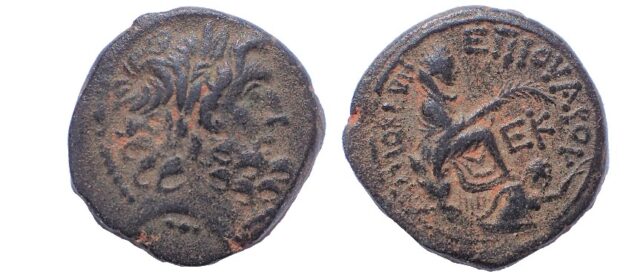
Figure 1. Bronze trichalkon coin (21 mm 6.5 g) minted under P. Quinctillius Varus, Governor of Syria. Dated year 25 of the Actian Era (7/6 BC). Obverse: Head of Zeus. Reverse: Seated goddess Tyche holding a palm branch; at feet, the river-god Orontes swimming. Inscription: ANTIOXEON EPI OVAROV (“Of the Antiochians under Varus”). EK = Actian year 25.
A better solution to the succession of Syrian governors is that Saturninus was governor from 4–2 BC, after the governorship of Varus that is marked by the coins. But Varus then had a second term as governor from 2 BC, during which period Herod died. Varus’ second term continued after Herod’s death in 1 BC, when Varus put down a revolt in Judea. Josephus does not mention Varus having two terms as governor of Syria, but this is understandable, because during Varus’ first term Herod was a “friend” of Augustus, and therefore not subject to interventions in his kingdom by the governor of Syria. This changed when Herod lost the “friendship” of Augustus during the governorship of Saturninus.[78]
Barnes attempted to counter this sequence of governorships by suggesting that during the governorship of Saturninus, Varus “had come to that post to replace C. Sentius Saturninus sometime earlier, perhaps in 7 BC.” However, this argument is completely unconvincing. If Saturninus was governor for two or three years, followed by Varus as governor immediately before the death of Herod (as Josephus claims), then how could the coins from 7–4 BC be minted by Varus rather than Saturninus? Clearly, Barnes’ proposal is designed to disguise the fact that his dating of governorships (and hence the death of Herod) does not fit with the numismatic evidence.
The coins struck by one of Herod the Great’s successors, Philip the Tetrarch, also provide important dating evidence. Philip was one of the three sons of Herod the Great, along with Antipas and Archelaus, who inherited parts of Herod’s kingdom under the sanction of Augustus. Typically, the coins of Philip have the head of the Roman emperor on the obverse (either Augustus or his successor Tiberius), and either Philip’s head or his temple at Caesarea Philippi on the reverse. The reverse also has Philip’s regnal year, indicated by Greek letters. Because coins were minted within a year of the death of Augustus and the succession of Tiberius, this allows the reign of Philip to be dated relative to Augustus, i.e., year 1 of Philip = year 27 of Augustus.
This calculation suggests that Philip began his reign in the year 4–3 BC, which appears to support the early (4 BC) date for Herod’s death.[79] However, Josephus claims that Herod’s oldest son, Antipater, essentially co-ruled with Herod during the last two years of the latter’s reign, which would also begin around 4–3 BC relative to the late (1 BC) date for Herod’s death.[80] Since Antipater was executed by Herod for treason a few days before his own death, it seems likely that Philip, Antipas, and Archelaus all antedated their own reigns to match Antipater’s co-regency with Herod, in order to bolster their own claims to the throne.[81] This inference is supported by the fact that no actual coins are known from the first few years of their claimed rule. On the other hand, two coins are known from the fifth year of Philip’s claimed rule, equivalent to AD 1–2. The clearest example is shown in Figure 2, which displays the head of Augustus on the obverse and Philip’s on the reverse, along with the date mark, LE (= year 5).
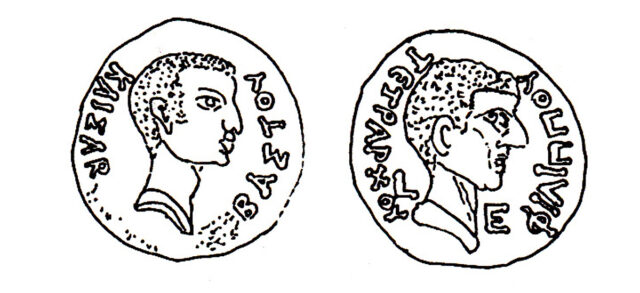
Figure 2. Bronze coin (24 mm) struck under Philip the Tetrarch. Obverse: Head of Augustus with the inscription KAISAR SEBASTOV. Reverse: Head of Philip with the inscription TETRARXOV FILIPPOV and the date LE. Drawings after Hendin.[82]
It should not be surprising that events in Judea did not generally figure prominently in the affairs of Rome—except when the Jews were revolting. But as Martin points out, there has been a tendency to date all events in Judea relative to an assumed death of Herod in 4 BC, and then to say that there is no evidence for events described in the Gospels.[83] The most obvious example is the description by Josephus of the refusal of 6000 Pharisees to swear the oath of allegiance to Caesar in the last years of Herod’s rule, as described above. This oath is a mystery, except when identified with the decree of Augustus that the whole world should be registered; i.e., that they should swear allegiance to Caesar.
Martin also pointed to several other lines of evidence that reconcile Josephus’ dating scheme with records of Roman army organisation. For example, in Res Gestae 16, Augustus names the consulships during which he gave monetary rewards to soldiers discharged at the completion of their army service. These consulships equate to the period from 7 to 2 BC.[84] Hence, Martin infers that the period from 7 to 2 BC was a time of peace, with no major revolts.[85] This is supported by the lack of any imperatorial victory salutations given to Augustus from 8 BC to 2 BC.[86] But Josephus records that the death of Herod was followed by a major revolt against Rome.[87] Hence, this militates against a 4 BC date for Herod’s death, but supports a 1 BC date. Furthermore, Augustus’ heir, Gaius Caesar was sent to the East around 1 BC to deal with various crises.
Gaius Caesar was the oldest grandson of Augustus, son of Julia Caesaris and Agrippa, but was adopted by Augustus as his son and heir. He was born in 20 BC, which means he had grown to adulthood around the time when Herod died. Gaius was involved in several events immediately following Herod’s death, such as being a member of the committee to advise Augustus on Herod’s succession, and being sent by Augustus to lead negotiations with the Parthian Kingdom in 1 BC.
Cassius Dio records a diplomatic tour of the East by Gaius in 2 BC, when he officiated at several important functions, including the dedication of the temple of Mars in Athens.[88] At that time Gaius also inspected Roman army legions on the Danube. However, Gaius had apparently returned to Rome after this tour, because Augustus arranged for him to marry his young cousin Livilla in 1 BC.[89] Barnes gave the supposed absence of Gaius from Rome in 1 BC as conclusive evidence against the death of Herod in early 1 BC. However, since Gaius was married in 1 BC, he must have been in Rome at the time, and therefore available for the committee on the Herodian succession, as recorded by Josephus.[90]
As the designated heir of Augustus, Gaius was the obvious choice of envoy to be sent to the East to negotiate with the Parthians. This was necessary because the Romans had lost control of the political situation in Armenia, which the Parthians were therefore threatening to take over. The Parthian Kingdom had been the principal threat to Roman interests in the East since Mark Anthony lost a war with them in 36 BC. Subsequently, Augustus had made peace with the Parthians, but the death of the Armenian king and the usurpation of the Parthian throne by Phrataces threatened the northern flank of the eastern Roman Empire in Cappadocia (eastern Türkiye). Since Augustus was too old to go himself, he sent Gaius to represent him in negotiations with the Parthians.
The proconsular authority given to Gaius in 1 BC implied a rank equal to a provincial governor.[91] Dio says that Gaius was in Syria in AD 1, acting as consul (Greek hupateuonta, supreme ruler).[92] However, this does not mean that he was governing Syria at the time. More likely, it was the presence of Gaius in Syria with at least two legions that persuaded Phrataces to reach a settlement with Rome. To ratify the treaty with the Parthians, Gaius went to Mesopotamia in AD 2, and then proceeded with his army to Armenia. However, Dio says that before these events, Gaius went to the borders of Egypt and into Arabia in 1 BC. This seems inexplicable, since it was clearly urgent to deal with the Parthians and the Armenians, the reason for his mission.
What was so urgent that Gaius diverted from his main mission to the northeast? The best explanation is provided by the death of Herod in 1 BC, after which there was the above-mentioned major revolt in Judea. This Jewish revolt threatened to weaken Rome’s position in the East, and make a Parthian attack even more likely. Therefore, putting down the rebellion was of crucial importance. Varus was governor of Syria at the time of Herod’s death, with three legions under his command at Antioch. Therefore, Varus sent two legions to Judea to quell the rebellion. This would be consistent with the presence of Gaius in Arabia at the time. Hence, we can see that a late (1 BC) date for Herod’s death is quite consistent with the Roman historical evidence.
The Star of Bethlehem in 2–3 BC
Adopting a 1 BC date for Herod’s death implies a date of 2–3 BC for the Nativity, which implies different theories for the identity of the Star of Bethlehem than the earlier dates. Two main models have been proposed, both of which identify the Star of Bethlehem as Jupiter, but with various interactions involving the moon, the star Regulus, and the planet Venus. These interactions mostly occurred in the constellation Leo (Table 3), the only constellation that Magi familiar with Jewish prophecies would reasonably have associated with the Messiah, since he was prophesied to originate from the tribe of Judah, described as a lion (Genesis 49:9–10). Hence the Messiah’s title, “The Lion of the Tribe of Judah.”
Table 3. Conjunctions involving Jupiter in 3–2 BC
| * Jupiter and Venus were each about 30 arc seconds wide. Hence, this separation was only 9 times the width of the planets themselves. | |||
| # This separation was only a fraction of the width of the planets themselves. | |||
| Date | Other object | Closeness | Zodiacal sign |
| 29 Jul 3 BC | Heliacal rising (in the East) | ||
| 12 Aug | Venus | 4.3 arc min* | Leo |
| 14 Sept | Regulus | 20 arc min | Leo |
| 17 Feb 2 BC | Regulus | 50 arc min | Leo |
| 09 May | Regulus | 40 arc min | Leo |
| 17 Jun | Venus | 5 arc sec# | Leo |
| 28 Jul | setting | Leo | |
There was a large Jewish community in Babylon at the time of Jesus’ birth, so it is reasonable that Babylonian astrologers would have been familiar with Jewish prophecies about the coming Messiah. Therefore, close conjunctions of Jupiter in the constellation Leo could reasonably have provoked the interest of Babylonian Magi. Only in a few cases have ancient Babylonian omens been linked to planetary conjunctions, but this does not diminish the importance of the few examples we have. Probably the best-known is the following: “If Venus enters Jupiter: The king of Akkad will die, the dynasty will change, either a soldier will go out or the enemy will send a message (asking for peace) to the land.”[93] The first interactions we will examine are those specifically involving the planet Jupiter. As we saw above, planetary conjunctions involving Jupiter are not particularly rare, but close conjunctions are, and the rarest of these phenomena are planetary occultations, when one planet visually passes behind another.
Precise calculations of planetary motions have revealed only three occultations of Jupiter by Venus in the past 2000 years.[94] One of these was too close to the sun to be visible, and the other two were only visible from unpopulated areas of the earth (mainly ocean). In comparison, a very close conjunction of Jupiter and Venus occurred on 17 June 2 BC, when the crescent of Venus was half full. If we (anachronistically) model the view through a telescope, the two planetary outlines would have come within five arc seconds, so that they nearly touched (Figure 3, inset). In addition, this near-occultation occurred when the two planets were unusually far from the sun, causing the event to occur around 9 pm against a dark sky (Figure 3, main view). Due to the dazzling brightness of both bodies, they would have appeared to the naked eye as a single very bright blur of light that could certainly have been described as the singular Star of Bethlehem.
In addition to the near occultation of June 2 BC, an earlier very close conjunction of Jupiter and Venus on 12 August 3 BC would have acted as “advance warning” of the main event the following year (Table 3). This conjunction was observed in the “East” (Matthew 2:3) when Jupiter joined Venus as a morning star. Subsequently, Jupiter passed behind the sun and then reappeared a few months later in the West as an evening star. This is when the uniquely close conjunction with Venus occurred, as the two planets moved progressively closer each evening in the western sky. However, before this happened, there was a triple conjunction of Jupiter with the star Regulus, the brightest star in the constellation Leo and the fifth brightest star in the zodiacal constellations.
The Jupiter–Regulus conjunction was repeated three times between its two conjunctions with Venus, because Jupiter demonstrated a period of retrograde motion, causing it to pass Regulus three times in eight months (Table 3). All of this happened in Leo, and because Regulus was widely regarded as the King of stars from an astrological point of view,[95] this triple conjunction between the King Star and the King Planet would have been more astrologically important than the more spectacular Jupiter–Venus conjunction (Table 3). This succession of events involving Regulus would have occurred in the western sky in the evening (the most suitable time for travelling), and could therefore have “led” the Magi westwards.
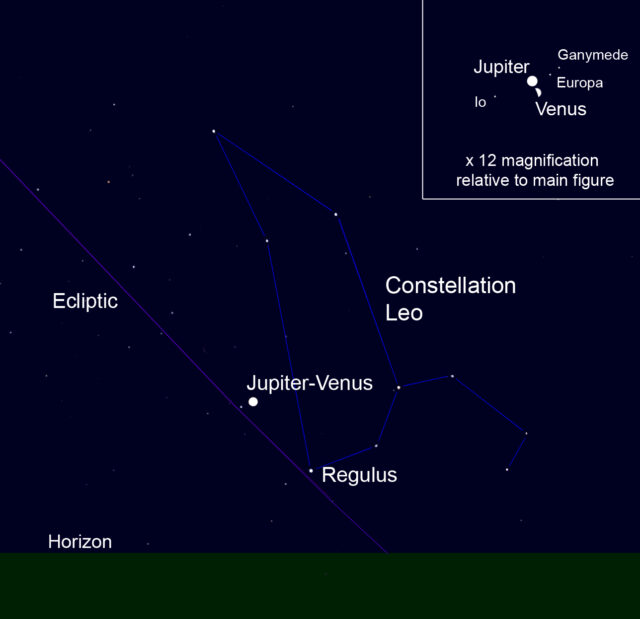
Figure 3. Calculated naked-eye view of the “single” star formed by the near occultation of Jupiter and Venus in the constellation Leo. Note that sizes of objects are indicative of relative brightness, not actual size, since all stars appear to the naked eye as point objects. Inset shows a simulated telescopic view of the conjunction relative to the moons of Jupiter. Calculated celestial locations from Larry Bogan.[96]
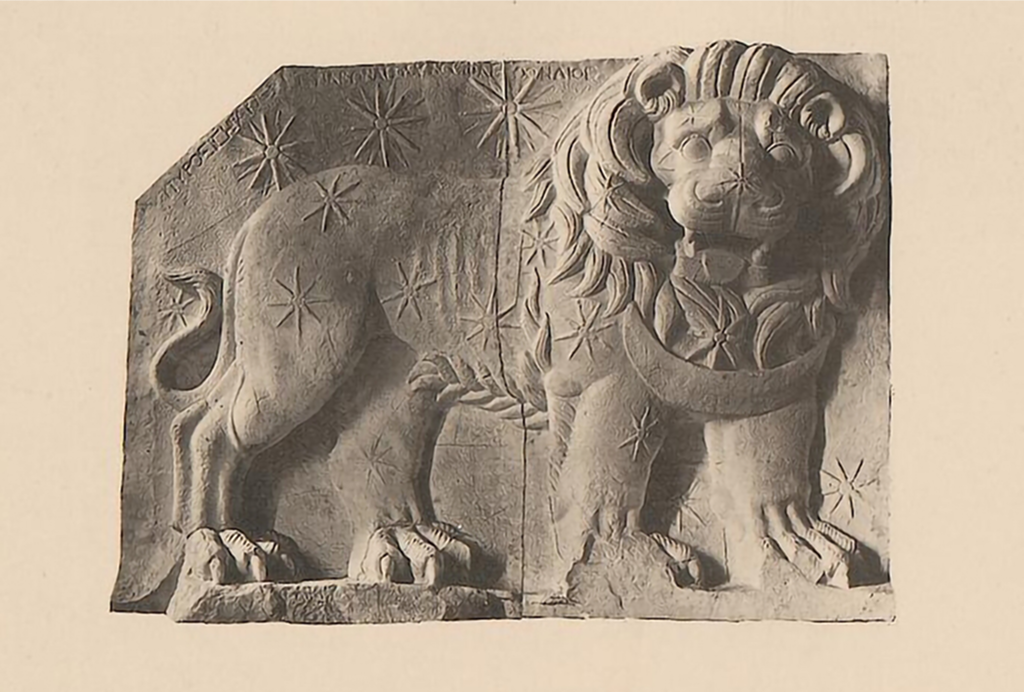
In comparison with this series of interactions, Dwight Hutchison has proposed a somewhat different prioritisation of the celestial events of 2–3 BC in Leo (Table 4). He still recognised Jupiter as the Star of Bethlehem, but he downplayed the significance of the Jupiter–Venus conjunctions, and instead identified two occultations of the star Regulus by the moon as astrologically more significant in alerting the Magi to the behaviour of Jupiter. One of the strongest justifications for this argument was a sculpture found in Türkiye that depicts the stars of the constellation Leo, along with a crescent moon.
Table 4. Celestial interactions involving Regulus in 3–2 BC
| Date | Objects involved | Closeness* | Jupiter’s location |
| *The full moon appears about 30 arc minutes wide (half a degree) | |||
| 28 Jul 3 BC | Sun–Regulus | 30 arc min | Heliacal rising |
| 27 Nov | Moon–Regulus | occultation | 1st stationary point |
| 14 Sept | Jupiter–Regulus | 20 arc min | |
| 20 Jan 2 BC | Moon–Regulus | occultation | Acronychal rising |
| 17 Feb | Jupiter–Regulus | 50 arc min | |
| 28 Mar | 2nd stationary point | ||
| 09 May | Jupiter–Regulus | 40 arc min | |
| 28 Jul | Sun–Regulus | 20 arc min | Heliacal setting |
This “Lion Horoscope” (Figure 4) shows that lunar occultations of Regulus were an important aspect of ancient astrology, but not as a portent of unusual events, because they were a common celestial occurrence. As noted above, Regulus is the fifth-brightest star of the zodiac, but by far the closest to the ecliptic (the path of the sun across the sky). In fact, Regulus is only 0.47 degrees from the ecliptic (the width of the full moon), in comparison with the Zodiac’s few brighter stars, Spica, Antares, and Aldebaran, which are respectively 2.06, 4.57, and 5.47 degrees from the ecliptic. Therefore, Regulus is quite often occulted by the moon (which travels close to the ecliptic), with spates of occultations every nine years. Hence, we can see that the basis for the sculpture is the frequency with which the moon passes close to Regulus, rather than the astrological significance of this event.
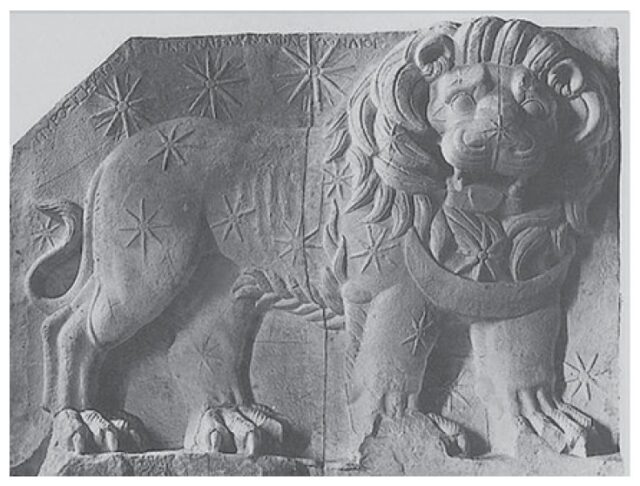
Figure 4. The “Lion Horoscope” showing the constellation Leo with the crescent moon below the star Regulus. Image from Lowenhoroshkop, an 1883 photo by Carl Humann.[97]
This is not to say that these events were insignificant in contributing to the celestial messaging of 2–3 BC, but the conjunctions between Regulus and Jupiter were clearly more significant. Such conjunctions occur at intervals of 12 and 71 years, with a typical proximity of about 0.5 degrees, as seen in 2–3 BC. In addition, retrograde movements by Jupiter occur every year, lasting about 4 months; so triple conjunctions of Regulus and Jupiter are only three times rarer than single conjunctions. Nevertheless, we can see that the combination of lunar occultations of Regulus and conjunctions with Jupiter in the same year would be quite rare, so these events of 2–3 BC would have been astrologically significant. But how does this fit with the narrative in Matthew?
The Star Over Bethlehem
Having discerned the significance of the above-mentioned celestial interactions as signs of the birth of a king in Judah, the Magi apparently followed normal protocol in going to the royal court before seeking the birthplace of the new king. Such protocol was well known, for example, because Dio and Pliny record that Magi visited Nero in AD 66.[98] In Jerusalem, the Magi were told to go to Bethlehem, and as they continued their journey we are told that “the star they had seen in the east went ahead of them until it stopped over the place where the child was. When they saw the star, they were overjoyed” (Matthew 2:9–10, NIV).
The description of the star “stopping over the place” has provoked much misunderstanding. Firstly, we should note that “stopped” is not the normal translation of the Greek word used (estatheh, based on the root histehmi). If we examine the twenty usages of the word in Matthew’s Gospel, we find that half of them refer to people who stood or are standing waiting. Humphreys argued that this usage was referring to a comet that “stood” in the sky with the tail upwards.[99] This interpretation was based on similar descriptions of stars or comets by Josephus and Cassius Dio, both of which were seen as celestial portents.
Actually, Dio used a different Greek word (aiorehtheis), generally translated as “hung.”[100] The sense was that a comet “hung over” Rome in 12 BC as a celestial “mark of respect” at the death of Marcus Agrippa, whereas Josephus says that in AD 66 “a star like a sword had stood above the city for a whole year and a comet too,” which he claims was a warning of the impending sack of Jerusalem by the Romans in AD 70.[101]
What these two historical accounts share with the description in Matthew 2:9 is their anthropocentric view of the stars or comets in question. The celestial objects were seen as hung or standing over each place (Rome, Jerusalem, Bethlehem), as a mark of important earthly events taking place. But unlike the journey of the Magi, which was prophetic of the Messiah’s birth, the accounts of stars hanging over specific places were all a posteriori interpretations. Dio claimed that the comet “hung over” Rome after the death of Agrippa, whom he had appraised as a great Roman general. Josephus, describing the sack of Jerusalem, claims that a star and comet “had stood above” Jerusalem four years earlier, as a warning which the Jews had failed to take seriously. Likewise, Matthew, describing the star “over Bethlehem” was writing after Jesus had been recognised as the Messiah. Therefore, we can see that the pious observers of these phenomena saw them as “messages” to the cities where they themselves lived, even though a scientific view shows that the stars or comets in question were really seen from the whole earth.
Returning to the usages of histehmi in Matthew’s Gospel, the word is used three times to describe people or objects that are placed in position by somebody else (AV = “set”). For example, the devil “set” Jesus on the pinnacle of the temple (Matthew 4:5), Jesus “set” a little child in their midst (Matthew 18:2), and Jesus shall “set” the sheep on his right hand and the goats on his left (Matthew 25:33). However, the star is an inanimate object, not a person, so the best comparison with Matthew 2:9 is probably Matthew 24:15, which describes an idol “standing in the holy place” during the Maccabean uprising, as an object on display. Therefore, I suggest that the best translation is that the star “stood” above the place where Jesus was, as in the AV, but in the sense of being on display.
This display was not necessarily long-lasting, but like the idol in the temple, it had a long-lasting effect. Although the conjunction of Jupiter and Venus to make a single brilliant star was short-lived (about one hour), it would never be forgotten. Furthermore, the near occultation of Jupiter and Venus on 17 June 2 BC is also the best explanation for Matthew’s claim that the sight of the star above Bethlehem provoked “great joy.” This joining of Venus and Jupiter was a unique event (in human memory) that truly fulfilled the expectations that had been raised by all of the previous stellar interactions, and a climax that can satisfy the wording of Matthew’s account.
A remaining question is which of this series of celestial events might have marked Jesus’s actual birth. Matthew 2:11 claims that when the Magi came to the house they saw the child with his mother. The fact that they visited a house suggests that the Magi arrived some time after Jesus’ birth. However, the mention of Jesus as a child does not signify his age, because Jesus is also described as a child at his circumcision (Luke 2:27), normally performed at an age of eight days (Leviticus 12:3).
Given these constraints, the best assumption is that the Magi identified September of 3 BC as the date of the Nativity, based on interpreting the closest Jupiter–Regulus conjunction as indicative of a royal birth in Judah. Their time of arrival in Bethlehem would have depended on the uncertain duration of organising their expedition, making the journey, and liaising with Herod’s court. However, it is very reasonable that they finally arrived in Bethlehem at the time of the Jupiter–Venus stellar “merger” in May of 2 BC, nine months after Jesus’ birth.
When Herod questioned the Magi, he reportedly asked them when the star “appeared” (Matthew 2:7). The Greek word used (phainomenou) often refers to a star’s heliacal rising,[102] as used for example in line 598 of Hesiod’s Works and Days to date the yearly rising of the constellation Orion.[103] Since Jupiter’s heliacal rising occurred near the end of July in 3 BC, this would be the earliest possible date (in Herod’s mind) for the Messiah’s birth. If Herod realised in June of 2 BC that he had been deceived by the Magi (when they did not return to Jerusalem), this would have been about a year after the earliest possible date for the Nativity. Hence Herod’s “precautionary” order to kill all the boys under two years of age in the region of Bethlehem (Matthew 2:16).
Conclusions
All of the early church authorities placed the birth of Jesus in 2–3 BC, which coincides with the best astrological explanation of the Star of Bethlehem as a very close conjunction of Jupiter and Venus, after a series of close conjunctions between Jupiter and Regulus, the principal star of Leo. Although this contradicts the most widely accepted date for Herod’s death (4 BC), that date itself is contradicted by numismatic evidence from Syria. The alternative 1 BC date for Herod’s death is consistent with Roman imperial records, and a 2–3 BC date for the Nativity is also consistent with Josephus’ account of the oath of allegiance to Caesar demanded in Judea. This occurred while Saturninus was governor, but Quirinius was almost certainly part of the Roman administration in Syria at the time. Hence, Luke’s statement about the date of the Augustan registration is correct if we give due attention to his precise wording.
The author reports there are no competing interests to declare.
Received: 10/12/25 Accepted: 24/03/26 Published: 31/07/26
© 2026 The Author(s). This is an open access article under the terms of the Creative Commons Attribution-NonCommercial-ShareAlike (CC BY-NC-SA) licence.
[1] Ernest L. Martin, The Star That Astonished the World (Ask publications, 1996).
[2] Peter Barthel and George H. van Kooten (eds), The Star of Bethlehem and the Magi: Interdisciplinary Perspectives from Experts on the Ancient Near East, the Greco-Roman World, and Modern Astronomy, Themes in Biblical Narrative 19 (Brill, 2015).
[3] James A. Nollet, “Astronomical and Historical Evidence for Dating the Nativity in 2 BC,” Perspectives on Science & Christian Faith 64, no. 4 (2012): 211–219.
[4] Dwight Hutchison, “Matthew’s Magi Never Visually Followed a Star Anywhere, But…” Perspectives on Science and Christian Faith 71, no. 3 (2019): 160–174.
[5] John Gerard, “Dionysius Exiguus,” The Catholic Encyclopedia, Vol. 5 (Robert Appleton Company, 1909).
[6] Georges Declercq, Anno Domini: The Origins of the Christian Er (Brepols Publishers, 2000).
[7] Dionysus Exiguus, Liber De Paschale, Cyclus Decemnovennalis, in Liber Dionysii Exigui, available at Documenta Catholica Omnia 0470-0544.
[8] Bernhard M. Lersch, Einleitung in die Chronologie: oder, Zeitrechnung verschiedener Völker und Zeiten, nebst christlichem und jüdischem Festkalender (R. Barth, 1889), 233.
[9] Gustave Oppert, “Ueber die Entstehung der Aera Dionysiana und den Ursprung der Null,” Verhandlungen der Berliner Gesellschaft fur Ethnologie und Urgeschichte (1900): 102–136.
[10] Georges Declercq, “Dionysius Exiguus and the Introduction of the Christian Era,” Sacris erudiri 41 (2002): 165–246.
[11] Clement of Alexandria, Stromata 1.21.
[12] Colin J. Humphreys and W. Graeme Waddington, “The Jewish Calendar, a Lunar Eclipse and the Date of Christ’s Crucifixion,” Tyndale Bulletin 43, no. 2 (1992): 331–351.
[13] H. W. Hoehner, “Chronological Aspects of the Life of Christ. Part III: The Duration of Christ’s Ministry,”
Bibliotheca Sacra 131 (1974): 147–162.
[14] Irenaeus of Lyons, Against All Heresies 3.21.3.
[15] Tertullian of Carthage, An Answer to the Jews 8.
[16] Clement, Stromata 1.21.
[17] Steven M. Bryan, “Onomastics and Numerical Composition in the Genealogy of Matthew,” Bulletin for Biblical Research 30, no. 4 (2020): 515–539.
[18] Henry A. Sanders, “The Genealogies of Jesus,” Journal of Biblical Literature (1913): 184–193.
[19] Anette Merz, “Matthew’s Star, Luke’s Census, Bethlehem, and the Quest for the Historical Jesus,” in The Star of Bethlehem and the Magi, ed. Peter Barthel and George H. van Kooten (Brill, 2015), 463–495.
[20] Peter A. Brunt, “The Revenues of Rome,” The Journal of Roman Studies 71 (1981): 161–172.
[21] Bart D. Ehrman, Did Jesus Exist? (HarperCollins, 2012), 359.
[22] Anthony Giambrone, “Augustus as Censor and Luke’s Worldwide Enrollment: Roman Propaganda and Lukan Theology from the Margins,” Revista Bíblica 83, no. 3–4 (2021): 337–362.
[23] Augustus, Res Gestae, trans. P. A. Brunt and J. M. Moore (Oxford, 1969).
[24] Giambrone “Augustus as Censor,” 352–353.
[25] Werner Eck, The Age of Augustus (John Wiley & Sons, 2007), 47–48.
[26] Augustus, Res Gestae 5.
[27] Giambrone “Augustus as Censor,” 353 n.36.
[28] Giambrone “Augustus as Censor,” 354.
[29] Roger S. Bagnall, “The Beginnings of the Roman Census in Egypt,” Greek, Roman, and Byzantine Studies 32, no. 3 (1991): 255–265.
[30] W. Graham Claytor and Roger S. Bagnall, “The Beginnings of the Roman Provincial Census: A New Declaration from 3 BCE,” Greek, Roman, and Byzantine Studies 55, no. 3 (2015): 637–653.
[31] Nollet, “Astronomical and Historical Evidence,” 217.
[32] Flavius Josephus, Antiquities of the Jews 16.9.3.
[33] William Ramsay, Was Christ Born at Bethlehem? A Study on the Credibility of St. Luke (Hodder and Stoughton, 1898), 97.
[34] Tertullian, Against Marcion 4.19.
[35] Josephus, Antiquities 17.2.4. See Martin, The Star That Astonished the World, 187.
[36] Tacitus, Annals 3.48.
[37] Ronald Syme, “Galatia and Pamphylia under Augustus: The Governorships of Piso, Quirinius and Silvanus,” Klio 27, no. 27 (1934): 122–148.
[38] Syme, “Galatia and Pamphylia.”
[39] Tacitus, Annals 3.48.
[40] Josephus, Antiquities 18.1.
[41] Armand P. i Tàrrech, “Why Was Jesus Not Born in Nazareth?” in Handbook for the Study of the Historical Jesus, ed. Tom Holmén and Stanley E. Porter (Brill, 2011), 3409–3436.
[42] Nicholas T. Wright, Who Was Jesus? (W. B. Eerdmans Publishing, 2014), 89.
[43] Josephus, Antiquities 18.1.1.
[44] Josephus, Antiquities 14.16.4 (the consulship of Agrippa and Gallus = 37 BC).
[45] Martin, The Star That Astonished the World, 201.
[46] Andrew Steinmann, “When Did Herod the Great Reign?” Novum Testamentum 51, no. 1 (2009): 1–29.
[47] Josephus, Antiquities 20.11.
[48] Johannes Kepler, Gesammelte Werke V, ed. Franz Hammer (München: Beck, 1953), 402; Rahlf Hansen, “Kepler and the Star of Bethlehem,” Acta Universitatis Carolinae: Mathematica et Physica 46, no. 3 (2005): 115–125.
[49] Josephus, Antiquities 17.6–8.
[50] Josephus, Antiquities 17.6.5.
[51] Josephus, Antiquities 17.8.4 and 17.9.3.
[52] Steinmann, “When Did Herod the Great Reign?” 13–14.
[53] Nollet, “Astronomical and Historical Evidence,” 218.
[54] Liberato De Caro et al., “The Beginning of the Christian Era Revisited: New Findings,” Histories 1, no. 3 (2021): 145–168.
[55] Tim Hegedus, “The Magi and the Star in the Gospel of Matthew and Early Christian Tradition,” Laval Théologique et Philosophique 59, no. 1 (2003): 81–95.
[56] Aaron Adair, “The Star of Christ in the Light of Astronomy,” Zygon 47, no. 1 (2012): 7–29.
[57] Augustine, Reply to Faustus the Manichaean 2.5.
[58] Dale C. Allison, Studies in Matthew: Interpretation Past and Present (Baker Academic, 2005), 28–34.
[59] Hegedus, “The Magi and the Star,” 85.
[60] Adair, “The Star of Christ,” 11.
[61] Colin J. Humphreys, “The Star of Bethlehem, A Comet in 5 BC and the Date of Christ’s Birth,” Tyndale Bulletin 43, no. 1 (1992): 31–56.
[62] Michael W. Burke-Gaffney, “Kepler and the Star of Bethlehem,” Journal of the Royal Astronomical Society of Canada 31 (1937): 417–425.
[63] Burke-Gaffney, “Kepler and the Star,” 421.
[64] Humphreys, “The Star of Bethlehem,” 45.
[65] Roy A. Rosenberg, “The ‘Star of the Messiah’ Reconsidered,” Biblica 53, no. 1 (1972): 105–109.
[66] Michael R. Molnar, “The Magi’s Star from the Perspective of Ancient Astrological Practices,” Quarterly Journal of the Royal Astronomical Society 36 (1995): 109–126.
[67] Molnar, “The Magi’s Star,” 110–112.
[68] Mark Kidger, The Star of Bethlehem: An Astronomer’s View (Princeton University Press, 1999), 107.
[69] Molnar, “The Magi’s Star,” 113–118.
[70] Molnar, “The Magi’s Star,” 109.
[71] Kidger, The Star of Bethlehem, 107.
[72] Michael R. Molnar, “The Historical Basis for the Star of Bethlehem,” in The Star of Bethlehem and the Magi, ed. Peter Barthel and George van Kooten (Leiden and Boston: Brill, 2015), 17–42; Molnar (1995), note 61, p. 125.
[73] Molnar, “Historical Basis,” 22.
[74] Stephan Heilen, “The Star of Bethlehem and Greco-Roman Astrology, Especially Astrological Geography,” in The Star of Bethlehem and the Magi, ed. Peter Barthel and George van Kooten (Brill, 2015), 297–357.
[75] David W. Hughes, “Astronomical Thoughts on the Star of Bethlehem,” in The Star of Bethlehem and the Magi, ed. Peter Barthel and George van Kooten (Brill, 2015), 103–137.
[76] Josephus, Antiquities 17.5.2.
[77] George Macdonald, “The Pseudo-Autonomous Coinage of Antioch,” The Numismatic Chronicle and Journal of the Royal Numismatic Society (1904): 105–135.
[78] Josephus, Antiquities 16.9.3.
[79] Frederic W. Madden, “Jewish Numismatics. Being a Supplement to the ‘History of Jewish Coinage and Money in the Old and New Testaments,’ published in 1864. III. Coins of the Herodian Family,” The Numismatic Chronicle and Journal of the Numismatic Society 15 (1875): 41–80.
[80] Josephus, Antiquities 17.2.4.
[81] Martin, The Star That Astonished the World, 227.
[82] David Hendin, Guide to Biblical Coins (American Numismatic Society, 1996), 117.
[83] Martin, The Star That Astonished the World, 156.
[84] Peter A. Brunt and John M. Moore, Res gestae divi Augusti: The Achievements of the Divine Augustus (Oxford University Press, 1967).
[85] Martin, The Star That Astonished the World, 159.
[86] Martin, The Star That Astonished the World, 160.
[87] Josephus, Antiquities 17.10.1.
[88] Cassius Dio, Roman History 55.10.9–17.
[89] Dio, Roman History 55.10.18.
[90] Josephus, Antiquities 17.9.5.
[91] C. Suetonius Tranquillus, Divus Augustus 47.
[92] Dio, Roman History 55.10a.4–5.
[93] Erica Reiner and David Pingree, Babylonian Planetary Omens, Part 3, Cuneiform Monographs 11 (Styx Publications, 1998), 45.
[94] Larry Bogan, “Mutual Planetary Occultations Past and Future: Their Observation Circumstances,” 12 February 1999, available at https://www.bogan.ca/astro/occultations/occltlst.htm (accessed 20 April 2026).
[95] Hutchison, “Matthew’s Magi,” 165.
[96] Larry Bogan, https://www.bogan.ca/astro/occultations/west_2bc.gif (accessed 20 April 2026).

[97] Hutchison, “Matthew’s Magi,” 166.
[98] Roger Beck, “Greco-Roman Astrologers, the Magi, and Mithraism,” in The Star of Bethlehem and the Magi, ed. Peter Barthel and George H. van Kooten (Brill, 2015), 286–295.
[99] Humphreys, “The Star of Bethlehem,” 37.
[100] Cassius Dio, Roman History 54.29.8.
[101] Josephus, Jewish Wars 6.5.3.289.
[102] Hegedus, “The Magi and the Star,” 83.
[103] Hesiod, Works and Days, trans. Dorothea Wender (Penguin Classics, 1973), 78.