


Book reviewed by Robert Brennan, March 2026
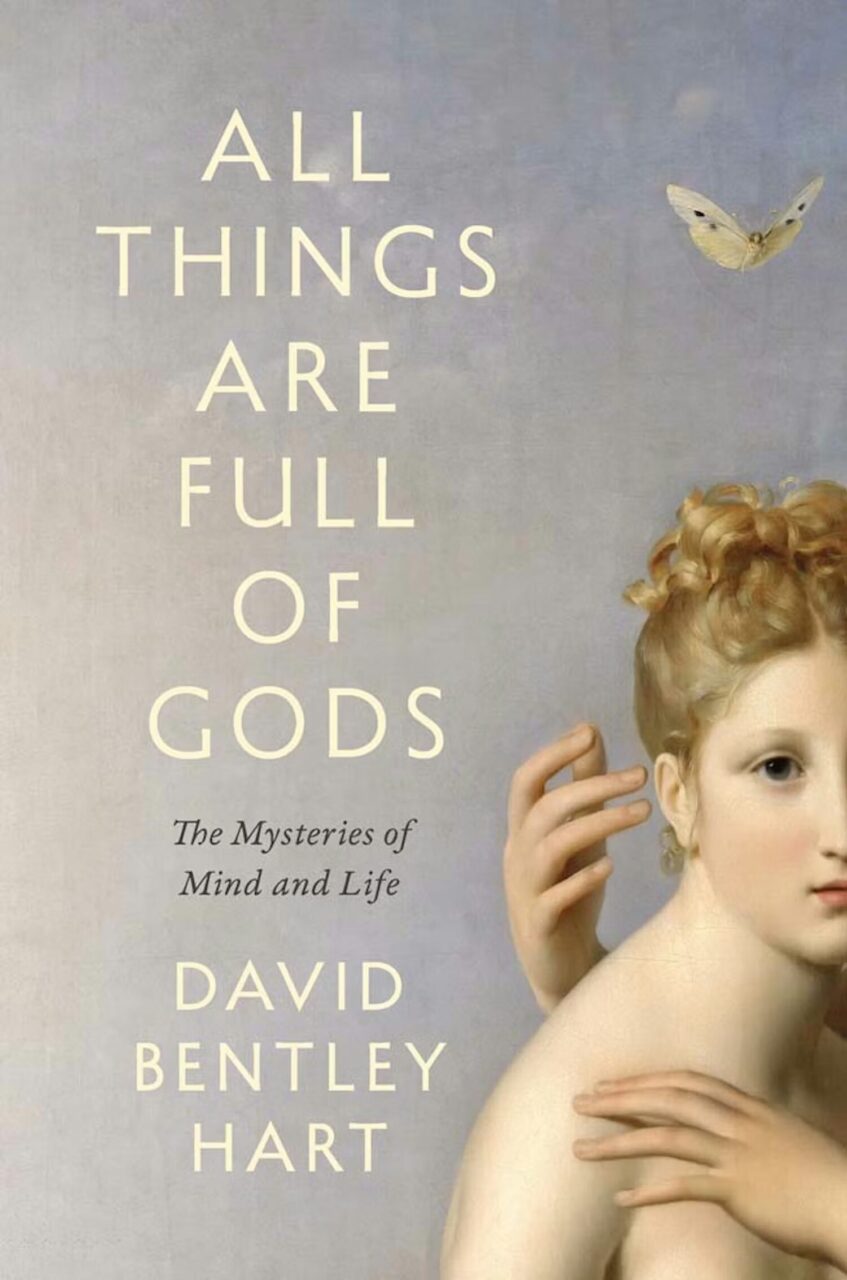
All Things Are Full of Gods: The Mysteries of Mind and Life
by David Bentley Hart
London: Yale University Press, 2024; 511 pages
ISBN 9780300254723, first edition, hardcover
AU$37
David Bentley Hart is a philosopher and religious scholar who has written a number of books discussing the reality of God. This book follows his Atheist Delusions and The Experience of God. At the beginning, Hart says that this is the book he has been working towards and the one that he has always wanted to write; that is, to find a better way to understand consciousness and the relationship between mind and reality, without the use of dualisms of matter and spirit.
His format is a philosophical dialogue. This is a device often used in philosophy, for example George Berkeley’s Three Dialogues between Hylas and Philonous (1713) to Jostein Gaarder’s Sophie’s World (Norway, 1991). Hart’s discussion takes place between the Greek gods Psyche, Hephaestus, Eros, and Hermes, over six days. The broad topics covered each day are 1. Mind, Life and Picture of Reality; 2. Mind and Matter; 3. Brain and Mind; 4. Machine and Soul; 5. Soul and Nature; and 6. Nature and Supernature.
During his introduction Hart proposes to show that the reduction of mind to some form of materialism is the most implausible position, even though he notes many philosophers and scientists adhere to it in spite of evidence. He argues that mind cannot be reduced to purely material causes. He also wishes to avoid the other common option that the mental and the physical are two irreconcilably different realities.
Hephaestus consistently argues for a reductionist materialism and becomes the foil against which the others react. For example, during day one, Psyche argues that because mind and body interact then they must have some ground of commonality; therefore, Hephaestus is demonstrably wrong (p. 46).
What follows is an exhaustive recounting of fundamental philosophical terms and dismantling of long-established arguments. Exhaustive analysis is typical of Hart’s work. Over the next few days of discussion, the case is built that consciousness cannot be reduced to simple elements of matter or neurons. Further, Hart argues against consciousness appearing as an emergent property of lower order and physical laws.
In the last couple of days of this six-day discussion, Hart moves his characters toward arguing that mind is an essential part of basic reality. The case he makes seems reasonable. He concludes with a monistic notion that god is in everything. Atman is Brahmin and Brahmin is Atman.
There is an excellent coda which concludes the book. This coda laments the nihilistic reduction of the study of nature and everything else into mechanism. This is an excellent commentary. It is a good stand-alone piece, and while not necessarily following the logic of the book, it may be the book’s best part.
Hart impresses the reader with his breadth of reading and engagement with contemporary research in many of the fields related to the mind–body problem. However, this is only an impression. Closer scrutiny leads to a different opinion.
This begins to highlight significant issues with this book. The first is that it is hideously difficult to read. Hart is meritoriously sesquipedalian. This sounds complimentary but actually is not. In my view, he is notable for using big words and obscure vocabulary unnecessarily. Expect to read this book with an exhaustive dictionary and encyclopaedia of philosophical terminology close at hand. Some apparently key sentences defy comprehension even after rereading.
He regularly introduces complex technical terms and thinkers into discussion without explanation. It is not clear who he expects his readers to be. Merely dropping eastern religious philosophical terms into discussion, as Hart does, is unlikely to be helpful to most western readers. Worse, he discusses the ideas of many writers without references or footnotes. It is impossible to be certain what part of an author’s body of work he refers to. This is especially the case when discussing Daniel Dennett. During the third and fourth days of discussion there is an exhaustive dismantling of Dennett’s ideas (pp. 241–349). However, it is not clear which of Dennett’s works is being discussed or even which parts of which work. This is problematic when ideas are heavily criticised or dismissed. More footnotes would help. Often there is no reference to any work by the contemporary scholars discussed. The few times where there are footnotes, they appear pages after the discussion and far too late. When Hart does choose to explain terminology or summarise an author’s work his explanation is idiosyncratic, not quite aligning with the normal definitions.
Hart cherry-picks what he uses. For example, in the closing chapters he refers (p. 439) to a key later chapter of Bernard Lonergan’s Insight (Chapter XIX), getting it largely correct but without referring to the major faith step that Lonergan makes earlier (Insight, Chapter X). The reasoning for Lonergan’s step helps Hart’s discussion. He references Paul Davies when Davies agrees with him but omits him where Davies directly contradicts him (p. 357). Readers who are expert in some of the fields of study Hart references may well be suspicious of Hart’s lack of rigor, and, consequently, may become suspicious of the rest of his arguments.
Many times, Hart moves the discussion towards his conclusion by logical jumps. The notion of monotheism and commitment to it is simply dropped into discussion on the fifth day. This is jarring given that the actors in the discussion are apparently not able to be committed to monotheism.
The characters often refer to obscure logical fallacies like this: “That is obviously an example of the ‘XYZ’ fallacy,” without explanation. There are many times when the real fallacy may apply, but its applicability is far from obvious and requires explanation that is lacking. The worst “fallacy” example is what Hart calls a pleonastic fallacy. It is obviously important to Hart and a key part of his argument, yet the definition given is not standard and what Hart means remains unclear (pp. 41, 97, 308).
This book is definitely not for the neophyte. It is complex and difficult. There is plenty to learn but it is hard to glean from the density of the text. Most readers are under the impression that books are meant to communicate ideas. Hart does not seem to realise this. Further, the book is long-winded and could be a fifth the length to make the same points.
Does Hart succeed in his stated goal to find a better way to speak about mind and nature? No. Hart acknowledges this in the concluding chapter when he breaks away from renewing ongoing circular arguments. The book promises much but, in eventually restating existing answers from a variety of philosophical traditions, it undermines its own purpose.
The title of the book is from a quote of the ancient Greek philosopher Thales of Miletus. Quoting Thales of Miletus is ironic. One part of Thales’ story is that he was so focused on the heavens that he walked into a well. It is possible that Hart has done the same thing.