


Book reviewed by Declan Ellis, December 2025
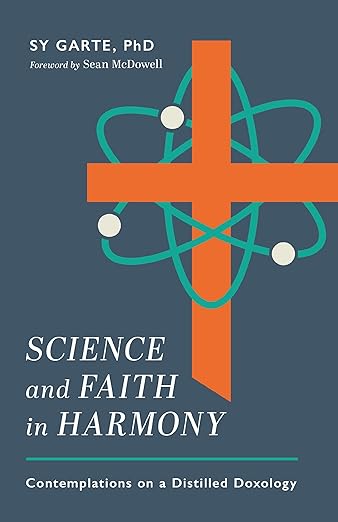
Science and Faith in Harmony: Contemplations on a Distilled Doxology
by Sy Garte
Grand Rapids, MI: Kregel, 2024; 256 pages
ISBN 9780825448157, first edition, paperback
AU$35
Many may consider Sy Garte an unlikely convert. Garte is a highly respected biochemist; he has been a professor at three universities, authored hundreds of scientific publications, and had leadership positions in the National Institutes of Health and a number of other scientific organisations. For much of his life, he was a self-described “full-blown” atheist (p. 176). If the New Atheists are to be believed, Garte is the last person who should have been tempted to accept the God hypothesis’s “most unloving instantiation, Yahweh, nor his insipidly opposite Christian face, ‘Gentle Jesus meek and mild’” (Richard Dawkins, The God Delusion, Bantam Press, 2006, p. 31).
As Garte’s dissatisfaction with his reductionist atheist worldview mounted, he found himself increasingly drawn to the world’s largest religion. A combination of apologetic arguments and a profound experience of Jesus finally led Garte to commit his life to Christ. He chronicled the story of his conversion in his 2019 book The Works of His Hands: A Scientist’s Journey from Atheism to Faith (Kregel Publications). In Science and Faith in Harmony, Garte sets out to describe how his scientific career and religious beliefs are not just compatible; they are also in deep harmony.
The book takes the form of forty-four short “vignettes,” discussing topics such as creation, grace, evolution, DNA, quantum physics, Christian growth, and the church. Each chapter normally includes a story from Garte’s life and a scientific concept explained in layperson’s terms. Garte pulls the threads together at the end of each chapter with a personal reflection. Sometimes this takes the form of a practical recommendation, but often Garte simply encourages the reader to be more awed by Creator and creation alike. After each chapter, Garte has included a short list of resources for engaging more deeply with the topic. These include books, articles, or videos, and can be anything from secular science talks to theology tomes. Having read or watched a number of the resources Garte recommends, I can testify that they are, in many cases, excellent choices and well worth engaging with.
There is much to commend about this book to Christians and sceptics alike. In particular, Garte’s own experience of becoming Christian lends considerable weight to his perspective on science and faith. As with C. S. Lewis before him, sceptical readers can be encouraged that Garte is coming from a place of understanding. Moreover, Garte’s tone is very personable. The book reads almost as if you are engaging Garte in a wide-ranging conversation on a lazy Sunday afternoon. Garte’s deep appreciation of the natural world and God’s grace infuses every page. It is easy to tell that Garte loves the things he is writing about, and his passion for them can be infectious. At many points throughout the book, Garte really does succeed in conveying the beautifully harmonious relationship between the study of the natural world and the tenets of the Christian faith.
Throughout the work, Garte engages in a number of intriguing speculations about theology and science. These are somewhat reminiscent of C. S. Lewis’s gentle speculations in his apologetics books. However, in contrast to Lewis, Garte’s speculations fly dangerously close to the borders of Christian orthodoxy. For example, in Chapter 13, Garte suggests that the new creation “isn’t even a physical universe at all but a spiritual realm” (p. 78). This is in tension with the historic Christian belief in the resurrection of the body, an event which happens to the human corpse. To be clear, it does not seem like Garte is deliberately trying to subvert orthodox belief in the resurrection, but rather that he does not grasp its importance.
Garte also uses quantum physics to justify some questionable statements about the Incarnation. Contrary to the understanding of many Christians throughout history, Garte seems to accept that Jesus being simultaneously human and divine “would violate the logical law of noncontradiction” (p. 120). To support this astonishing admission, Garte appeals to quantum physics, asserting that it reveals a reality which “defies the rules of logic” (p. 120). This is not only a nonstandard interpretation of the Incarnation, but also a misunderstanding of the relationship between quantum physics and logic. While both the Incarnation and quantum physics are frequently described as mysterious, or even paradoxical, to claim that they are logically impossible (like, for example, a married bachelor) is philosophically untenable. Garte wraps up his argument with an even more shocking conclusion: “when we want to know the truth about our created world, science trumps logic every time” (p. 120). This assertion leans into the dogma of scientism, which holds that science is the best or only way of ascertaining truth, normally at the expense of philosophy. I was disappointed to see that Garte is still sympathetic to this aspect of the New Atheists’ ideology.
For a book that spends much of its time discussing the concept of purpose, it remains unclear what purpose Science and Faith in Harmony is meant to fulfill. Garte imagines the book serving to bring a rationalistic sceptic to church and helping a science-loving child of Christian parents retain her faith. According to Garte, “my overall purpose … is to reveal God’s truth that science and Christianity are not in conflict” (p. 16). However, Sean McDowell clarifies in the foreword that “this is not an apologetics book” (p. 12). McDowell’s observation holds true, as Garte references theistic arguments, historical evidence, and answers to objections without ever exploring them in detail. He also devotes very little space to some of the most serious areas of alleged conflict between science and Christianity, such as how to interpret the first chapters of Genesis, or how to understand evolution and imago Dei. Because of the book’s sparse coverage of these topics, I am doubtful that a sceptic would find much here to convince them. Likewise, I do not think a Christian struggling with doubt would find much solace in Garte’s words.
What would Science and Faith in Harmony be good for? I think Garte’s use of the term “doxology” in the subtitle is a good hint. Garte’s vignettes may work better as liturgy than apologetics. Given their brevity, his chapters could act as a suitable scientific and personal prelude to worshipping God in a church context. It is easy to imagine a chapter being read out in a service or small group Bible study for the encouragement of the parishioners. However, even though it contains the potential to edify Christians, I would caution those who wish to use this book for such a purpose. Garte’s wild speculations, untethered as they are from mainstream Christian theology, may severely limit the usefulness of his book.