


Book reviewed by Charles Sherlock, January 2026
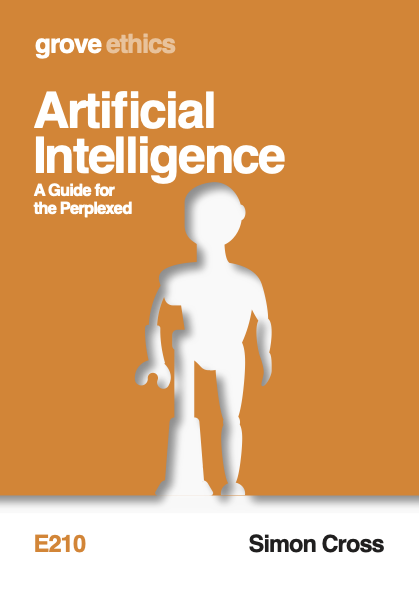
Artificial Intelligence: A Guide for the Perplexed
by Simon Cross
Cambridge: Grove Books, 2023; 30 pages
ISSN 1470-854X (Grove Ethics Series), first edition, paperback
AU$9
Grove Books claim to be “not the last word but often the first” on a wide range of topics. Each is a long essay by a “practitioner not a theorist.” This booklet is exemplary on all counts. Simon Cross, a former airline pilot, has a PhD on “metaphysical tensions in scientific perspectives on divine action.” He works for the Church of England on “researching technology, ethics and the regulatory and governance challenges AI poses for society.”
After a brief Introduction, the essay has four main sections: “What is AI?,” “Theological and Ethical Issues,” then focusing especially on “AI and Human Being,” and “Practical Theology and Artificial Intelligence.” The first argues that AI is, and can be no more than, (complex and interactive) algorithms that search for patterns, using these to search for matches—on the basis of probability. The discussion is clear and lays the ground for the following sections.
The theological sections focus on aspects of what it means to be human, how AI relates to this, and what challenges and opportunities it presents for authentic human existence. The author starts by clarifying the importance of language as metaphor to being human (Rowan Williams and Janet Soskice are cited), then the human exercise of will, and the nature of soul (nicely nuanced). The issues raised move beyond the individual human to social and environmental factors in the Practical Theology section. All this should be familiar territory for Christian readers but is open to others: fresh and non-defensive.
What really sold me on this booklet, however, is the fifth section: “A Missional Response to AI.” This takes up the “Anglican Marks of Mission”—not because they are Anglican but because they include a full-orbed biblical perspective on God’s mission: proclaiming Christ, forming disciples, serving others, transforming society, caring for creation. In each dimension of this mission the author offers not only warnings about dangers in AI (as did an earlier book on AI I reviewed) but also AI’s opportunities for each dimension of mission, not just individual Christians. The author avoids addressing policy matters, but broad foundations will assist those in positions to do so.
A brief Conclusion draws the discussion together under three main points. First, “the enduring scientific and philosophical mysteries attending freedom and consciousness” must not be set aside, including “wisdom, empathy, the apprehension of the sublime and the moral and spiritual formation of character.” Secondly, the “complications posed by language’s remarkable and innate flexibility to shape meaning” call for ongoing attention. Thirdly, “what it means, fully, to be a human” is key. AI “cannot love, or rejoice, or sacrifice, or freely choose mercy instead of justice as we human beings can.”
Our reflection on these dimensions, the author concludes, “will empower us to welcome potential while also recognising hype, rejecting temptations to reduce and diminish the human, and motivating us to resist the identifiable harms as we seek mutual and collective flourishing.”
I have no hesitation in commending this short book; it would make an excellent resource for group discussion.
A digital copy of Artificial Intelligence: A Guide for the Perplexed is available to purchase from Grove Books.