


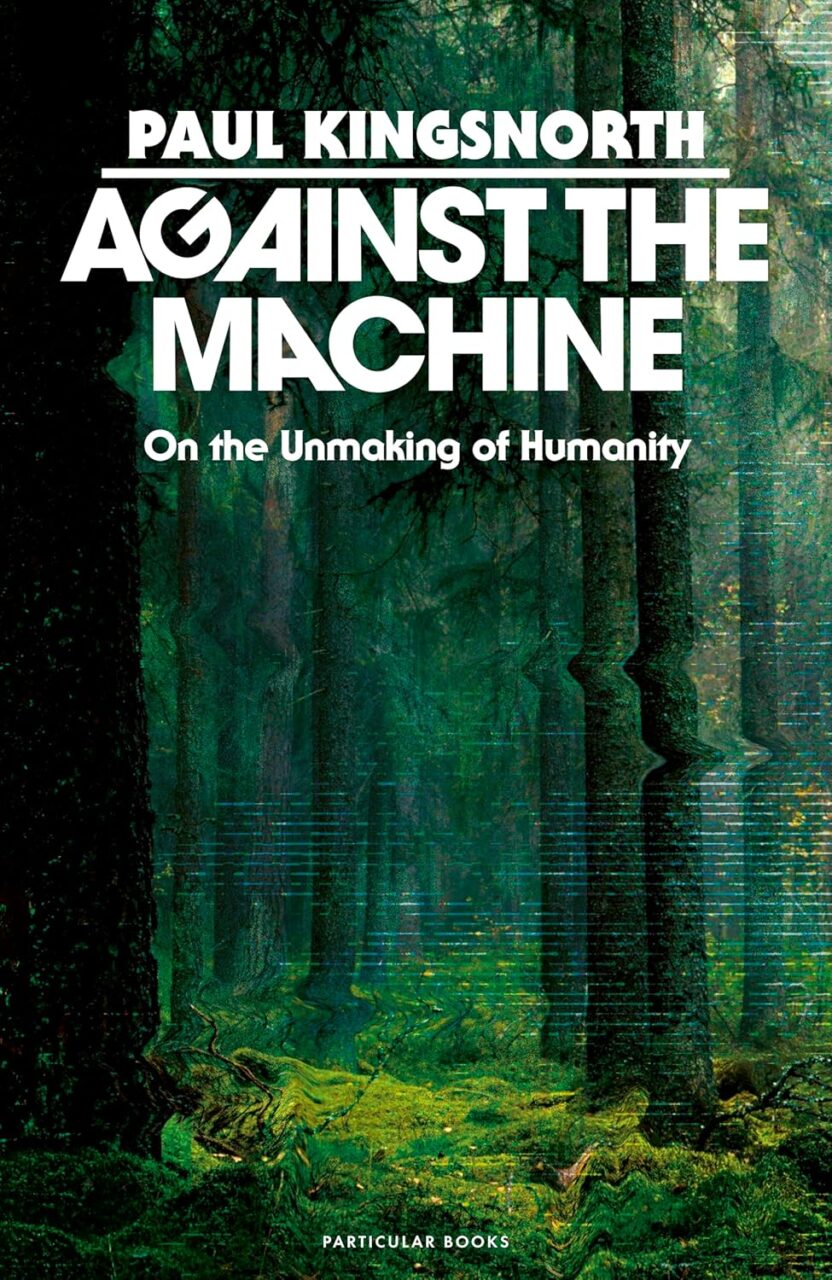
Book reviewed by Phil Hurwood, February 2026
Against the Machine: On the Unmaking of Humanity
by Paul Kingsnorth
Particular Books / Penguin Random House, 2026; 368 pages
ISBN 9780241788400, first edition, hardback
AU$45
Have you ever felt like there’s some relentless and unstoppable force at work in the world? A force that makes yesterday redundant and tomorrow a new horizon of supposed “Progress”? Have you ever felt like a dinosaur in such a world? I have. Which is why I so enjoyed this book. Author Paul Kingsnorth calls this force “the Machine.” Pushing us further and further into dependence upon it. Progress. Technology. Growth. Mammon. It is never satisfied. Computers. The internet. Robots. Is life getting easier or more complicated and frantic?
Kingsnorth says the Machine has pushed us into urban sprawls, disconnected us from nature, isolated us from the people next door. Not only so, the Machine is redefining what it means to be human, blurring the boundaries between human and machine. Artificial intelligence. Artificial wombs. The Machine enslaves us to ourselves. Families fragmented. Sexuality fluid. Children raised outside the home, parents disempowered. The Machine has colonised us, he says. It derided past times as dominated by superstition and smallness. We’ve now thrown off the shackles.
He paints something of a bleak picture of what he calls the “post-western West.”
He argues that what defined civilisations and communities up until two or three hundred years ago were four things: People (connected with their neighbours and local communities), Place (where you lived helped explain who you were), Past (people honoured their ancestors and their past, and lived in continuity with their story), and Prayer (people had a sense of the divine, whether Christian or otherwise; that there was some reality beyond just themselves).
He says these have been replaced by a different group of identity-defining markers: Sex (the unmooring of stable marriage and removal of sexual boundaries), Science (in the sense that we trust science as the all-knowing arbiter of truth and reality and technical progress), The Self (individual feelings are pre-eminent over social norms), and The Screen (we’re all addicted and dependent upon them). Kingsnorth says, “We have every gadget and recipe and website and storefront and exotic holiday in the world available to us, but we are lacking two things that we seem to need, but grasp at nonetheless: meaning, and roots” (p. 13).
He doesn’t have a solution, except to say we need to return to the four P’s wherever and however we can. We need “to build new things, out on the margins … to light little fires fuelled by the eternal things … to prepare the ground with love for a resurrection of the small, the real and the true” (p. 30).
Kingsnorth was formerly deputy editor of The Ecologist. Also once an active environmental campaigner with the Green movement, he became disillusioned by their political and social agendas which he considered as under the Machine’s sway. Both the left and right of politics he sees as dominated by Machine observance. In some ways this book reminded me of a time, way back in the 1970s, when we talked about living simply and not being enticed into the burgeoning materialism of the day. And that was before the digital takeover. Most of us have ridden the wave and adapted ourselves to the benefits. Hippies became Yuppies.
Presently he lives on the land and homeschools his children—shielded, in part, from the Machine’s reach. Kingsnorth became an Orthodox Christian a few years ago. That influence is evident as he begins in this book with the garden of Eden story: “Outside the garden, we are homeless and can never be still. We forget the creator and worship ourselves. All of this happens inside us every day” (p. 4). He comments: “The West is the result of the binding together of people and peoples across a continent, over centuries of time, by a sacred order constructed around this particular religious story” (p. 6; that is, Genesis, the garden, incarnation, cross, resurrection). “We have dismantled our story from within. What replaced it was not a new sacred order, but a denial that such a thing existed at all” (p. 10). He remarks, “There is a throne at the heart of every culture, and whoever sits on it will be the force you take your instruction from” (p. 11).
This is not a Christian work in an overt sense. There are few Bible quotes, nor is there biblical exploration apart from referencing, at times, its larger themes. Yet in some ways it is deeply Christian, as Kingsnorth seeks to reclaim what it is to be human, and how our humanity, along with creation itself, can be sustained in healthy balance.
At 368 pages it may be a bit detailed for the average reader, especially the final hundred pages. He digs deeply into wisdom from the past, especially from a wide range of social and cultural observers (including Jacques Ellul, which immediately raised my estimation of the book!).
For me this book was compelling and readable, giving language to some of what I’ve been feeling. I appreciated that it wasn’t politically aligned and gave no simple answers. I’m not sufficiently well versed in history and technology to evaluate all of the book’s claims. Although there is no turning back the clock on our addiction to Progress, I agree with Kingsnorth that we can reclaim the four “P”s in the midst of it all.
The book reinforced my sense that little things matter, that we build life and community from the ground up, that God so often works under the radar, beyond public and political gaze. And it encouraged me to value afresh those ancient concepts of simplicity, ordinary church community, and planting mustard seeds of the kingdom whose fullness we await.