


Book reviewed by Katherine Seaton, December 2025
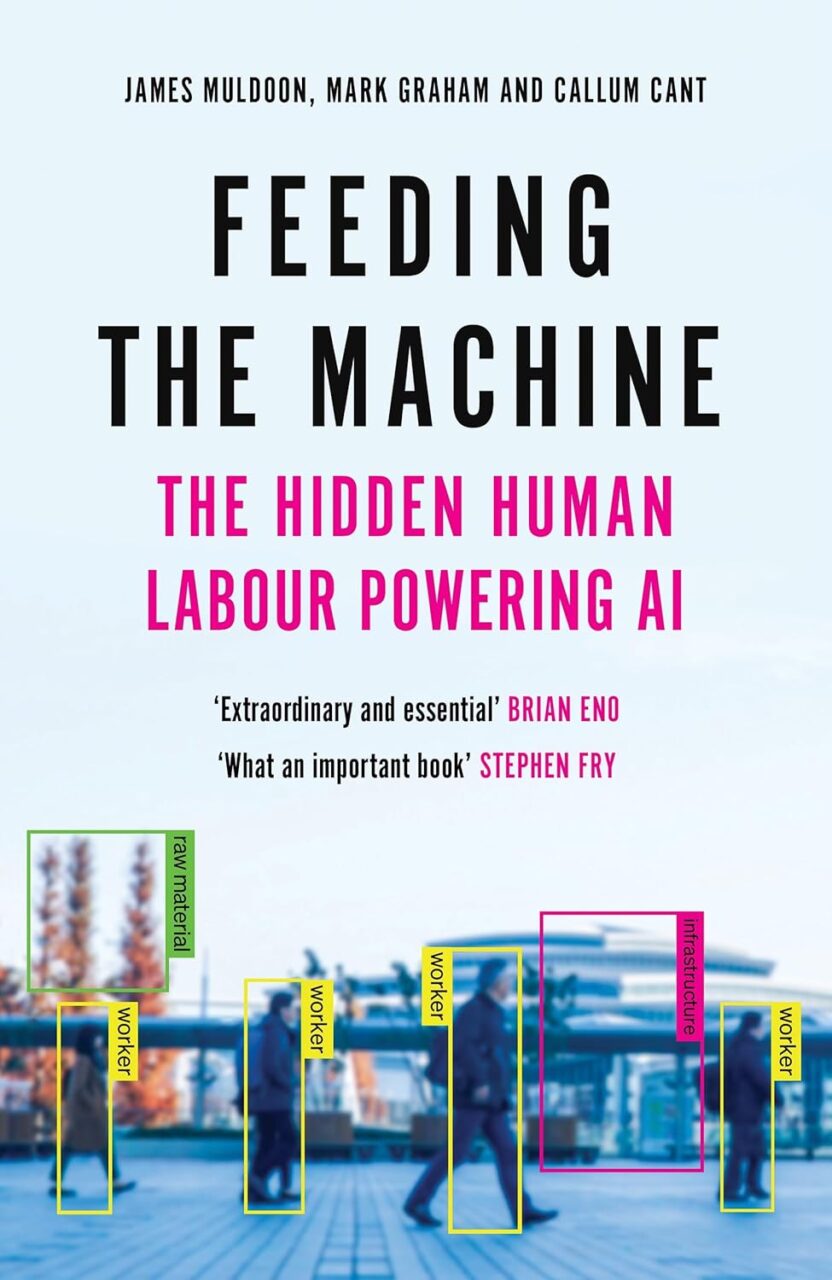
Feeding the Machine: The Hidden Human Labour Powering AI
by James Muldoon, Mark Graham, and Callum Cant
Great Britain: Canongate Books, 2024; 288 pages
ISBN 9781837261857, first edition, paperback
AU$35
One is tempted to think that the main ethical issues surrounding the use of artificial intelligence are misinformation, or students and authors not doing their own creative and critical thinking, or the unauthorised use and privatisation of intellectual property to train large language models (LLMs). However, this book reveals a hidden iceberg of other disturbing considerations. It is not specifically written from a Christian world view, but it is thought-provoking for people who share the kingdom values of Christian faith.
This book is suitable for a wide audience, being a popular work analysing the impact on society of the range of evolving technologies which are grouped under the banner of AI. Specialised understanding of the inner workings of large language models or other forms of AI is not required to follow the authors’ arguments. While the book is some 280 pages in length, around 50 of these comprise comprehensive end notes and extensive acknowledgements.
Muldoon, Graham, and Cant, academics who research and write about the economic and social impact of new and digital technologies at the Universities of Essex and Oxford, collaborate on the Fairwork project. For over a decade, since the first fibre-optic cables joining Kenya, and hence the last unconnected parts of Africa, to the internet were laid down, they have conducted interviews and fieldwork around the globe, revealing exploitative and precarious work practices and the human cost behind the shiny, “clean” façade of new technologies. They describe their book as combining “a deep economic and political analysis of the systems of labour that produce artificial intelligence, and a rich ethnographic account of workers’ lives and how their work contributes to broader production networks” (p. 15). Rather than focusing on AI as a mirror of human intelligence, they term it an “extraction machine.”
Each chapter is introduced by the real-life story of a representative person working at some level within the intermeshing industries which appear to the end-user as just being “AI,” that is, one of those who feed, or perhaps are fed to, the machine. In the introduction, a content moderator located in Africa, who spends her entire working day watching video content so that she can correctly label the severity of its horror to protect social media feeds, is featured. “Artificial” intelligence relies on all-too-real intelligence. Subsequent chapters begin by describing the working situation and concerns of “the annotator,” “the engineer,” “the technician,” “the artist,” “the operator,” “the investor,” and “the [labour] organiser.” The chapters each then go on to explore the themes set by these vignettes.
The idea that artificial intelligence consists of computers trawling real or synthetic data, learning as they go, is illusory. In Chapter 1, we see how human labour is essential to curate the data. Big AI frequently finds this human labour through BPO (Business Process Outsourcing) companies in the poorer nations of the Global South. Post-colonial communities have fluency in English which serve the ends of the “extraction machine,” and at low cost. If BPO costs were to rise due to higher wages, better working conditions, or greater job security, the work would simply dry up in that market and be relocated to another. The authors encourage us not to fall for the trap of thinking that equality of connection (to the internet) means anything like a power balance.
In Chapter 2, the authors take us to much nicer premises in London, where human engineers provide feedback on responses produced by LLMs. These humans effectively train the models in accuracy but also ethically; LLMs cannot engage in reflection. In fact, we must remember that while they produce what looks like the result of thought, they do not even think. Following this argument, we can see how bias is reinforced when the AI workforce is homogeneous (as it happens: white, young, male, and American). If we then follow the authors’ argument one more step, to examine the use of AI to replace human decision makers in welfare, health, and policing, we can see that such decisions are not necessarily fairer or more objective!
AI relies on physical resources as well as the human, so Chapter 3 takes the readers to Finland, where the climate is cool and electric power is cheap. Data centres require water and electricity for cooling in amounts that the authors helpfully compare to the consumption of particular cities, states, or countries, so readers can understand the scale. On the other hand, data centres do not require many technicians to run them. Utilisation of what could be life-sustaining resources (providing little employment in return) is the extraction machine in operation. This chapter also touches on the critical minerals required to create the chips that provide computational power, and asks whether the competing interests of private industry (financial) and governments (military and economic advantage) have any interest in providing the kind of humane liberation that technology could provide.
Chapter 4 struck a real note with me, asking us to examine what it is to be creative humans (as Christians assert, we are made in the image of a creator God). The lead character here is a voice artist, whose bread-and-butter jobs (like recording training materials) are being taken by AI versions of her voice, and those of other actors—without her knowledge or her permission. While AI may never produce true “art,” if artists cannot support themselves, they may not be able to produce it either, and we will all be the poorer for that.
The next three chapters ask us to consider the nature of work in an automated warehouse, the role of investors and venture capitalists in shaping what an AI-using society becomes, and how labour might be organised in a global AI workforce. In these chapters, the central premise of the book—that the artificial intelligence industry uses models of operation which are not particularly novel, replicating colonialism and the plantation or assembly line—is underlined. The authors point out that the very routes of the fibre optic cables which send data around the globe in milliseconds follow the same ocean trenches as telegraph cables did in previous centuries, entering countries at the ports that merchant ships once frequented. Processes broken into small, repetitive tasks in which no central purpose can be discerned, and conducted under continuous e-surveillance, dehumanise those doing them.
In Chapter 8, entitled “Rewiring the machine,” the authors offer five strategies: (i) transnational and cross-level exercise of the collective power of workers, (ii) consumer-led pressure on companies, (iii) regulation and global agreements, and even more ambitiously, expanded models of what (iv) worker-led industries and (v) capitalism itself might look like. If we use a chatbot, a robotic vacuum cleaner, or parking assist in a motor vehicle, we are part of this AI economy, and knowing something of how it works is, according to the authors, our responsibility.
To summarise, I would describe this book as eminently readable, but one with a hard-to-hear message. Significant transformation of society for a fairer digital and AI economy seems like an enormous undertaking. While this book presents some well-thought-out and human-focused suggestions towards this end, Christian readers will acknowledge that true justice and lasting transformation depends on God.