


Book reviewed by Samuel McKee, December 2025
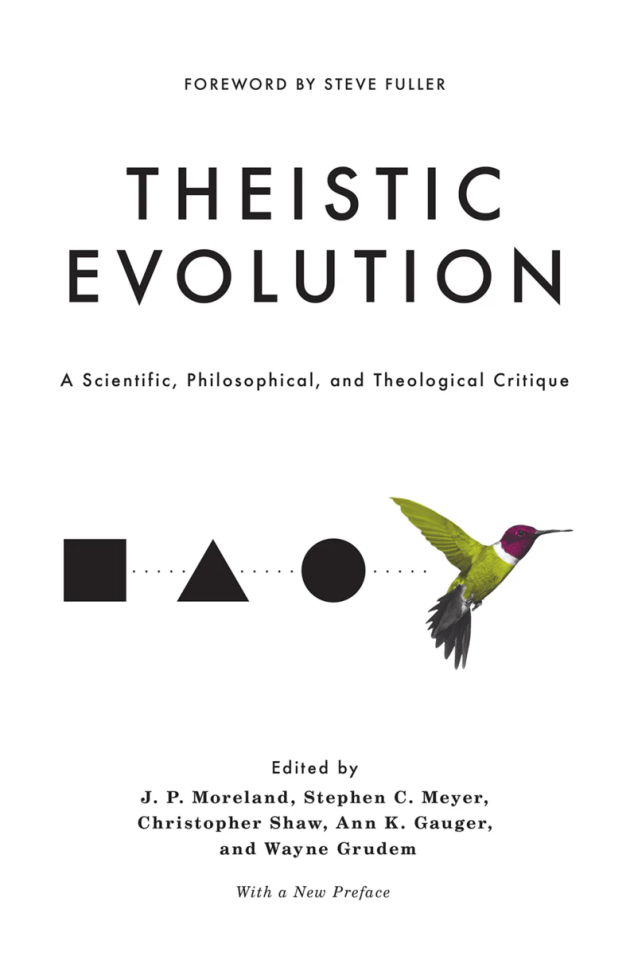
Theistic Evolution: A Scientific, Philosophical, and Theological Critique
by J. P. Moreland, Stephen C. Meyer, Christopher Shaw, Ann K. Gauger, and Wayne Grudem (eds.)
Wheaton, IL: Crossway, 2017; 1005 pages
ISBN 9781433552861, first edition, hardback
AU$185
From the full-frontal attack on evolutionary theory by the Intelligent Design (ID) creationist community comes this large work on theistic evolution. All the major names rallied their voices into an extensive text on the problems they claim make the position untenable. Given how each has marshalled their previously published works into each chapter, this is presented as a comprehensive debunk of the scientific, philosophical, and theological basis of being a person that holds to the truth of both evolution and theism.
I have little good to say about this book, mostly because the book itself has almost nothing scientific to say. Anyone that has read a scientific paper or text before in school, college or research expects data, information presented clearly, and scientific analysis. Despite the promises in the preface and introductory chapters, there is no science at all from the very beginning. Given my experience reading the ID works, my expectations were already low for the scientific content (both its volume and truth) but even then I was shocked by the complete absence of science. We meet a few claims, followed by hundreds of pages of philosophy, theology, and apologetics. There is simply no new data, which is especially odd given that this work comes from 2017, and biology has exploded into a new data revolution. The giveaway comes from the fact that the two most cited evolutionary scientists in the book (by a huge margin) are Charles Darwin and Richard Dawkins. One suspects that the authors have little familiarity with modern evolutionary biology, nor current biology in general.
I am disappointed that we are promised one thing and then left empty handed. We are told “this is the best critique of theistic evolution available” and that it “persuasively argues that theistic evolution fails as a theory—scientifically” (p. 1) but this never comes. We are warned of “the common, unwarranted assumption that Darwinism is doing well as measured by scientific evidence” (p. 1). These encouragements from the recommendations, all from theologians rather than scientists, clue us as to the real target audience. No scientist will be satisfied. This book is to persuade Christians with no scientific understanding that ID is scientific truth. It could not work on any other audience.
The foreword by Steve Fuller informs us that Intelligent Design “remains very much on the table as a scientific explanation” (p. 27) and that evolution “amounts to an outright betrayal of both the scientific and Christian message” (p. 32). Strong claims indeed. In a bizarre comparison to the effect of the Reformation on the explosion of modern science, ID is arrogantly compared to a new Reformation. This is especially odd given the immense productivity of biology following the Darwinian revolution of the nineteenth century, the modern evolutionary synthesis of the mid-twentieth century, and the transformation of all the life sciences since the Human Genome Project led by Francis Collins, who is also relentlessly attacked in the book. The truth is that the 160 years since Darwin has seen biology morph from an observational science into a practical science, so the reverse of Fuller’s claim is true.
In one of the most ironic statements in the entire book, Stephen Meyer tells us, of evolutionary biology, that “this tangled—indeed, convoluted —view of the origin of living systems adds nothing to our scientific understanding of what caused living organisms to arise” (p. 47). This is a perfect description of ID which has produced zero scientific understanding of life and its origins, but is completely untrue of evolutionary biology, especially in its modern context. Apparently, evolutionary biologists are leaving in droves (p. 52; in fact, they are not), scientists everywhere are coming round to ID (they are not), and the only reason more are not is because evolution has been insulated from criticism (p. 54). This is the opposite of the truth in the booming hard-data science of 2025, along with the continual claims of bias (p. 54) which repeat throughout the book—again ironic coming from ID which is pure bias. Meyer promises that the first nine chapters will produce “a wealth of scientific evidence from an array of biological subdisciplines” (p. 50) but this never comes.
In Chapter 1. Section 1, Doug Axe begins the so-called scientific critique by explicitly telling us that we require no technical expertise or understanding to denounce evolution —only intuition (p. 83–84), before then explaining why experts cannot be trusted. There are unsurprisingly no data claims made in this chapter which is not a good start for the scientific critique. Meyer, himself not a scientist since graduate school in the early 1990s, also offers no data. He assures us that Axe’s work (published between 2000 and 2004) showed that functional genetic sequences are too rare to account for evolution (p. 105), but this data is not presented in the book so we simply must trust their “expertise.” For those with knowledge of genetics, this claim is untrue but it is also very dated. We are now 20 years removed from Axe’s work and in a new era of biology.
The third chapter by Matti Leisola is the only chapter offering any hard science in exploring synthetic biology (p. 140) but almost immediately becomes an attack on “naturalism.” After this, evolution is left behind for an exploration of abiogenesis instead by James Tour (p. 165) and the origins of information by Meyer again, promising to “demonstrate scientifically” that evolution cannot account for it without any demonstration. All this amounts to is a pointing at actual research and saying “I don’t think so” whilst offering no science in return, only the idea of a designer. Perhaps the worst attempt at science comes from Jonathan Wells in Chapter 7 which is a hopelessly fumbled and outdated attempt at molecular biology from someone who never practiced nor published in molecular biology. There really is nothing to see here. This book should not sit on any science and religion shelf because from then on, all that follows is philosophy and theology.
The book is also a fierce attack on science itself, both the authority and practice of it. A huge problem one encounters even before reading is the sheer lack of scientific expertise. The authors, with one or two exceptions, have published almost no science or have not done so for decades. None are authorities in their fields, nor can they hold up against the litany of Nobel Laureates and research professors on the side of evolution. This puts them in the strange position of touting their own expertise to be trusted but discounting all expertise overall. This is a fundamental problem for ID as an industry. Moreland is touted as a scientist with a PhD though he graduated in the 1980s and never published. Axe’s work is championed yet he has only four publications from twenty years ago. It explains the lack of data presented in the book and why from the opening chapters this is evidently an apologetics book, rather than any kind of scientific critique.
A contradiction of the book is that, until Wayne Grudem’s chapter, it states that it does not advocate for creationism or a literal reading of Genesis, but from that chapter onwards (p. 61) we are explicitly told repeatedly that a literal interpretation of Genesis’ creation account is essential to faith and apologetics. This is not the only contradiction that the reader is continually tossed between. Given the old-earth roots of many of the authors, one wonders why exceptions are made to the data of other sciences regarding the earth’s age, but not to biology. If one were to follow the advice given, one would emerge a flat-earth creationist believing in a domed, primeval model. This is perhaps the ultimate tragedy of the ID movement today: the other creationist positions lean heavily on ID for its scientific claims, and yet these creationist movements are becoming more conspiratorial and many now teach flat earth and reject all science. Rather than the new Reformation promised by Steve Fuller and a new dawn for scientific freedom under ID promised by Stephen Meyer, William Dembski, Doug Axe, and others in the book, ID is leading creationists against science in more extreme forms than ever.