


Book reviewed by Neil Ormerod, February 2026
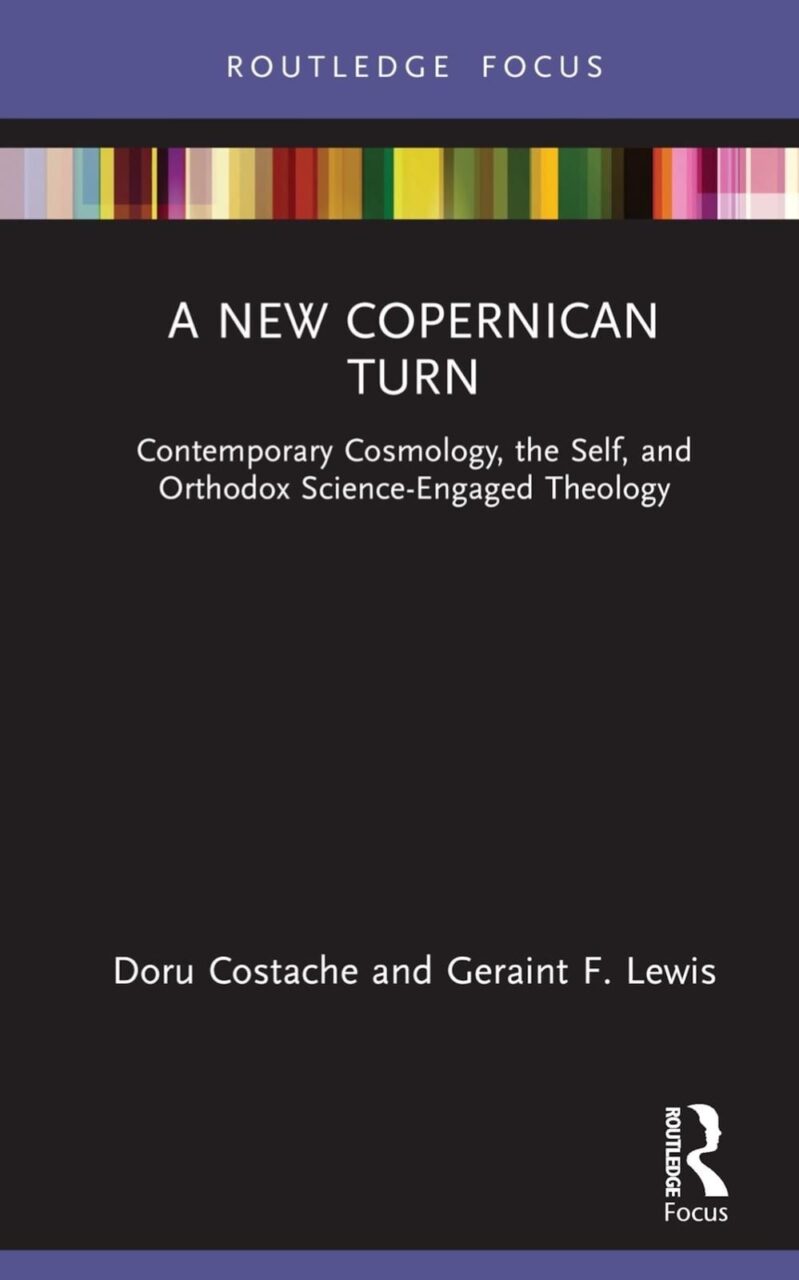
A New Copernican Turn: Contemporary Cosmology, the Self, and Orthodox Science-Engaged Theology
by Doru Costache and Geraint F. Lewis
London: Routledge, 2024;
ISBN 9781003527138, first edition, e-book
This book is a contribution to the Routledge Focus on Religion series. Doru Costache is a leading researcher in the Orthodox science and religion debate and is affiliated with the Sydney College of Divinity, while Geraint F. Lewis is research scientist in astronomy at The University of Sydney. The dual authorship is meant to demonstrate what the authors refer to as “science-engaged theology” from the Orthodox perspective of Costache. They spell out what is meant by science-engaged theology in the introductory chapter: it “brings to the fore the advantages of engaging the sciences within a defined traditional framework, such as Orthodox theology, which inaugurates new avenues for tackling matters of interest” (p. 2). Further, it “facilitates the critical assimilation of scientific information within faith communities and, in turn, forwards its discourse in ways that might elicit the interest of the scientists who work free of ideological bias or who explore holistic views of reality” (p. 6). Clearly the main driver of this particular project is Costache who contributes most of the chapters, with Lewis providing the scientific material that Costache engages with.
The work consists of four major chapters: an Introduction, primarily written by Costache; a chapter by Lewis providing an overview of contemporary cosmology; a chapter by Costache providing an Orthodox perspective on the engagement of theology with science; and a final chapter by Costache which is more speculative on how Orthodox practices might enrich our approaches to scientific questions. There is a brief conclusion summing up the achievement of the work.
The second chapter provides a history of developments in cosmology basically from Einstein’s proposed theory of general relativity, taking us through debates over the expansion of the universe, the notion of the Big Bang, first proposed by the Belgian priest Georges Lemaître, dating the age of the universe, proposals around dark matter and dark energy and the like. Inevitably the question of the contingency of the universe emerges as a key issue. As Lewis notes, there are many things science does not know, in particular why various physical constants, such as the speed of light, the strength of gravity, the masses of fundamental particles and the like, are what they are. Could they be otherwise? Significantly, would life be possible if some of these constants were varied? This sort of question was thoroughly explored by John Barrow and Frank Tipler in their book, The Anthropic Cosmological Principle, written in 1988. Lewis dismisses the notion of some sort of divine fine-tuning of these constants and proposes the idea of a multiverse as an alternative: “The notion of the multiverse offers another potential solution, with the suggestion that each universe is written with its own distinct laws of physics and physical properties written into it when it is born. In this picture, most of the universes in the multiverse possess a mix of physics that makes them sterile” (p. 31). I was a bit disappointed with this approach. As far as I can tell, the multiverse is not a scientific hypothesis because these different universes would be causally disconnected—a claim from no less a figure than the atheist physicist Lawrence Krauss—meaning there is no way to verify their existence. As such it is not a scientific hypothesis but a metaphysical one seeking to overcome the annoying problem of the contingency of the universe.
In the third chapter Costache presents a fascinating insight into the Orthodox world for those not familiar with it. The subheading, “Should Orthodox Theology Be Afraid of Cosmology?” would suggest a reticence or even fear on the part of some Orthodox theologians to engage with science, a stance similarly found in the fundamentalist western churches. In response, Costache details the ways in which early Church Fathers, figures central to the Orthodox faith, engaged with the science of their days. He notes, for example, Basil the Great setting a “precedent for the incorporation of scientific information into the Orthodox representation of reality” (p. 41). He concludes this survey to note “that what the scientists currently know about the universe cannot shock Orthodox theologians and believers, at least not in regard to the traditional sources surveyed here” (p. 48). Costache goes on to suggest that the preferred Orthodox understanding of the relationship between Creator and creation is one of “panentheism” which “briefly put refers to God’s presence in the universe and the universe’s presence in God,” representing a “fundamental interaction between the divine and the cosmic energies” (p. 52). This is in part based on Orthodox theology’s notion of the divine energies as the means of God’s interaction with the created order. The divine energies are the Orthodox variation to the Catholic use of the natural/supernatural distinction, which to my mind Costache misrepresents as “levels of reality” (p. 51). Catholic theology speaks of the natural and supernatural orders, that is, orderings to ends, not levels. Thus, natural ends are taken up into the supernatural end of redemption, not separated from it.
The final substantive chapter turns from the outer world to the inner world, the world of the “self.” Costache draws on eclectic sources, the Catholic philosopher Walker Percy, the science fiction writer Kurt Vonnegut, French philosopher and mathematician Blaise Pascal, physicist Steven Wienberg, and satirist Douglas Adams, to highlight the plight of the self in our present era. Costache remarks: “Humanity’s final terror is not the fact of being lost in space, figuratively or literally, within a silent universe whose vastness dwarfs the self to insignificance; it is the fact of having no grasp of itself, thinking reeds though people might still be” (p. 70). Inner knowledge has been lost. This extends to scientists who Percy argues, “the science of the scientist can understand everything in the Cosmos, but the self of the scientist” (p. 72). This leads to what Costache identifies as “the widespread resistance of contemporary cosmologists to the anthropic principle—with the commonsense link between the human phenomenon, the fact that we are here, and the universe” (p. 73). This leads into a provocative and speculative discussion about the interplay of the claims of objectivity in science and the subjectivity of the scientists, including the possible role of mystical contemplation. I have no qualms about the role of subjectivity in science; it is after all the product of conscious human subjects. But I was more uneasy with raising the possibility of mystical experience playing a positive role in scientific research. There are important questions to be raised about the relationship between objectivity and subjectivity, but I am not convinced of the approach adopted here. Still, I can agree with Costache’s sentiment that “wonder and enjoyment [of the cosmos] improve the situation of the self in the world. They also pave the way for a theological perception of the universe” (p. 91).
Overall, this book achieves what it sets out to do, to elevate theological engagement with the physical sciences through purposeful dialogue. As I noted above the main driver of this is Costache and the focus of his concern is locating this dialogue within the Orthodox tradition. Orthodox Christianity constitutes some 260 million adherents. It is a voice not often heard in the West, dominated by Catholic and Protestant tradition. It is a rich tradition and deserves to be heard and better understood.