


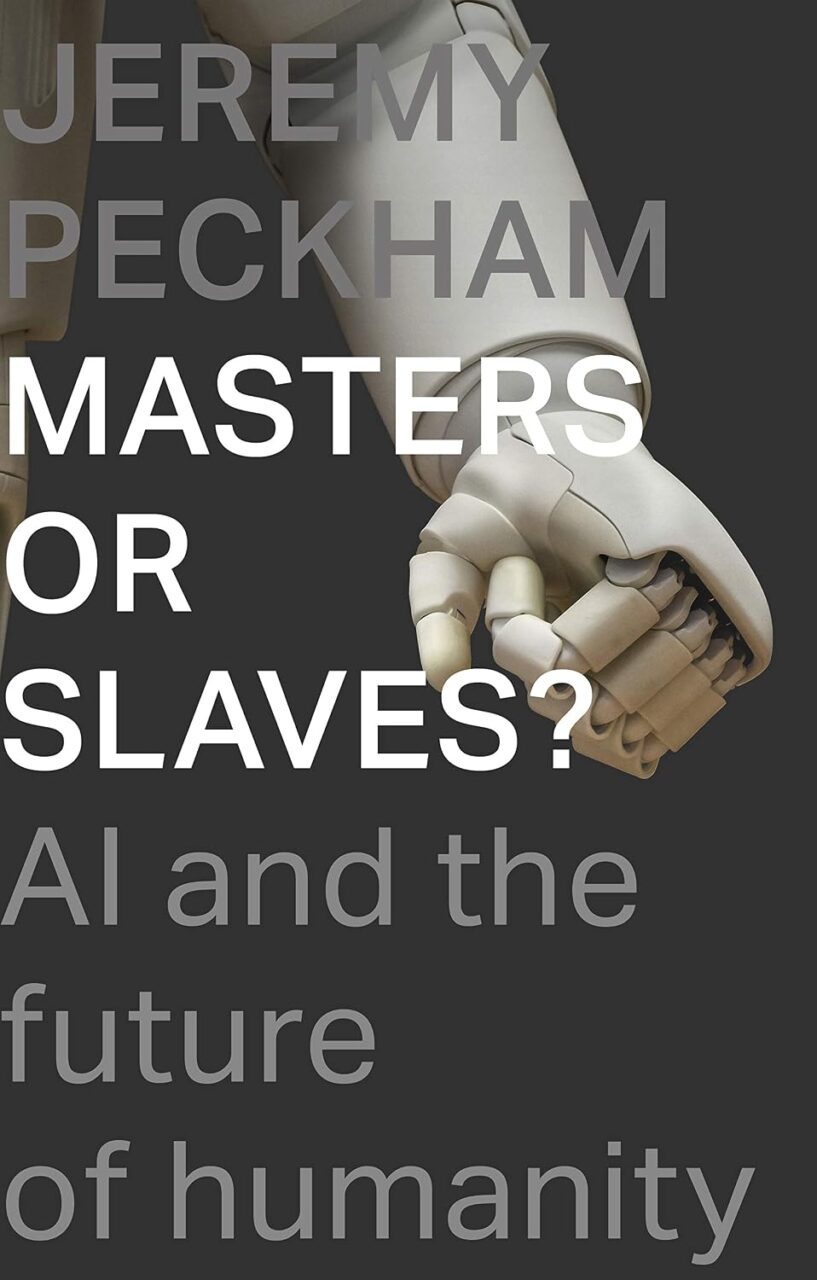
Book reviewed by Gordon Preece, August 2026
Jeremy Peckham: Masters or Slaves? AI and the Future of Humanity
Inter-Varsity Press, 2021; xiv + 237 pages
ISBN 978-1-78974-239-8 (paperback)
A$50
Jeremy Peckham FRSA is both a scientist and entrepreneur, turning the products of his largely artificial intelligence research into his first business in 1993, followed by many others, public and private.
As background and spelt out in his preface, the genesis of Peckham’s book was conversations with an academic colleague and PhD students about the need for serious Christian discussion of AI in International Fellowship of Evangelical Students (IFES) circles. Adding to his background has been his practically inspired research at the Royal Aircraft Establishment into how pilots in flight manage massive amounts of complex data by using AI to reduce complexity and stress. He then turned to other practical problems that AI could help solve in phone systems (though pondering a potential loss of call-centre jobs), and its safety effects on drivers or in mass surveillance (pp. xi–xii). Discussions on AI applications and ethics with an advocacy organisation made Peckham aware of ethical differences around AI in instances from self-drive vehicles to sex robots, regarding full autonomy in the first case and protection against abuse of human sexuality in the second.
Writing around 2020, Peckham was less interested in future dystopian applications than relatively recent ones like Poland’s use of facial recognition AI during the COVID-19 pandemic, which demanded that people upload a selfie by smartphone within twenty minutes of a broken curfew alert, or find police at their door. Such “emergency” or boundary thinking leads to desensitisation to the original issue and “normalisation” in society (pp. xii–xiii).
Peckham’s key issue concerns whether some applications of AI could reduce our ability to reflect God’s image in us. In both its author’s origins in IFES and PhD student contexts and its shared key issue of the nature of humanity, this book is similar to the 2025 Australian Christian Book of the Year winner, Stephen Driscoll’s Made in Our Image: God, Artificial Intelligence and You (Matthias Media, 2024). However, Peckham draws on Christian philosophical influences as well as biblical ones and perhaps operates more at the postgraduate level than Driscoll. While Driscoll is well aware of the potentiality of sin in AI uses, he surprisingly accepts what technology studies call the fallacy of technological neutrality (Driscoll, p. 83). Peckham, by contrast, follows philosophy professor Bruce Little’s key questions of technology, such as “What does this technology do for us and what does it do to us, what’s gained and what’s lost?” (p. xiv).
Peckham’s prologue presents a brilliant, easily imaginable scenario of a typical family start to a working day with all its interactions with, and envelopment by, various AI technologies, domestically (with children’s homework, and relationships over-reliant on Alexa, AI, and robotics), at work (the mother facing delivering the news of AI-enabled sackings to workers), and politically (as state and corporations seem “too cosy, sharing people’s data” [p. 8]).
This is all unpacked well in chapter 3, “A Mistaken Neutrality.” It is then filled in through chapter 4’s biblical anthropology and the various aspects of our imaging God as deputies in exercising dominion over creation (and technology), equality and relationality as male and female, rationality relative to the rest of creation, but not absolute rationality or progress as Enlightenment-based modernity aspires to.
To address these philosophical and practical challenges and questions, Peckham details in chapters 5 to 10 six ways in which our humanity is subject to various influences conflicting with biblical perspectives outlined in chapter 4.
Beginning in chapter 5, AI’s rational influence on our cognitive abilities and skills at work increasingly competes with humanity’s often slower and less accurate approach—as in AlphaGo’s famous victory over a human Go world champion.
Chapter 6 unpacks relationally how humanlike simulations are distancing us from more real and whole relationships. Advice-giving, ethical obligations, and algorithm rights arise as huge issues.
Chapter 7 examines AI’s impact on privacy versus freedom, interacting with the internet of things, smart cities, and mass facial surveillance, as big tech monetises our data for advertisers, without our active agency.
Chapter 8 explores how human dominion or vice-regency in the kingdom of creation interacts with human responsibility and agency in relation to autonomous weapons and self-drive vehicles.
Chapter 9 depicts AI’s looming impact on the workforce, both blue and white collar, for better and worse.
Chapter 10 asks the question of whether augmented and virtual reality could abolish our sense of reality completely.
Chapter 11 gathers together the previous six issues and their surrounding arguments well. A framework of practical guidelines is given, and a classically biblical and Christian philosophical virtue approach is offered to help resolve tensions developing from fast-rising AI and its default of convenient applications.
A manifesto in chapter 12 concludes on a positive but realistic note for individuals, churches, and wider society. It also provides a useful, brief summary of how a range of global bodies address the above issues. It closes with a challenge for Christians to walk with the one true Homo Deus and not neglect their call to imitate Christ.
While some of the more philosophical aspects of Peckham’s book make for a slower read compared with Driscoll’s, Peckham’s book is only about forty pages longer, that is, 237 pages compared to 195. It is clearly and imaginatively written with excellent contemporary illustrations. It is punctuated by helpful tables and summaries. For instance, chapter 11, “Soul Purpose,” provides a comparison of ethical frameworks argued from a Christian relational or personalist worldview applied through a virtues approach. The table and figure on pages 192 and 196 both provide a way forward for resolving tensions.
Similarly, the panel for chapter 12’s “A Christian Manifesto for AI” on pp. 204–5 is a compact guide to march to as we move into the future, holding on to hope and refusing the forced acceleration that the tech principalities and powers demand. For Christians seeking guidance in regard to AI, I would suggest that younger and less theologically educated Christians go to Driscoll first, for a biblical base, but not last. After that, they should read Peckham, as should more theologically and philosophically sophisticated readers. His book provides great practical wisdom for today’s AI challenges. Despite being three years older, it has hardly dated in any damaging way.
© 2026 Gordon Preece. This work is licensed under a Creative Commons Attribution-NonCommercial-ShareAlike 4.0 International Licence (CC BY-NC-SA 4.0), except where otherwise stated.