


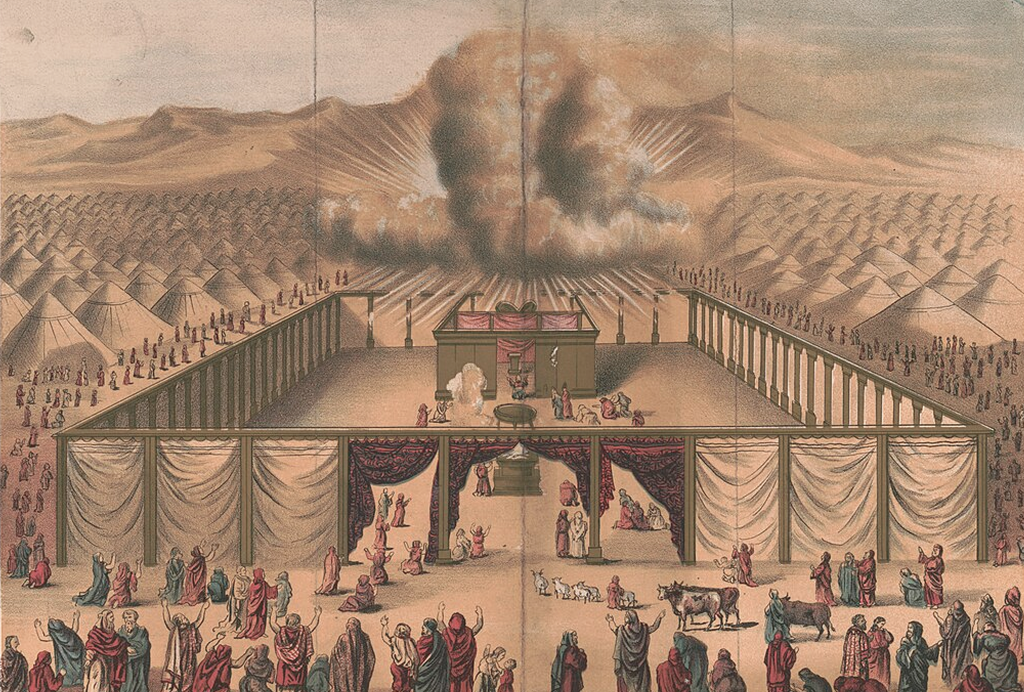
Abstract: The Epistle to the Hebrews can be read as an orienting statement about the relationship between the human architecture and the human future. The people of God have a glorious destiny. Their basis for eschatological hope is their endowment with the divine image, which is a pattern that is present in the nested and mirrored design of the tabernacle. The cosmology of Hebrews facilitates this holistic interpretation of the epistle, but scholarly discussion of the cosmology has become mired in a misunderstanding of the heavenly domain. An unfortunate outcome is that, when viewed from the perspective of modern scientific cosmology, Hebrews appears to be making comically primitive assertions about the physical universe. However, there is internal evidence that the tabernacle has the attributes of a mind, so it is reasonable to conclude that the heavenly domain is a cognitive domain that hosts the divine image. External evidence supports this conclusion by revealing that the tabernacle pattern can also be extracted from biology (e.g., self-referencing activity of a eukaryotic cell via its embedded design plan) and from physics (e.g., structural and functional isomorphism between brain-like systems and the universe). Ultimately, Hebrews’ cosmology is an exploration of conscious systems, not a pronouncement about spatial locales. This result demonstrates the hermeneutical value of supplementing biblical theology with attentiveness to science and philosophy.
When biblical scholars discuss cosmology in the Epistle to the Hebrews, they are talking about the use of nouns that are translated as “earth” and “heaven,” and adjectives that are translated as “earthly” and “heavenly.” Assigning these terms to a cosmology category is reasonable and customary, but it can also be problematic because it is an interpretive act that can subtly impose a bias toward a semantics of “place” as a spatial domain.[1] That bias would have important consequences: Hebrews’ cosmology is tightly linked to its christology, soteriology, and eschatology, so much so that decisions about the meaning of cosmological terms have a strong influence on conclusions about the identity and actions of the Son.[2] Those conclusions inevitably flow back as forces that influence views about the physical and metaphysical characteristics of the world(s) to which those terms refer, and it is precisely at that point that Hebrews’ cosmology is contentious.
The historically fragmented state of Hebrews studies can be partially attributed to the complex hermeneutical spiral that has just been described. Johnsson recognised the phenomenon almost fifty years ago as he analysed the reasons that a “holistic interpretation of Hebrews” had, in his opinion, not yet been produced.[3] He began with a tone of consternation as he reviewed two major Hebrews studies that had recently been published and found them to be “poles apart” in their outlook,[4] thereby preserving the epistle’s reputation as an enigma. Johnsson was particularly concerned with how to approach the choice to read either literally or figuratively, because “[t]he decision made concerning the valence of the language shapes the understanding of the entire document, and is particularly acute in the areas of cosmology and eschatology.”[5] He observed that “[i]n general, interpreters of Hebrews have merely launched into their exegesis, presupposing the valence of the cultic language. There has been no clearcut awareness of alternate interpretations and of the need to justify the stance adopted.”[6]
There are numerous recent instances of that behaviour. Although there are internal indications that the semantic range of “earth” and “heaven” is wider than notions of land and sky,[7] those indications are routinely ignored, so Hebrews scholars often settle comfortably into conclusions that might have been different if they had questioned the scope of the cosmology category at the outset. Adams, for example, in an article on Hebrews’ cosmology, never deeply inquires about the possibility that earth and heaven are qualitatively distinct. He begins by defining the author’s cosmology as “his general view of the universe and what lies beyond it,”[8] and as Adams proceeds it becomes clear that he believes that “universe” and “cosmos” are coterminous with the current “created, physical world.”[9] When he interacts with the suggestion of other scholars that the epistle manifests cosmological dualism, he focuses on axiological rather than ontological considerations; that is, he asks whether the author sees more value in the heavenly world than in the earthly world, not whether the author believes the worlds are two different kinds of things. For Adams, the two worlds are concrete places and therefore they share a genus, but the former is constituted by invisible things and the latter by visible things.[10] In the end, Adams is certain that Hebrews has much to say about the cosmos but nothing to say about cognition: “Nowhere in chaps. 8–9 or the letter as a whole does the writer draw a contrast between the intelligible world (the κόσμος νοητός) and the perceptible world.”[11] As a result, the nature of the “heavenly reality”—a phrase that is common in Hebrews cosmology studies[12]—remains obscure, the epistle is regarded as silent about epistemology, and the cosmos is presumed to be lifeless (i.e., not involved in information processing).[13]
A second example comes from Ellingworth, who identifies eight of the most problematical cosmological texts in the epistle (2:9; 4:14; 6:19–20; 7:26; 8:1–2; 9:1–14; 9:24; 10:19–20) and attempts to show what a reader can learn from them about “the universe.”[14] He cautions that his use of diagrams to illustrate the cosmology of Hebrews “involves some simplification” because he is “taking picture language at its face value.”[15] He also acknowledges that meaning is dependent on whether the language is literal or figurative,[16] and at the end he mentions that prima facie cosmological language might sometimes be “used in an ad hoc and incidental way to express a soteriological reality.”[17] Additionally, he claims that the “author’s terminology is fluid, imprecise, and sometimes confusing.”[18] His eight texts, however, are always given a spatial or physical interpretation according to which “heaven” denotes the area above the earth. Ellingworth thus arrives at a monistic cosmology: each domain is a place in a univocal sense, so there is “one reality” and “one universe,”[19] and there is no engagement with internal signals of a distinction between matter/hardware and mind/software in the epistle’s cosmology.
Jamieson’s review essay regarding the time and location of Jesus’ self-offering is a third example of work that uncritically adopts a spatial outlook on both the earthly and heavenly domains.[20] He aims to “describe five ways in which scholars have aligned three elements in Hebrews’ exposition of atonement: Christ’s death, his entrance to the heavenly sanctuary, and his self-offering.”[21] The starting point is Moffitt’s view “that Christ’s bodily resurrection, rather than being passed over or transformed into spiritual translation, is crucial for Hebrews’ argument, and is central to its cultic construal of the Christ-event.”[22] Jamieson carefully sorts the opinions of dozens of scholars, but uses “heaven” in a mostly indiscriminate manner to denote a conventional place (i.e., a spatiotemporal location). The task for scholars, as he portrays it, is to properly arrange the priestly events in a temporal sequence, and they have no need to posit ontological discontinuity between earth and heaven because the events plainly occur in different regions of the cosmos.
Jamieson does not press the issue of whether it is legitimate, indeed necessary, to rigorously assess the metaphysics of the epistle. However, it seems that having an accurate understanding of the heavenly domain would be a prerequisite for all scholars who study the atonement; how could one decide, for example, where Jesus’ entrance to the heavenly sanctuary fits on the timeline of priestly events without first having a well-defined stance on the sanctuary’s ontological category?[23] Many of these scholars speak of a “spiritual realm,” a “heavenly/spiritual perspective,” a “heavenly/spiritual significance,” “spiritual fruit,” “spiritual translation,” “spiritual ascension,” and/or “spiritual exaltation,” but in Jamieson’s article there is meagre assistance regarding these concepts, especially about time in the “spiritual realm” in comparison to relativistic time in the cosmological domain; he only remarks that “spiritual” is synonymous with “disembodied.”[24] Jamieson’s collected data, therefore, suggest that biblical scholars are adept at invoking the heavenly/spiritual domain but shuffle it around as a black box that is impenetrable. Consequently, progress on the “when and where” question may be dependent on facing the issue of whether there is an objectively real but non-spatial domain in which there are discernible effects of Jesus’ sacrifice.
Those three examples show the flavour of much of the literature on Hebrews’ cosmology. Classifying the heavenly domain as a place of material objects appears to be a default action, and one that is done instinctively by a majority of interpreters. Like Newtonian physics before the arrival of quantum mechanics, it sidelines the phenomenon of consciousness as if that were irrelevant to the existence and functionality of the cosmos.[25]
There is, however, at least one other—and better—option, given that it does not omit consciousness as the most interesting property of the cosmos. Heeding Johnsson’s admonition that having the correct cosmology is a major step toward a properly holistic perspective, this article now begins to rebuild the conversation by developing a hypothesis: in Hebrews, the heavenly domain is a cognitive domain (i.e., it pertains to a set of abstract objects, including design plans, self-models, and messages, all of which are patterns detected by and resident in a mind or consciousness).[26] It is a domain that, rather than being ontologically merged with the cosmological domain, is distinct from it, while it maintains a relationship with the latter. The relationship is enunciated by saying that each domain mirrors the other, but they are not spatially or temporally separated.[27] The adjectives “earthly” and “heavenly” therefore mark the kind of a particular entity, not its location. A human, due to architectural configuration as a microcosm that matches the pattern of the tabernacle, participates in the heavenly domain, and thereby can become a dwelling place of God.[28]
Ten Desiderata for a Theory of the Heavenly Tabernacle
The heavenly domain of Hebrews, unlike the earthly domain in which ordinary human activities are conducted, is purportedly unfamiliar, so in order to understand its nature it is necessary to work with the available clues. Most of them come from the heavenly tabernacle, but despite the linkage of this “true tent” with the author’s “main point” (8:1–2), the author does not “speak in detail” (9:5) about the earthly copy and shadow (8:5) that resembles it. Instead, he deposits the clues obliquely and leaves them for ripening. There are many studies that attempt to develop the clues into a viable theory of the heavenly tabernacle, but before examining the status of that conversation it would be helpful to establish criteria for evaluating them. A theory of the heavenly tabernacle should display parsimony, internal consistency, external coherence, explanatory power, and predictive power, all arising from desiderata that include those on the following ten-item checklist.
1. Congruous with Engrossment in the Human Phenomenon
If positioning of a topic at the forefront of an epistle, and the amount of space devoted to it, is an indication of the topic’s importance, then the human phenomenon is evidently the principal motif. The epistle opens with a magisterial statement about the Son of God (1:1–3a) but immediately begins to reveal his solidarity with humans (1:3b).[29] That is a surprising manoeuvre, since the Son’s divine nature would seem to preclude a close association with any creature. Perhaps one could predict that the Son would have a relationship to angels since they also reside in heaven, but angels are dismissed as mere servants. Humans, on the other hand, sin and receive salvific aid from the Son (1:14; 2:3; 2:16), so if he deigns to involve himself with them in the most extraordinary way by sharing αἵματος καὶ σαρκός (2:14; see also 7:1 and Genesis 14:18), then they must be peculiar.[30] Humans stand out all the more because they, in contrast to angels, have been promised dominion over creation, despite their natural insignificance (2:5–8).[31] Humans are also interesting because many of them are transitioning into a glorious future (2:10), rather than remaining in their present lowly state. Furthermore, humans constitute the house over which the Son is head (3:6), so they obtain derivative honour (3:3).
All of this fascination with humans arrives far ahead of the first mention of the heavenly tabernacle, which leads one to wonder how a tent could be competitive against humans on an index of interestingness. Yet the heavenly tabernacle’s massive importance is indicated by its positioning at the structural and topical apex of the epistle, and by the repeated mentions of it there (8:1–10:18).[32] Why would the author shift his gaze to a tent when he was initially so enamoured with the human phenomenon? There are no remarks about the properties of the tent, such as its size or the material from which it is constructed, that explain its power to attract attention away from the properties of humans.
What, therefore, is the attribute of the tent that eliminates the tension with human attributes? Perhaps the answer lies in the vicinity of a parallel question: why is humanity’s vocation highlighted?[33] The vocation is displayed in Hebrews in the form of a prompt from a psalmist to seek an attribute of humans that makes them interesting even to God (Psalm 8:3–4). The Genesis 1:26–28 background of the psalm contains the solution: it is the divine image. If, therefore, the tabernacle itself carries the divine image, the tension is resolved: humans and the tabernacle are equally interesting because they have the divine image in common. A theory of the heavenly tabernacle that does not incorporate this point is deficient.
2. Congruous with the Principle of Compatibility Between Dwelling Place and Occupant
The biblical storyline presents the immense and immutable God as dwelling in various places that are outwardly dissimilar, and moving among them. These sacred spaces include the garden, the tabernacle, and the temple.[34] In the narrative of God’s movements, there is an element of God’s frustration and dissatisfaction with sojourns during a restless search for a suitable house; it is not found or produced immediately.[35] However, it also depicts an eventual permanent dwelling in a preeminent place. Thus, a theory of the tabernacle needs to justify this diachronic development and this perspective on compatibility between finitude and infinitude. A long-standing principle is that a high degree of commonality is a necessary condition for two entities to have the high degree of compatibility that is connoted by “indwelling.”[36] Because God has life, linguistic capability, and self-consciousness, this principle requires the dwelling place to also have those attributes. A domain that is spatiotemporal but has no information flow is therefore disqualified, but Hebrews declares that God is not homeless, so the final dwelling place must itself be a partaker of the divine domain.
3. Congruous with the Strong and Frequent Emphasis on Knowledge, with Implied Self-Knowledge
Hebrews is emphatic about the need for advanced cognition, and knowledge is a theme within the epistle, so some scholars have found gnostic tendencies in it.[37] Members of the audience are expected to master many topics, starting with “elementary principles” but going far beyond them to the point of being instructors who can work at the high level of ability that the author demonstrates in his exposition of the scriptures (5:12–14; 6:1–3). Eventually teachers will no longer be needed because universal knowledge of God will become the norm under the new covenant (8:11). One could gauge its spread, however, by knowing the state of a mind, and indeed throughout the epistle there are numerous comments about these internal states,[38] which are intrinsically private albeit communicable. Implicit in this situation are self-reference and self-representation,[39] which are outstanding cases of advanced cognition inasmuch as they only appear in complex systems that evidence consciousness. A theory of the heavenly tabernacle should incorporate this datum because priestly action in the sanctuary somehow affects at least one human cognitive faculty, namely, consciousness (9:9, 14; 10:2, 22).[40]
4. Congruous with Mappings Between Cosmological and Cognitive Domains
Thinkers throughout history have used cosmological terms to discuss the cognitive domain. Clement of Alexandria, for example, articulates a cosmology that is disclosed by consideration of angelic offices. The heavenly domain is arranged in multiple levels, and inferior angels are periodically promoted to a higher class. In effect, ontological upgrades to the angels equip them to perform new functions at the level to which they have moved. Although the angels have a “relative corporality” according to the level that they occupy, “this type of ‘form’ is entirely different from any earthly forms,”[41] so they belong to the heavenly domain. However, that domain is not a place that is an extension of the earthly domain, because in Clement’s discussion of it “all imagistic details, such as specific intervals of space or time are emptied of the literal meaning they had had in the apocalyptic cosmology.”[42] Thus, although Clement appears to be speaking about the physical universe, he is referring to “ascent on the cosmic ladder as descriptions of an interior phenomenon.”[43] Paraphrasing Alexander Golitzin, Bucur calls this account of angelic advancement an “interiorized apocalypticism” that is “paradigmatic for the widespread hierarchical cosmology in the early centuries of the common era.”[44]
Mappings between cosmological and cognitive domains have also been created outside the Jewish and Christian traditions. Burley, for example, has analysed a debate among Buddhist scholars about “how to understand the relation between what appear to be cosmological and psychological aspects of certain central ideas” in its literature.[45] He identifies three interpretations of Buddhist cosmology. First, there is a demythologising or psychologising approach, wherein “the accounts of ‘realms of existence’ are really figurative descriptions of mental states.”[46] Second, there is a literalist approach that insists that cosmological terms refer to spatiotemporal places or structures in the universe. Third, there is an approach that seeks to unify the cosmological and cognitive domains as a “one-reality” view.
The psychologising view has appeal because of the crucially important topic of mental states within Buddhist doctrine and practice. The literalist party, in turn, claims that cosmological terms should not be interpreted figuratively unless there is a clear indication within the text that one should do so. Meanwhile, the one-reality camp maintains that a single referent is alternately described from cosmic and personal perspectives.[47] Burley says that the one-reality option is metaphysically intriguing, but in his critique of it he observes that some of its proponents, “while intending to explain how ostensibly cosmological and psychological vocabularies might be referring to ‘the same thing,’ repeatedly slip back into implying that there are in fact two discrete, though somehow correlated, orders of existence being denoted.”[48] In other words, these two orders “are held to parallel or reflect each other,” but he believes this “collapses into a version of literalism,” since it preserves the spatiotemporal aspect of cosmology.[49] In the end, Burley leaves all three views on the table for further study, but even though the conundrum persists he has demonstrated that the mapping proclivity is not limited to a small slice of history. A theory of the heavenly tabernacle should explicate this proclivity.
5. Congruous with the Experience of Mystical Union with God
The heavenly tabernacle draws worshippers due to the presence of the Son, who can intercede as high priest on their behalf (7:25). The earth/heaven duality is axiomatic for the Son’s effectiveness: his superiority to all other priests is proven by the fact that he operates in the heavenly domain (8:4). He is qualified to be there because of his membership in the order of Melchizedek (5:6, 10; 6:20; 7:11, 15, 17). According to the logic of the epistle, the problem that has been overcome is not that the earthly priests are far away from the heavenly tabernacle; rather, it is that—because they belong to the Aaronic order, which is restricted to the earthly domain—they have no authority to minister in the heavenly domain.
Consequently, the ontology of Hebrews is fully consistent with the manner in which one can comply with the old covenant injunction to cleave to God (e.g., Deuteronomy 10:20). That command, of course, is absolutely incomprehensible to any object that is unable to be informed by such a linguistic pattern—that is, an object that is mindless. Philo, however, is among those who understand that obedience to it “is possible because man is ultimately a Nous that can escape the sensible realm, elevate itself to God’s ‘place,’ and there unite with the transcendent God.”[50] Philo, in at least two writings, says that a mind must be “cleansed” or “purified” from “all things pertaining to creation” in order to be successful in this endeavour; thus, “somatic and corporeal” entities are impediments.[51] Just as the tribe of Levi was exempted from worldly affairs, so also preparation for union is done by relinquishing sense experience.[52] In light of this strong and carefully developed conviction from a premier representative of Hellenistic Judaism,[53] it is worthwhile to consider whether a spatiotemporal heavenly tabernacle would be an appropriate antitype of its earthly counterpart. The latter was necessarily a material structure, but its layout as a series of increasingly compact enclosures fortifies the idea that movement toward God is a cognitive movement toward the interior (6:19), where one is progressively shielded from sensory influence in order to be completely devoted to God. Totality of that progression is death.[54] By entering the dark Most Holy Place, a high priest has analogically entered a tomb.
6. Congruous with Angelology and Divine Action
Angels are mentioned numerous times in Hebrews. Some biblical scholars accentuate their function as helpers of humans (1:14; 2:16; 13:2),[55] so there is a tendency to believe that they belong to the cosmological domain. However, the epistle defines their essence both directly and indirectly, leaving no uncertainty about their kind. In 1:14, they are categorised as spirits, and from 2:16 and its context a reader can reach the same conclusion: one way in which angels differ from humans is that they do not die, precisely because they are not incarnate. Furthermore, “heavenly Jerusalem” is the site where angels, humans, spirits, and God assemble (12:22–24),[56] and mention of the presence of sprinkled blood, along with static representation of cherubim in the earthly copy (9:5), indicates that “heavenly Jerusalem” refers to the heavenly Most Holy Place. Some of the agents who meet there innately lack a material component, so a claim that they all gather in spacetime is dubious. It is more reasonable to infer that the meeting place is in the cognitive domain, else it would be unable to host immaterial beings due to categorial mismatch. The cosmological domain does not lack a cognitive complement,[57] so angelic ability to operate in the cosmos is not inexplicable.[58] Nevertheless, a theory of the heavenly tabernacle should uphold the author’s desire to avoid categorial sloppiness regarding essence—a desire that is evident in the epistle’s angelology.
7. Congruous with the Reciprocity Between Renewal of the Mind and Renewal of the Cosmos
The most important event in the heavenly tabernacle is the entry of Jesus as high priest. His intention is to cleanse it, and he does so by analogically reenacting the procedures of the earthly priests for the earthly tabernacle. A major section of this article below will discuss how the heavenly tabernacle became polluted, but one must start with the fact of its pollution. Why must it be cleansed rather than letting it stay in that condition? The cleansing is expensive, after all: the Son pays with his own life. An intuitive answer is that the heavenly tabernacle is the dwelling place of the holy God, so pollution is simply intolerable. One assumption that is packed within the question and the response is that spacetime is applicable to the heavenly domain, but that introduces incoherence on two fronts. First, how is it that the infinite and immutable God is dwelling in a domain that, if corruptible, is apparently finite and mutable? Second, how long is God willing to wait for the cleansing?
Such questions evince a conceptual runaway initiated by anthropomorphic language and a notion of sin as a material pollutant, resulting in a mistaken view of the nature of the heavenly domain. Backtracking, it is important to remember that a holistic interpretation of the epistle is the original goal. From that standpoint, cleansing the heavenly tabernacle is a tactic to clear the way for fulfilment of humanity’s vocation of dominion. It is the first step in liberating the cosmological domain from its bondage to decay, as described in Romans 8:18–25.[59] Reestablishing order in the cognitive domain—leading to restored communion with God—sets up eradication of chaos in the cosmological domain, so one can infer that there is an interface between the two domains across which an ordering (or disordering) influence can flow.[60] The tabernacle illustrates the interface, because in its nested and mirrored architecture it unites an occupant (tent) with its environment (courtyard).[61]
8. Congruous with the Pervasive Dualism of the Epistle
Many expositors of Hebrews have identified an important set of dualities in the epistle. It includes the following binaries: animal / human; Aaron / Melchizedek; death / life; many / one; temporal / eternal; inferior / superior; old / new; external / internal; flesh / spirit; visible / invisible; earth / heaven. Thompson, in his prolific study of Hebrews, has often pointed to its conceptual and rhetorical force.[62] In turn, Attridge, in an article dedicated to the topic, notes how these members cluster in 8:1–10:18,[63] where the tabernacle is spotlighted.
The overall purpose of the dualities is to denote rigorously certain kinds: they comprise discrete ontological categories into which various entities can be sorted. An implicit boundary guarantees discontinuity between the poles of each duality. Gradation is never envisioned; an entity is confined to one pole or the other. This observation is especially pertinent for the earth/heaven pair because, if its poles define a distance rather than a kind, it would be a uniquely illogical exception in the set of dualities. Whereness, rather than whatness, would be indicated, and there would be a possibility of movement between the poles as per the continuous nature of space.[64] However, Hebrews’ cosmology is not inconsistent: “the author envisages a clear distinction between earth and heaven and is careful not to blur these boundaries … there remains a significant ontological dualism between earth and heaven that the author is at pains to preserve.”[65] That distinction is affirmed by Kline, who observes that Genesis corroborates and refines it by reference to one earth and two heavens: one domain is visible earth plus visible heaven, while the other domain is invisible heaven.[66] Unfortunately, Kline misses the opportunity to clearly state that the role of the visible/invisible duality is to mark two different kinds.[67] Regardless, the takeaway lesson is that equivocation on “heaven” can be a source of confusion when it lands in a theory of the heavenly tabernacle.
9. Congruous with the Doctrine of Omnipresence and the Revelatory Role of Patterns
In Hebrews, God’s presence, entailing a disclosure of God’s nature, is superficially associated with the cosmological domain. For instance, the Son is said to be seated at the right hand of God (1:3, 13; 8:1; 10:12; 12:2), and humans approach the throne of God (4:16), draw near to God (7:19, 25; 10:1, 22), and have come to God (12:23). However, canonical factors require a figurative reading of these statements. Solomon acknowledged at the dedication of the temple that talk about God’s dwelling in any spatiotemporal structure is only an approximation; strictly speaking, God dwells in “heaven” (1 Kings 8:27, 30; 2 Chronicles 6:18, 21).[68] Jesus reinforced the idea when he said that location-based worship is obsolete because God’s spiritual nature requires a spiritual access method (John 4:20–24).[69]
The classical doctrine of divine omnipresence is rooted in these textual considerations, but the earthly tabernacle furnished a preview of it. Because it was a comprehensive model,[70] the earthly tabernacle proclaimed that God is present at all spatial scales, but especially in a domain where spatial scale is irrelevant, which is the cognitive domain.[71] A pattern, the detection of which is accomplished by consciousness, is therefore an eminently suitable agent for bridging immanent and transcendent domains. Since a pattern is informative, it entails that information is the divinely designated mediator between God and other minds. Structures made with human hands (9:11; cf. 8:2) are superfluous for knowledge of God because patterns are coextensive with all things that God created (1:10; 3:4; 11:3).[72] Gregersen sustains that observation when he writes, “Astonishing parallels between the informational worldview and the view of deep incarnation come up, both at cosmic and at organismic level.”[73] Nevertheless, some patterns convey the divine nature with more fidelity than others, which explains the stern warning not to deviate from the tabernacle design plan that was shown at Mount Sinai (Hebrews 8:5; Exodus 25:9; 26:30; Acts 7:44).[74]
10. Congruous with the Tabernacle’s Architectural Disclosure of the Divine Nature
The earthly tabernacle is a relatively simple structure, but its architectural specification is not an arbitrary design with a merely utilitarian purpose of providing shelter for religious activities. Its precise description (Exodus 26–27), followed by a laborious account of its construction (Exodus 36–40), strongly suggests that its architecture is highly significant. Interpretive schemes of tabernacle symbolism are commonplace, and there might be validity in more than one of them due to the “multifaceted character” of the tabernacle.[75] Within Hebrews, though, there are several intertextual elements that provide a single coherent and non-arbitrary key to the message that the tabernacle, in its layout, is broadcasting.
The leading edge of the epistle contains the programmatic statement that the Son “is the radiance of [God’s] glory and the exact representation of [God’s] nature” (1:3). It is a statement as firmly anchored in Exodus as the content about the tabernacle, because it closely corresponds to the episode of the burning bush. In Exodus, the “blazing fire” that issues from the bush (Exodus 3:2) is paired with a revelation of YHWH’s nature via self-identification as “I AM” (Exodus 3:14). That name intensely communicates self-consciousness as the foremost divine attribute, so it is reasonable to expect that self-consciousness would be clearly represented in the earthly tabernacle. That could happen if the tabernacle exemplifies the pattern that is a necessary condition for being a divine dwelling place. It is a pattern that originates in the Trinity. Poythress says that “the mutual indwelling of the Father and the Son presents us with the ultimate form of indwelling, namely, the original indwelling of the Persons of the Trinity. This original uncreated indwelling must be the model for all instances of God dwelling with human beings who are made in the image of God.”[76]
The relationship between the Father and the Son is therefore an archetype of divine indwelling, but it is simultaneously an archetype of self-consciousness. The Father, as God, has complete self-knowledge, and the self-knowledge is expressed as a word. That “living and active” word (4:12) is the Son who reflexively knows and makes known the Father in the act of being known.[77] Consequently, God is disclosed through a scenario in which an observer observes its self by observing its own image, and that image is always an image of the observer observing.[78] Self-consciousness is thereby shown to be a looping pattern wherein an original and a copy are entangled with one another.
These theological loci reverberate in Hofstadter’s work. From philosophical and scientific ingredients he has carefully developed an account of self-consciousness that is founded on interplay between a description and a construction. These two entities mirror each other: the construction is generated from the description (i.e., the design plan), but the description can be derived from the construction. Thus, although in ordinary experience a description often precedes a construction and therefore could be considered the original entity, perfect correspondence between the two entities makes it difficult to assign labels of “original” and “copy.”[79] Hofstadter calls this phenomenon a “strange loop,” defined as “a paradoxical level-crossing feedback loop,” wherein the starting point and ending point appear to be identical.[80] In a human, the strange loop manifests through the relationship between the mind and the self-symbol (“I”). The mind is the description, and it is monitored in an ongoing act of consciousness by the self-symbol, which is a construction that is generated by the mind. A length limitation precludes further exposition of this subject/object loop,[81] but it is an essential consideration for a theory of the tabernacle because Father/description and Son/construction elements are conspicuous in the Hebrews treatment of the bicameral tent, enabling recapitulation of YHWH’s self-consciousness.[82]
Church and Moore in Dialogue about the Heavenly Tabernacle
There is scant evidence that the ten desiderata, or any similar checklists, are being employed by scholars when they create and refine theories of the heavenly tabernacle. That is an unfortunate methodological oversight, because without the wide perspective afforded by the desiderata, scholarly discussion has sometimes been channelled into unproductive and/or erroneous lines of thought. A recent dialogue between Church and Moore is instructive because it has resulted in a stalemate about the nature of the heavenly tabernacle. Church initiated the conversation when he published his view that it is an entity that begins to exist at the end of time.[83] Moore offered a rebuttal that was based on the heavenly tabernacle’s role as a pattern for the earthly tabernacle, which implies the former’s existence during the life of Moses as an entity that was nevertheless located somewhere other than Earth. Church then responded to Moore’s critique.
A brief analysis of the dialogue can pinpoint the reason for their different conclusions. Church’s position is that the tabernacle in Hebrews “is not a structure, either in heaven or on earth. Rather, it is a metaphor for the eschatological dwelling of God with his people.”[84] Taking a cue from the future-oriented perspective in Jewish apocalyptic literature, he prioritises temporal properties of the heavenly tabernacle and interprets spatial terms so that they do not encroach on temporality. In particular, Church is motivated by his emphasis on eschatology to translate ὑπόδειγμα in 8:5 and 9:23 in such a way that it weakens “a Platonising interpretation of the earthly tabernacle as a material instantiation of an eternal idea or archetype”.[85] His reasoning is that if the heavenly tabernacle did not exist when the earthly tabernacle was constructed then it could not have been an archetype for the latter.
Moore defends a view that “for Hebrews, the heavenly tabernacle is a pre-existent, cosmological, spatial reality.”[86] He begins his rebuttal by pointing out that cosmological or spatial dualism is not a uniquely Platonist trait; it is also found in Jewish apocalyptic literature, so it is compatible with an eschatological perspective.[87] He later provides evidence that ὑπόδειγμα can mean “correspondence—showing what something else is like—without reference to whether such correspondence is future, past, above, or below.”[88] Yet he also asserts that the heavenly tabernacle came into existence, even if it is not possible to determine the exact point in time when that occurred.[89]
Church and Moore are now at an impasse.[90] Their respective articles are verbose and often technical but there are two main problems. First, their efforts are underway without a perspicuous initial definition of “heaven.” Both scholars assume that it is a spatiotemporal domain and then proceed with that assumption without being aware that it is derailing their work. Church’s overall approach, for example, forces a choice of emphasis between spatial and temporal properties of the heavenly tabernacle, but a choice is unnecessary when “earth” and “heaven” are properly defined by basic biblical and metaphysical distinctions. An object in the earthly domain has both spatial and temporal properties, but an object in the heavenly domain is both non-spatial and non-temporal. Similarly, Moore’s claim that the heavenly tabernacle is cosmological, spatial, and temporal is rooted in a category mistake: an entity with those properties is earthly, not heavenly.[91]
The second main problem is related to the first. Church and Moore have no room for abstract objects in their theories, but their discourse about entities such as God and patterns shows that abstract objects are unavoidable. Their fundamental disagreement would perhaps be resolved by recognising that as a pattern the tabernacle does not have spatial or temporal properties, but every expression of the pattern certainly does. One must acknowledge a distinction between the tabernacle as description/genotype and the tabernacle as construction/phenotype, but neither Church nor Moore does so, hence the confusion.[92]
Jamieson’s Theory of the Heavenly Tabernacle
In the Church and Moore dialogue one can begin to see that 9:23 is critical in the epistle’s cosmology. Jamieson says that it “provides something of a litmus test for how an interpreter handles Hebrews’ treatment of the heavenly tabernacle.”[93] He notes that many commentators are thrown by this verse’s jarring claim that the heavenly domain was polluted, so he wants to dispel the shock by analysis. He lists three clusters of readings that have been advocated. First is a reading in which the heavenly things denote an aspect of humans, so the heavenly tabernacle tends to fade as a separate structure. Second is a reading in which the heavenly tabernacle is a structure inaugurated by blood but not cleansed by blood, because it was never polluted. Third is a reading in which the heavenly tabernacle is a structure that is not identical to an aspect of humans but is nevertheless polluted and thus in need of cleansing rather than mere inauguration. Jamieson aims to defend a version of the third cluster.
By careful exegesis of the nearby context (9:18–22 and 9:24–26), Jamieson persuasively argues that cleansing from pollution occurred during inauguration of the earthly tabernacle and during subsequent atonement activity within it. He thereby provides a plausible account of the cultic activity that is analogically replicated in the heavenly tabernacle.[94] His understanding of the identity and nature of the heavenly tabernacle begins to emerge as he responds to the first reading cluster. Jamieson suggests that its proponents shift the target of cleansing from the heavenly tabernacle to human consciousness as a calming reaction against the upsetting notion of a polluted heavenly domain. He counters by providing a selection of texts showing that “defilement of the heavenly sanctuary was apparently not as unthinkable within an apocalyptic early Jewish milieu as it seems to be for many modern scholars.”[95] Consequently, he believes that the heavenly tabernacle exists as a non-symbolic spatial structure, so the shift to consciousness is unwarranted.
Jamieson’s theory of the heavenly tabernacle is unsatisfactory for at least three reasons. First, in his discussion there is equivocation about the manner of cleansing. Clearly in the old covenant cult it is a physical action that involves putting animal blood into contact with material objects, but that does nothing to resolve the pollution problem (10:4, 11).[96] Sin is an abstract entity that cannot be touched by a material substance such as blood. Furthermore, material objects cannot be morally polluted because they are not moral agents. Therefore, the heavenly tabernacle and the earthly tabernacle are polluted in an analogous, not an identical, way. Jamieson does not address the conceptual link that joins moral cleansing to physical cleansing, so his theory does not acknowledge a need for a non-spatial entity that is isomorphic to the earthly tabernacle.[97]
Second, his view does not engage 8:10 and 10:16, which establish the scene for divine action in the new covenant: it is the cognitive domain rather than the cosmological domain. Although Jamieson accurately restates the bottom line from Attridge and other scholars who maintain that “heaven” refers to human interiority,[98] he does not wrestle with the argument by which they arrived at that conclusion. Rather, he holds tenaciously to his conviction that the heavenly things reside in the cosmological domain and that the language of Jesus entering heaven can only mean a movement of his body.[99]
Third, his view does not interact with the statement in 3:6 that humans constitute God’s house. After his careful investigation of inauguration and Yom Kippur cleansing procedures, it is especially odd that Jamieson does not connect the old covenant rituals to new covenant counterparts, such as justification and sanctification of humans.[100] As it is, the proposal leaves a discrepancy between what needs to be cleansed (heavenly tabernacle) and what actually is cleansed (consciousness).[101] Overall, Jamieson’s theory could be improved by interaction with the ten desiderata, for that process would clarify the nature of the heavenly tabernacle, which he calls “a transcendent place, but no less a place for that.”[102]
A Biblical Case for a Non-Spatial Heavenly Domain
The preceding discussion shows that theories of the heavenly tabernacle are often complicated and sometimes cluttered, but a simple argument for a non-spatial heavenly domain can be formulated:
- A1. There are two mutually exclusive ontological domains: earthly and heavenly.
- P1. If an entity is cleansed by the better sacrifice then it is a heavenly entity.
- P2. Consciousness is an entity cleansed by the better sacrifice.
- C1. Therefore, consciousness is a heavenly entity.
- P3. All properties of consciousness are representative of the heavenly domain.
- P4. Non-spatiality is a property of consciousness.
- C2. Therefore, non-spatiality is representative of the heavenly domain.
Axiom A1 is justified by the dualistic categorisation scheme of the epistle. Proposition P1 is supported by 9:9b–14 and 10:1–4, which affirm that inferior sacrifices were sufficient for cleansing earthly entities such as tents and human bodies. Proposition P2 is supported by 9:14 and 10:22. The intermediate conclusion C1 logically follows by modus ponens from the conjunction of P1 and P2. Proposition P3 is another outcome of the dualistic scheme, according to which there are no entities with a mix of properties from both domains. Proposition P4 is self-evident. The final conclusion C2 logically follows as the last step of the categorical syllogism begun by P3.
Confirming Hebrews’ Cosmology by Interdisciplinary Studies
Heretofore, this article has presented support for the hypothesis that—in Hebrews’ cosmology—the heavenly domain is a cognitive domain of abstract objects, and is complementary to the cosmological domain of spatiotemporal objects. Moreover, the article has proposed that the epitome of the divine image is a description embedded within a construction, and in the functional topology of a strange loop these elements constitute consciousness in a living system. The cosmological and cognitive domains are thereby represented by the tabernacle, both in its original patterning in the ontological Trinity and in its derivative patterning in the bicameral earthly tent. Any structure that instantiates the tabernacle pattern can (more or less perfectly) be a dwelling place of God, but the pattern comes to fruition when it is expressed in the most complex organisms, particularly humans. These special creatures participate in the heavenly domain because they have inherited the pattern as a potent differentiator, and consequently they are poised to develop and rule over creation from within it. This optimistic outlook is undergirded by recognition that the pattern is written into the cosmological domain at multiple scales.
The Eukaryotic Cell as a Conscious Organism: The Tabernacle at a Small Scale
A rough visual correspondence exists between the primary nested compartments of the earthly tabernacle and a eukaryotic cell,[103] thus hinting that the tabernacle is to be regarded as an organism. Of course, it falls short of life and consciousness because of its rudimentary architecture, but it is still noteworthy as a handmade model of a natural object that manifests cognition at a small scale. The visible components in the cell do not by themselves give rise to cognitive activity; the ingenious task that has been achieved in nature is to integrate the invisible design plan in such a way that it can be observed by the cell as a self-model through an act of consciousness. Having thus been provisioned for self-reference, the cell has also acquired a capacity for self-reproduction: the model serves as a template for making copies of the cell.[104] The tabernacle design plan (genotype) and tabernacle material (phenotype) are represented in a eukaryotic cell, as shown in table 1.[105]
Table 1. Isomorphic Relationship between the Tabernacle and a Eukaryotic Cell
| Tabernacle | Eukaryotic Cell |
|---|---|
| Courtyard | Extracellular environment |
| Holy Place | Area within the cell membrane |
| Most Holy Place | Nucleus containing the genome |
| Book of the Law | Genome |
| Ark of the Covenant | Nucleolus containing a subset of the genome |
| Ten Words | Subset of the genome |
Placement of the design plan within the tabernacle is worthy of special attention because of its tight agreement with its cellular counterpart. Poythress says that “[i]nside the ark is the law, symbolizing the blueprint for the whole pattern of the tabernacle,”[106] while in a cell the nucleolus contains a subset of genetic information.[107] Furthermore, the “many other instructions that God gave through Moses were also later written down and put not inside the ark but beside it,”[108] while in a cell the nucleus contains all the chromosomes and thus the full genome.
The combination of genotype and phenotype gives the sense in which heaven and earth coincide at the tabernacle and at the cell. As an abstract structure composed of symbols, a design plan belongs to the cognitive domain, and the material structure that it specifies belongs to the cosmological domain. A biological system exploits the categorial distinction between the domains in order to execute its survival strategy of acquiring, storing, and using information. In fact, all epistemic endeavours are crucially dependent upon an “epistemic cut” between symbol and matter, subject and object.[109] The cut is illustrated by the curtain that serves as a boundary between the Most Holy Place (heavenly domain) and the Holy Place (earthly domain).[110]
The domain distinction is upheld by the field of biosemiotics, which analyses the use of signs by organisms. The necessity of the epistemic cut is disclosed by analysis of the measurement process in physics, wherein the subject (i.e., the place of consciousness) is conventionally a human observing an external target. The epistemic cut, however, “must first arise at the genotype-phenotype control interface” rather than at the mesoscopic level of a human person, because an observing subject is extant at the microscopic level in the guise of a cell.[111] Like a human who is able to direct consciousness toward the self instead of toward the world, a eukaryotic cell can know its own self by its consciousness of the description that it contains.[112]
Although cellular consciousness is currently affirmed by a minority of researchers,[113] evidence for it is accumulating.[114] According to one account of its cognitive activity, a eukaryotic cell is a multicellular organism in its own right, per its architecture as a collection of organelles that function as symbiotic subsystems when they are enclosed within the cell membrane.[115] That membrane acts as the primary nanobrain for the cell,[116] while the nuclear envelope complements it as a secondary nanobrain. The two nanobrains together generate a nano-mind that is a “cellular self.”[117] The self is an agent that continuously observes the cell via an informational matrix in order to initiate actions that maintain its equilibrium in a dynamic environment.[118]
Through cell-cell communication, an aggregate consciousness is formed from the consciousness of individual cells.[119] A multicellular organism maintains equilibrium in its larger-scale environment via this super-observer, which is a “reiterative manifestation” of the smaller-scale consciousness occurring in all of its components.[120] Hence, consciousness is a fractal (i.e., self-similar) phenomenon that appears in “organelles of symbiotic origins, cells, tissues, organs and finally the whole-organism level.”[121] In short, “basic life processes have fundamentally cognitive features”;[122] there are instances of mindful agents at each of those levels. The employment of those agents is conditional on the principle that “all cells are self-referential”:[123] the non-material model that a cell builds and updates from the informational matrix is an image of the cell’s physical state. It is available for observation, as if presented on a management console, by the agent that is monitoring each biological level.
There is a different perspective that treats the cellular self-model not as a real-time field but as a record that is updated through multi-generational interaction between a phenotype and its environment. In this view, the genotype anchors a type II tangled hierarchy (TH-II) that has its other endpoint in the phenotype.[124] The phenotype is a self,[125] and it continuously explores its phase space. The patterns that it finds can be embedded in its genetic material and reassessed for fitness in future cycles. This self-referential, self-modelling, and self-modifying phenomenon is possibly the basis for open-ended biological complexity (i.e., non-halting innovation): the self is learning, through a computational process, to eliminate discrepancy between its actual state and its ideal state.[126] Prokopenko and his collaborators do not claim that a cell is conscious, but in this kind of discussion of a physical system exploring a phase space and perceiving patterns within it, they are in proximity to a theory of mind that engages three worlds: physical, mental, and Platonic.[127] Furthermore, there appears to be no barrier to a claim that every TH-II system is conscious, because they are intentionally following the lead of Hofstadter, who argued that the key to the mystery of consciousness “is not the stuff out of which brains are made, but the patterns that can come to exist inside the stuff of a brain.”[128]
The theories of cellular consciousness and self-modelling that are presented by Baluška, Prokopenko, and their colleagues are strikingly reminiscent of the philosophy of mind that Leibniz offered in the late seventeenth and early eighteenth centuries. Without embarrassment, Leibniz viewed all of nature as biological.[129] According to him, monads as elemental centres of consciousness arranged in a nested hierarchy of scales are ontologically foundational. Each monad mirrors the universe in its own way, and his theory of monadic perception and representation has been intensively analysed.[130] The details are beyond the scope of this article, but the general concept of executive coordination at the cellular level is evidently not new. Bohm, who acknowledged that the Leibnizian picture of monads had affinities with his own thinking about enfoldment and holographic principles,[131] was at least mildly panpsychist due to his reasoning that every entity has both a physical and a mental pole.[132] Hence, participation in the cognitive domain can be construed as broadly inclusive of small-scale members of the cosmological domain.
The Universe as a Conscious Organism: The Tabernacle at a Large Scale
Because the tabernacle is an organismic and conscious model of the universe, one can surmise that the universe at the largest scale is also organismic and conscious. There is a growing body of evidence that supports that perspective. Collated data from mainstream physics and neuroscience has revealed an elaborate isomorphism between the universe and the human brain. Structurally and functionally, these two complex entities exhibit many similarities.
On the side of physics, interaction between matter particles by means of force particles is a communication process that is analysed according to information theory.[133] When a system constituted by those particles is isolated from its environment (i.e., it is not being observed by virtual particles, humans, or other systems), it exists as a nonphysical probability wave that encodes all possible states of the system. Each system, therefore, has a physical and nonphysical mode, and the mode that manifests is determined by the presence or absence of consciousness.[134] In the cosmological framework of M-theory, the physical and non-physical aspects of the system reside in two branes that are “tightly interlocked—anything that happens in one brane has a corresponding event that occurs in the other, making them, in a sense, a form of parallel universe.”[135] Because the probability wave serves as a design plan insofar as it contains all information about the system, it is reasonable to classify it as a genotype that belongs to the “heavenly” boundary brane. By contrast, the phenotype plausibly belongs to the “earthly” interior brane as a projection of the genotype.[136]
After a lengthy exposition of structures and functions of the human brain, Felton maps them to structures and functions of the universe.[137] Having done so, he concludes that the presence of humans within the universe means that the universe “displays the ultimate self-similar characteristic—it contains a subsystem that is a model of the whole.”[138] That being true, a description of the human brain is a design plan that is embedded within the largest construction, implying that the universe carries the divine image and is conscious.[139]
Similarities between the human brain and the universe conveniently permit discoveries about one system to lead to discoveries about the other,[140] and there is an implication for the vocation of dominion. Researchers in systems science found that in order to be maximally successful in regulating a system, a regulator “must be isomorphic with the system being regulated.”[141] Now that the isomorphism is realised and humans model and regulate their environment at expanding levels of scope and precision, the situation in which “we do not yet see all things subjected” to humanity (2:8) may be near an end.
Summary and Conclusion
This article began by pointing to the long history of conflicting efforts to interpret the cosmology of the Epistle to the Hebrews.[142] In response to that history, it assembled a checklist of ten desiderata that should be woven into a theory of the heavenly tabernacle in order to make one that is successful. When those criteria were used to evaluate representative contemporary theories, the deficiencies of those theories were exposed. None of them adequately explain the deep and ancient intuition that the tabernacle is a concentrated statement about the universe, life, and consciousness. Simplistic readings of “earth” and “heaven” as land and sky fail to do justice to the sophisticated cosmology of Hebrews, so they should be deprecated.
There is a way to move forward, and it becomes visible through an interdisciplinary approach. When the epistle’s data regarding the cosmological and cognitive domains are correctly synthesised, the result is compatible with many modern findings in science and philosophy. The dwelling place of God—the repository of the divine image—has attributes of a mind, so it is more like a smart building than a tent. The tabernacle, with its bicameral architecture and its internal operations, is a sketch of the looping information pathways that can eventuate in self-referential conscious systems.
Increasingly, consciousness is acknowledged to be a phenomenon that is widespread in creation. It is inseparable from life that is known to exist at and below the scale of Earth, and there is evidence that it also exists at the highest scale of the universe. Apparently, consciousness is indispensable for the operation of the cosmos; its proper functioning is vital. Prioritising it for remediation after it develops a problem is an eminently rational decision. The Epistle to the Hebrews asserts that the Son successfully took on the responsibility of remediation. In a remarkable feat of software engineering, he entered the cognitive domain and heroically purified it, and thereby secured the future of humanity and the cosmological domain.
Appendix 1
Architecture of a Cognitive System
This diagram depicts a “vertical” relationship between “earth” and “heaven” that exists in the human cognitive system. The “Large Face” and the “Small Face” of the Godhead, who constitute consciousness, invite correlation to the Two Powers in Heaven that were recognised in some rabbinic circles; for historical context and doctrinal analysis, see Daniel Boyarin, “Beyond Judaisms: Metatron and the Divine Polymorphy of Ancient Judaism,” Journal for the Study of Judaism 41 (2010): 323–365. Also see the position of the Son at the “right hand” of the Father in heaven (Hebrews 1:3, 13; 8:1; 10:12; 12:2).
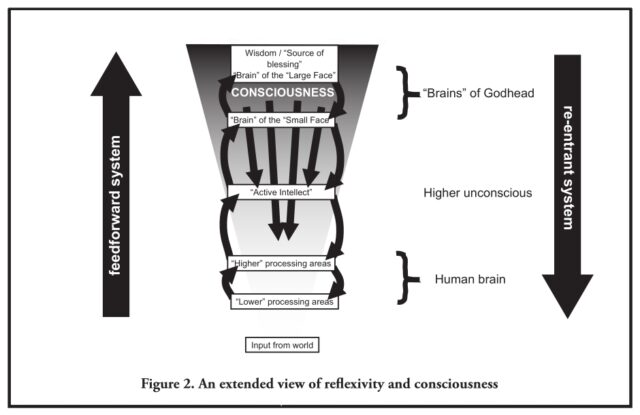
Rotation of the diagram ninety degrees counterclockwise schematises the tabernacle in its East-West directionality, with a feedforward path from the world/courtyard through the intermediary Active Intellect to the divine presence in the Most Holy Place. With regard to the reentrant path, see Hebrews 9:28 and 13:20. Arrows suggest that there are “strange loops” that emerge across multiple levels between the earthly pole and the heavenly pole.
The diagram comes from Brian L. Lancaster, “The Cognitive Neuroscience of Consciousness, Mysticism and Psi,” International Journal of Transpersonal Studies 30 (2011), 18, and is discussed on 17–19. It is licensed under CC BY-NC-ND 4.0.
Appendix 2
Architecture of the Tabernacle
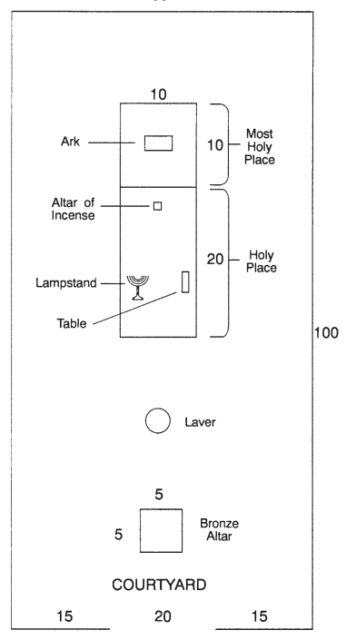
In this vertical orientation of the tabernacle, the Most Holy Place is spontaneously associated with both heaven and a human head as cognitive operation centres. At the same time, the Most Holy Place is the nucleus of a cell that is delimited by the Holy Place and dynamically engaged in information processing. (Numbers indicate length in cubits.)
The diagram comes from Vern S. Poythress, The Shadow of Christ in the Law of Moses (Brentwood, TN: Wolgemuth & Hyatt, 1991), 17. It is used with permission from P&R Publishing, Phillipsburg, NJ.
Appendix 3
Architecture of a Eukaryotic Cell
In a single-celled eukaryotic organism, the nucleus and the nucleolus are isomorphic to the Most Holy Place and the ark of the covenant. The former structures contain a description of the organism in genetic material, and the latter structures contain a description of the tabernacle on stone tablets and in a book, per table 1 in the body of this article.
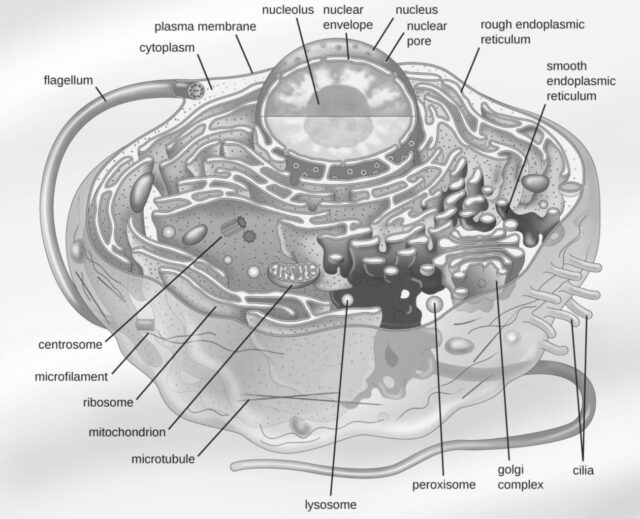
The illustration comes from Rosanna Hartline, Microbiology Laboratory Manual (LibreTexts Project, 2024), 1.16.2, https://commons.libretexts.org/book/bio-79229. (Colour in the original has been converted to greyscale.) It is licensed under CC BY-NC-SA 4.0.
Appendix 4
Architecture of the Holographic Universe
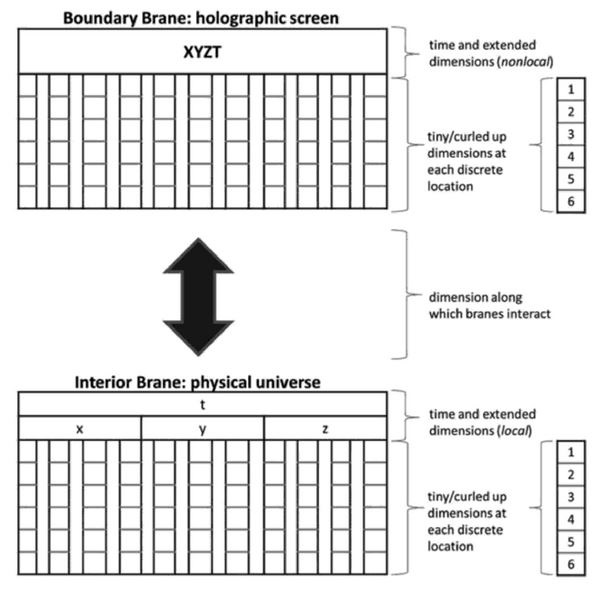
This diagram depicts two interacting branes of the holographic universe according to M-theory. Non-physical probability waves (also called wave functions, interpreted as genotypes or design plans or Platonic forms) exist on the “heavenly” boundary brane, while spatiotemporal physical structures (phenotypes) exist on the “earthly” interior brane.
The diagram comes from Melvin A. Felton, Jr., Universe Within: The Surprising Way the Human Brain Models the Universe (Washington: Iff Books, 2021), 90, and is discussed on 87–91. It is used with permission from John Hunt Publishing Limited.
Appendix 5
Strange Loop Model of Bipolar-Relational Unity
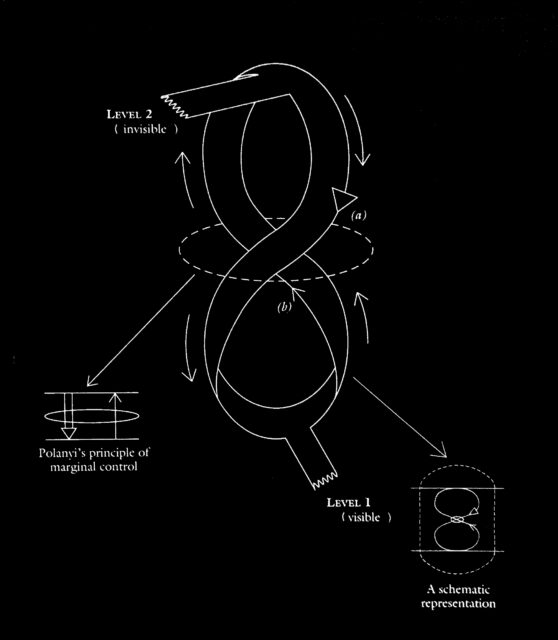
The Möbius band illustrates the relationship between the cosmological domain (level 1) and the cognitive domain (level 2). The diagram comes from James E. Loder and W. Jim Neidhardt, “Barth, Bohr, and Dialectic,” in Religion and Science: History, Method, Dialogue, ed. W. Mark Richardson and Wesley J. Wildman (New York: Routledge, 1996), 274. It is adapted and used with permission from Taylor & Francis Group.
Appendix 6
Strange Loop in the Tabernacle
| Heavenly Domain | Curtain | Earthly Domain |
|---|---|---|
| Cognitive Domain | ∞ | Cosmological Domain |
| Implicate Order | ∞ | Explicate Order |
| Most Holy Place | ∞ | Holy Place |
| Invisible | ∞ | Visible |
| Genotype | ∞ | Phenotype |
| Description | ∞ | Construction |
| Bit | ∞ | It |
| Software | ∞ | Hardware |
| Symbol | ∞ | Matter |
| Original | ∞ | Copy |
| Archetype | ∞ | Model |
| Imaged | ∞ | Image |
| Observed | ∞ | Observer |
| Mystery | ∞ | Revelation |
| Unknown | ∞ | Known |
| Uninterpreted | ∞ | Interpreted |
| Encoded | ∞ | Decoded |
| Mind | ∞ | Body |
| Subject | ∞ | Object |
| Thought | ∞ | Word |
| Referent | ∞ | Expression |
| Concept | ∞ | Percept |
| Form | ∞ | Instance |
| Ground | ∞ | Figure |
| Source | ∞ | Manifestation |
This table depicts the strange loop that unites the heavenly domain and the earthly domain by inhabiting the tabernacle. As a bipolar-relational unity, the two domains are inseparable in both the heavenly tabernacle and the earthly tabernacle. The dualities have been compiled from the theological, philosophical, and scientific sources cited throughout this article.
The strange loop is a pattern that is found in biological and cosmological contexts, among many others, including subatomic physics. See James E. Loder and W. Jim Neidhardt, The Knight’s Move: The Relational Logic of the Spirit in Theology and Science (Colorado Springs, CO: Helmers & Howard, 1992), 12–13, 46, 170–181, 189–191.
The author reports there are no competing interests to declare.
Received: 16/12/25 Accepted: 12/05/26 Published: 14/10/26
© 2026 Ed Haymond. This work is licensed under a Creative Commons Attribution-NonCommercial-ShareAlike 4.0 International Licence (CC BY-NC-SA 4.0), except where otherwise stated.
Notes
[1] For an attempted defence of the materiality of the heavenly tabernacle, see Luke Woo, The Spatiotemporal Eschatology of Hebrews: Priestly Participation in the Heavenly Tabernacle (London: T&T Clark, 2024), especially 133–135. To neutralise bias and leave room for objective scrutiny of “earth” and “heaven,” this article uses “domain” instead of “place” whenever possible. “Domain” still has a connotation of three-dimensional physical space, but it opens a route to alternatives, especially a high-dimensional zone such as a field or a state space that can be explored mathematically or philosophically or introspectively.
[2] As Adams has it, “To a significant degree, the author’s cosmological assertions are intertwined with his Christological claims, so that one could not jettison his cosmology without doing serious damage to his Christology.” Edward Adams, “The Cosmology of Hebrews,” in The Epistle to the Hebrews and Christian Theology, ed. Richard Bauckham et al. (Grand Rapids, MI: Eerdmans, 2009), 138. According to Moffitt, “One’s understanding of so many elements of this homily, particularly when examining Hebrews’ language of and about heavenly realities, depends on an account of the author’s implicit understanding of the structure and makeup of reality.” David M. Moffitt, “Human Beings and Angels in Hebrews and Philo of Alexandria: Toward an Account of Hebrews’ Cosmology,” in Son, Sacrifice, and Great Shepherd: Studies on the Epistle to the Hebrews, ed. David M. Moffitt and Eric F. Mason (Tübingen: Mohr Siebeck, 2020), 13.
[3] William G. Johnsson, “Issues in the Interpretation of Hebrews,” Andrews University Seminary Studies 15, no. 2 (1977), 187.
[4] Johnsson, “Issues,” 175.
[5] Johnsson, “Issues,” 179.
[6] Johnsson, “Issues,” 185.
[7] For example, the statement that “you have come to Mount Zion and to the city of the living God, the heavenly Jerusalem … and to God” (12:22–23), if interpreted as a communal weekly experience of bodily relocations, would be bizarre, so apparently it is a place that is not geographic or atmospheric. Even researchers who advert to reports of corporeal heavenly ascent typically emphasise heaven’s radical otherness, so trips are infrequent. Thus, for Moore, “While heaven is somewhere humans can enter, it is also a place to which most people cannot go, and to which even special people may not normally go, and it is thus a place which needs special conditions or enabling in order to enter. … The transformation of human flesh in order to enter heaven is a commonplace in various early Jewish and Christian apocalypses.” Nicholas J. Moore, “Temple, Cosmology, and Myth in the New Testament,” Tyndale Bulletin 76 (2025), 90.
[8] Adams, “The Cosmology of Hebrews,” 122.
[9] Adams, “The Cosmology of Hebrews,” 122. Like Adams, Jon Laansma, “Hidden Stories in Hebrews: Cosmology and Theology,” in A Cloud of Witnesses: The Theology of Hebrews in Its Ancient Contexts, ed. Richard Bauckham et al. (London: T&T Clark, 2008), 9–18, uses “cosmos” and “creation” interchangeably. Nevertheless, Laansma concentrates on the destiny of the cosmos rather than on its structural division into two separate places. See also Edward Adams, “Graeco-Roman and Ancient Jewish Cosmology,” 5–27 and Jon Laansma, “The Cosmology of Hebrews,” 125–143, in Cosmology and New Testament Theology, ed. Jonathan T. Pennington and Sean M. McDonough (New York: T&T Clark, 2008).
[10] Adams, “The Cosmology of Hebrews,” 131–132. Adams, at 134, refers to heaven as a “location” but does not attempt to explain why the heavenly domain is imperceptible even though it is currently accessible. A similar issue is found in three other articles: David H. Wenkel, “Sensory Experience and the Contrast Between the Covenants in Hebrews 12,” Bibliotheca Sacra 173 (2016): 219–234; Scott D. Mackie, “‘Let Us Draw Near … But Not Too Near’: A Critique of the Attempted Distinction between ‘Drawing Near’ and ‘Entering’ in Hebrews’ Entry Exhortations,” in Listen, Understand, Obey: Essays on Hebrews in Honor of Gareth Lee Cockerill, ed. Caleb T. Friedeman (Eugene, OR: Wipf and Stock, 2017), 17–36; Nicholas J. Moore, “Heaven’s Revolving Door? Cosmology, Entrance, and Approach in Hebrews,” Bulletin for Biblical Research 29, no. 2 (2019): 187–207.
[11] Adams, “The Cosmology of Hebrews,” 133. This claim begs the question of how τὸν τύπον was “shown” to Moses (Exodus 25:40; Hebrews 8:5). At 132, Adams says that “[i]t was believed by some ancient Jews that Moses was actually given a glimpse of the heavenly sanctuary when he was on Mount Sinai,” but δείκνυμι has a semantic range that includes “make known” or “explain” (BAGD, 172), so it is possible that Moses acquired the design plan of the tabernacle from the intelligible world as a description (corresponding to the verbal non-pictorial format of Exodus 25–40), rather than by visual perception of a physical structure. Similarly, see Hebrews 11:27: Moses was “seeing Him who is unseen.” For analysis, see Georg Gäbel, “Reading ‘According to the Revelation Shown to Moses’: A Study of the Influence of the LXX Text on Patristic Biblical Interpretation,” in New Avenues in Biblical Exegesis in Light of the LXX, ed. Leonardo Pessoa da Silva Pinto and Daniela Scialabba (Turnhout: Brepols, 2022), 303–326.
[12] Adams, “The Cosmology of Hebrews,” 132, 134, 138. For other instances, see Ardel B. Caneday, “God’s Parabolic Design for Israel’s Tabernacle: A Cluster of Earthly Shadows of Heavenly Realities,” The Southern Baptist Journal of Theology 24, no. 1 (2020): 103–124.
[13] For Roederer, a living system can be defined as a “system capable of information-driven interactions,” so “[l]ife is information at work.” J. G. Roederer, Information and Its Role in Nature (Berlin: Springer, 2005), 120, 160 (emphasis original). Given the numerous dualities in Hebrews (discussed later in this article), there is special relevance in the fundamental dualism that is manifested in every organism as a combination of a design plan and the structure that it specifies; it is “the unity of [invisible] genotype and [visible] phenotype,” points out Gennadiy Zhegunov, The Dual Nature of Life: Interplay of the Individual and the Genome (Berlin: Springer, 2012), 11.
[14] Paul Ellingworth, “Jesus and the Universe in Hebrews,” The Evangelical Quarterly 58, no. 4 (1986): 337–350.
[15] Ellingworth, “Jesus and the Universe,” 340.
[16] Ellingworth, “Jesus and the Universe,” 348.
[17] Ellingworth, “Jesus and the Universe,” 349 (emphasis original).
[18] Ellingworth, “Jesus and the Universe,” 350.
[19] Ellingworth, “Jesus and the Universe,” 350.
[20] R. B. Jamieson, “When and Where Did Jesus Offer Himself? A Taxonomy of Recent Scholarship on Hebrews,” Currents in Biblical Research 15, no. 3 (2017): 338–368.
[21] Jamieson, “When and Where,” 339.
[22] Jamieson, “When and Where,” 339.
[23] Woo justifiably asserts that the quiddity of the heavenly tabernacle must be addressed before there can be progress on “the question of how the heavenly tabernacle is being used in Hebrews” (The Spatiotemporal Eschatology of Hebrews, 14; emphasis original). It would be easy to suppose that one could know where Jesus’ entry to the heavenly tabernacle belongs on the priestly timeline without knowing anything about the tabernacle itself. However, that would foreclose various alternative timeline assignments. If, as this article proposes, the heavenly tabernacle is a mind (either discrete or collective) and Jesus enters it for the purpose of cleansing, then arguably that cleansing is an operation that is customised for various circumstances and therefore occurs at many times and in many ways surrounding his once-for-all-time death. This points to the need to bring the atonement act or sequence into alignment with the doctrine of progressive sanctification. Benjamin J. Ribbens, “Ascension and Atonement: The Significance of Post-Reformation, Reformed Responses to Socinians for Contemporary Atonement Debates in Hebrews,” Westminster Theological Journal 80, no. 1 (2018), 15–16, shows efforts by Johannes Cocceius and John Owen in that direction, which distinguish between the act of sacrificial atonement and its application to believers. Also relevant is Richard M. Davidson, “Christ’s Entry ‘Within the Veil’ in Hebrews 6:19–20: The Old Testament Background,” Andrews University Seminary Studies 39, no. 2 (2001), which on 186–188 provides evidence that the cleansing mentioned in 9:23 has a background in both the one-time inauguration event and the annual Yom Kippur event. Furthermore, an account of heavenly tabernacle cleansing needs to address the manner by which it is able to affect believers who lived before the old covenant, believers who lived before the new covenant, and believers who have not yet been conceived. These considerations show that a covert philosophy of mind accompanies the Hebrews atonement conversation.
[24] Jamieson, “When and Where,” 347, 349.
[25] For perspectives on influential correctives from two leading physicists (Arthur Eddington and John Wheeler), see Ian T. Durham and Dean Rickles, eds, Information and Interaction: Eddington, Wheeler, and the Limits of Knowledge (Cham: Springer, 2017). Consciousness is also indispensable for Alexei V. Nesteruk, “The Universe as a Saturated Phenomenon: The Christian Concept of Creation in View of Modern Philosophical and Scientific Developments,” Theology and Science 12, no. 3 (2014): 236–259.
[26] This view is proffered with full awareness that “[s]cholarship (at least English-speaking) now largely concurs that while Hebrews uses language which evokes Platonist concepts, it does not subscribe to a Platonist worldview” (Nicholas J. Moore, “Sacrifice, Session, and Intercession: The End of Christ’s Offering in Hebrews,” Journal for the Study of the New Testament 42, no. 4 (2020), 522 n. 2). However, it also recognises that biblical scholars sometimes mischaracterise Platonism due to naïveté in metaphysics. This article does not endorse any particular conclusion regarding the degree of overlap between the cosmologies of Plato, Philo of Alexandria, and the author of Hebrews. (For an overview of that debate, see Jeremy Punt, “Hebrews, Thought-Patterns and Context: Aspects of the Background of Hebrews,” Neotestamentica 31, no. 1 (1997): 125–134.) Rather, it emphasises one point on which they would agree: cosmology is never solely concerned with spatiotemporal entities if some of them are able to seek knowledge, because their thoughts constitute or represent a separate domain that is populated by abstract objects such as the ruliad. See Stephen Wolfram, Metamathematics: Foundations & Physicalization (Champaign, IL: Wolfram Media Inc., 2022), 221–272. Christian philosophers have laboured to formulate an account of abstract objects that does not compromise classical divine attributes. See, for example, William Lane Craig, God Over All: Divine Aseity and the Challenge of Platonism (New York: Oxford University Press, 2016). For application of Christian Platonism to modern cosmology, see Alexei V. Nesteruk, Light from the East: Theology, Science, and the Eastern Orthodox Tradition (Minneapolis: Fortress Press, 2003), especially 39–40, 194–248.
[27] Thus, the view advocated in this article is distinguished from one that is informed primarily by apocalyptic texts with an emphasis on a temporal/horizontal axis. It is also distinguished from one with an emphasis on a spatial/vertical axis. The cosmological domain is at least four-dimensional spacetime, and the intelligible/Platonic domain is not spatially positioned above the perceptible world, pace Caneday, “God’s Parabolic Design” and also Scott D. Mackie, Eschatology and Exhortation in the Epistle to the Hebrews (Tübingen: Mohr Siebeck, 2007), 3–8.
[28] In this article, it is not possible to address the apparent contradiction between the classical doctrine of divine simplicity and the complexity of systems that host large dynamic software structures. However, mind-like attributes have been discovered in numerous natural structures, so the range of systems that can host lesser deities may be enormous. See the positioning of panpsychism as a viable option in Robert Lawrence Kuhn, “A Landscape of Consciousness: Toward a Taxonomy of Explanations and Implications,” Progress in Biophysics and Molecular Biology 190 (2024): 28–169. Meanwhile, the classical doctrine of divine immateriality has been challenged from several directions, with suggestions that divinity is invariably deployed in hardware. See, for example, Daniel O. McClellan, YHWH’s Divine Images: A Cognitive Approach (Atlanta: SBL Press, 2022); Gary A. Anderson, “Towards a Theology of the Tabernacle and Its Furniture,” in Text, Thought, and Practice in Qumran and Early Christianity, ed. Ruth A. Clements and Daniel R. Schwartz (Leiden: Brill, 2009), 161–194; Stephen Webb, Jesus Christ, Eternal God: Heavenly Flesh and the Metaphysics of Matter (Oxford: Oxford University Press, 2012); Elijah Nicolas Mueller, “The Word is an Angel of the Mind: Angelic and Temple Imagery in the Theology of John Mansur, The Damascene” (PhD diss., Marquette University, 2014).
[29] According to Boyd, “the reference to the son being appointed by God as heir of all things (1:2) has more to do with reaching the purposed destiny of humanity than his unique and eternal position as the one and only Son of God.” Rick Boyd, “The Use of Psalm 8 in Hebrews,” in Listen, Understand, Obey: Essays on Hebrews in Honor of Gareth Lee Cockerill, ed. Caleb T. Friedeman (Eugene, OR: Wipf and Stock, 2017), 11.
[30] For Lee, “the letter has a particular interest in Adam, especially in the author’s appeal to Ps. 8 in Heb. 2:6–10.” Jihye Lee, A Jewish Apocalyptic Framework of Eschatology in the Epistle to the Hebrews: Protology and Eschatology as Background (London: T&T Clark, 2022), 1.
[31] For a full investigation, see George H. Guthrie and Russell D. Quinn, “A Discourse Analysis of the Use of Psalm 8:4–6 in Hebrews 2:5–9,” Journal of the Evangelical Theological Society 49, no. 2 (2006): 235–246.
[32] As Cockerill has it, “Hebrews 8:1–10:18 is the pastor’s grand ‘symphony’ on the sacrifice of Christ.” Gareth Lee Cockerill, The Epistle to the Hebrews (Grand Rapids, MI: Eerdmans, 2012), 71.
[33] Cockerill says regarding the “heavenly calling” of 3:1 that “[w]ith this phrase, the pastor orients them toward their destiny,” which implies that the calling is a summons to heaven (The Epistle to the Hebrews, 158). However, its proximity to the vocation of dominion in 2:5–8 suggests that “heavenly calling” is a reiteration of that vocation. Otherwise, humanity’s vocation would drop out of sight, leaving those who are saved with no clear purpose. Boyd challenges the notion that salvation is a final goal rather than a strategy: “If God’s purpose is unchanging, what happened to God’s purpose for humanity at creation? Has it been completely abandoned?” (“The Use of Psalm 8 in Hebrews,” 9).
[34] Gregory K. Beale, “Eden, the Temple, and the Church’s Mission in the New Creation,” Journal of the Evangelical Theological Society 48, no. 1 (2005): 5–31.
[35] For example, 2 Samuel 7:5–7.
[36] Brian L. Lancaster mentions this as an epistemological principle rather than a condition of spatial occupancy. See his “The Cognitive Neuroscience of Consciousness, Mysticism and Psi,” International Journal of Transpersonal Studies 30 (2011), 22 n. 13, https://doi.org/10.24972/ijts.2011.30.1-2.11. However, a conceptual connection between “indwelling” and “informing” can permit one to grapple with the intricate biblical scenario of God as both occupant and place (e.g., Psalm 90:1, in saying that God is a dwelling place, reverses the theme of other places hosting God). This connection is supplied by the thesis that “information leads to communication, which in turn leads to transformational processes”—as Niels Henrik Gregersen has it. See his “‘The God with Clay’: The Idea of Deep Incarnation and the Informational Universe,” Zygon 58, no. 3 (2023), 689 (emphasis original). Hence, one can envision a cybernetic occupant modifying a place merely by its presence, which corresponds to a change performed by “active information,” or “activity of form,” as opposed to a mechanical “activity of substance.” See an analysis of the work of physicist and philosopher David Bohm by Paavo T. I. Pylkkänen, Mind, Matter, and the Implicate Order (Berlin: Springer, 2007), 181–205.
[37] See relevant discussions in Cockerill, The Epistle to the Hebrews, 29 n. 119 and 35 n. 148; Punt, “Hebrews, Thought-Patterns and Context,” 135–137. For Schenck, “special knowledge of God” is an important “dimension of sonship” in Hebrews and related literature such as Philo’s corpus and Wisdom of Solomon. See Kenneth Schenck, “Keeping His Appointment: Creation and Enthronement in Hebrews,” Journal for the Study of the New Testament 66 (1997), 102–104 (see also 104–115 for analysis of the use of σοφία and λόγος).
[38] For example, human “hearts” frequently went astray under the old covenant (3:10); humans are often ignorant and misguided (5:2); humans can be enlightened (6:4); humans can have knowledge of the truth (10:26). The transformation from old to new described in 8:10 and 10:16 is concomitant with depositing information into “minds” and “hearts” rather than into the Most Holy Place of the earthly tabernacle.
[39] For example, a human must monitor the “heart” to ensure that it does not fall away from the living God (3:12).
[40] For the rationale behind the translation of συνείδησις as “consciousness,” see Joshua D. A. Bloor, Purifying the Consciousness in Hebrews: Cult, Defilement and the Perpetual Heavenly Blood of Jesus (London: T&T Clark, 2023), 6–16. For convenience, there will be no attempt here to distinguish between a cognitive engine (consciousness as mind) and the domain that the engine explores (consciousness as container). Other important issues such as segmentation of consciousness into divine, human, and nonhuman subdomains are also beyond the scope of this article; the cognitive domain is treated here as a single realm in which all minds participate.
[41] Bogdan G. Bucur, “The Other Clement of Alexandria: Cosmic Hierarchy and Interiorized Apocalypticism,” Vigiliae Christianae 60 (2006), 259.
[42] Bucur, “The Other Clement,” 262.
[43] Bucur, “The Other Clement,” 265.
[44] Bucur, “The Other Clement,” 267–268. Similarly, the spiritual teachings of Evagrius Ponticus were hidden in cosmological discourse in order to exercise his students. See Doru Costache, “A Note on Evagrius’ Cosmological and Metaphysical Statements,” The Journal of Theological Studies 71, no. 2 (2020): 718–730.
[45] Mikel Burley, “Conundrums of Buddhist Cosmology and Psychology,” Numen 64 (2017), 344.
[46] Burley, “Conundrums,” 344.
[47] Burley, “Conundrums,” 353.
[48] Burley, “Conundrums,” 346.
[49] Burley, “Conundrums,” 354.
[50] Adam Afterman, “From Philo to Plotinus: The Emergence of Mystical Union,” Journal of Religion 93, no. 2 (2013), 180.
[51] Afterman, “From Philo to Plotinus,” 185–186, 190.
[52] Afterman, “From Philo to Plotinus,” 192–194.
[53] For exposition of the role of the mind in contemplative ascent to God, see Scott D. Mackie, “Seeing God in Philo of Alexandria: The Logos, the Powers, or the Existent One?” Studia Philonica Annual 21 (2009): 25–47; Mackie, “Heavenly Sanctuary Mysticism in the Epistle to the Hebrews,” The Journal of Theological Studies 62, no. 1 (2011): 77–117; Mackie, “Seeing God in Philo of Alexandria: Means, Methods, and Mysticism,” Journal for the Study of Judaism 43 (2012): 147–179.
[54] Perhaps it is not coincidental that movement of the curtain at the Most Holy Place and movement of the stone at the garden tomb resemble an eclipse.
[55] For example, Gert J. Steyn, “Hebrews’ Angelology in the Light of Early Jewish Apocalyptic Imagery,” Journal of Early Christian History 1, no. 1 (2011), 151–152, 157.
[56] Steyn, “Hebrews’ Angelology,” 153–155.
[57] For analysis of the laws of nature as algorithms, see Mauro Dorato, The Software of the Universe: An Introduction to the History and Philosophy of Laws of Nature (Aldershot: Ashgate, 2005), 36–44.
[58] Swinson shows that, because angels are interchangeable with “natural elements of creation,” a traditional bifurcation of the cosmos into natural and supernatural categories is problematic. See L. Timothy Swinson, “‘Wind’ and ‘Fire’ in Hebrews 1:7: A Reflection Upon the Use of Psalm 104 (103),” Trinity Journal 28NS (2007), 219–223. Still, he retains the distinction, even while admitting on 225 that it cannot be decisively grounded in grammatical features. See also Steyn, “Hebrews’ Angelology,” 148–151.
[59] Pace Jason A. Whitlark, “Cosmology and the Perfection of Humanity in Hebrews,” in Interpretation and the Claims of the Text: Resourcing New Testament Theology, ed. Jason A. Whitlark et al. (Waco, TX: Baylor University Press, 2014), 117–128. Whitlark is aware of the view that the cosmos will be transformed, but pessimistically sides with the opposing view that it will be annihilated. Describing the transformation as “miraculous” (128) suggests that it is brought about entirely and instantly by God, but that scenario does not align with the time-oriented thesis “that, according to Hebrews, God has structured the creation for the training and the perfection of his children” (117). It also neglects the possibility that renewal of the mind will lead to renewal of the cosmos during a historical process of working out salvation for both domains.
[60] For a model of how this could occur, see Harvey Cawdron, “The Regeneration of the Cosmic Mind: Cosmopsychism, Mental Chaos, and the New Creation,” Religious Studies 61, no. 4 (2025): 811–827.
[61] For an exploration of how the “paradox” of the form/matter union is resolved via the human as “embodied consciousness” within the cosmos, see Alexei V. Nesteruk, “Universe, Incarnation, and Humanity: Thomas Torrance, Modern Cosmology, and Beyond,” Participatio 4 (2013): 213–239.
[62] James W. Thompson, “‘That Which Cannot Be Shaken’: Some Metaphysical Assumptions in Heb 12:27,” Journal of Biblical Literature 94, no. 4 (1975): 580–587; Thompson, “The Conceptual Background and Purpose of the Midrash in Hebrews VII,” Novum Testamentum XIX, fasc. 3 (1977): 209–223; Thompson, “Hebrews 9 and Hellenistic Concepts of Sacrifice,” Journal of Biblical Literature 98, no. 4 (1979): 567–578.
[63] Harold W. Attridge, “The Uses of Antithesis in Hebrews 8–10,” Harvard Theological Review 79 (1986): 1–9.
[64] Thompson’s habitual use of “sphere” when talking about a category is therefore regrettable, because it is a term that connotes a “spatial framework” for the dualities (“The Conceptual Background,” 214, 216, 217, 218), and thereby undermines his intention to speak about an “order” (τάξις, not τόπος: see 216 n. 25).
[65] Moore, “Heaven’s Revolving Door,” 207.
[66] As Kline points out, “For the interpretation of ‘the heavens’ of Genesis 1:1 as the invisible heavens and their hosts, see Nehemiah 9:5ff.; (cf. Ps. 103:19f.); Psalm 148:1–4; Colossians 1:16. Note also that as the Genesis 1 account continues, the visible heavens emerge as a derivative of what is called ‘the earth’ in verses 1 and 2.” Meredith G. Kline, “Creation in the Image of the Glory-Spirit,” Westminster Theological Journal 39, no. 2 (1977), 250 n. 2.
[67] Kline, “Creation,” 254, says that the “world of the Glory theophany is a dimensional realm normally invisible to man”; it is “the invisible (or ‘third’) heaven brought into cloud-veiled visibility.” According to the rigid dualism of Hebrews, such a conversion from software to hardware is an impossible category switch. Still, Kline comes tantalisingly close to affirming that a theophany straddles an ontological boundary as immanentised software. Hence, his biblical theology has a valuable nascent metaphysics.
[68] The temple inauguration text functions as a mirror, demonstrating that God’s dwelling place is reflective: because the cognitive domain is the “place” where linguistic processing occurs, the conceptualisation of God’s dwelling place happens within God’s dwelling place. See Albert Kamp, “The Conceptualization of God’s Dwelling Place in 1 Kings 8: A Cognitive Approach,” Journal for the Study of the Old Testament 40, no. 4 (2016), 419–423, 430 n. 33.
[69] Leonardo G. Nunes, “Function and Nature of the Heavenly Sanctuary/Temple and its Earthly Counterparts in the New Testament Gospels, Acts, and the Epistles: A Motif Study of Major Passages” (PhD diss., Andrews University, 2020) is an excellent compilation of biblical data on the heavenly tabernacle, but its complaints about “spiritualising” are tendentious. Aurelian Botica, “Philo of Alexandria and the Epistle to the Hebrews on the Concept of the Spiritualization of the Cult,” Perichoresis 21, sup. 1 (2023): 40–66, erases the derogatory tone from “spiritualisation” by showing that “reinterpretation” is a more suitable term for a process that began in the OT and continued in the NT.
[70] Beale, “Eden,” 16–18. See also L. Michael Morales, The Tabernacle Pre-Figured: Cosmic Mountain Ideology in Genesis and Exodus (Leuven: Peeters Publishers, 2012).
[71] Lancaster, in order to prevent misunderstanding of “lower” and “higher,” says bluntly that “[t]here is no spatiality in the psyche” (“The Cognitive Neuroscience,” 21 n. 10). Beale provides five points to support the view that “the Holy of Holies represented the invisible heaven where God and his angels dwelt,” but does not discuss the cognitive domain vis-à-vis “the invisible heavenly dimension that was separated from the physical [dimension]” (“Eden,” 16).
[72] For development of this idea, see William A. Dembski, Being as Communion: A Metaphysics of Information (New York: Routledge, 2016).
[73] Gregersen, “The God with Clay,” 705. See also Alexei V. Nesteruk, “From Deep Incarnation to Deep Anthropology: Hypostatic Union and the Universe in the Image of Imago Dei,” Theology and Science 21, no. 1 (2023): 81–95.
[74] If the earthly tabernacle carries the genuine divine image then it cannot be classified as an idol. Its exclusive pattern therefore justifies its exemption from the prohibition against making “any likeness of what is in heaven above” (Exodus 20:4).
[75] Vern S. Poythress, The Shadow of Christ in the Law of Moses (Brentwood, TN: Wolgemuth & Hyatt, 1991), 30.
[76] Poythress, The Shadow of Christ, 33.
[77] Lydia Schumacher, “The Trinity and Christian Life: A Broadly Thomistic Account of Participation,” New Blackfriars 96, no. 1066 (2015): 649–651; Andrew Robinson, “Representation and Interpretation as the Basis of Participation in the Trinity,” Religions 6 (2015): 1017–1023, 1028–1030.
[78] The biblical language of filial imaging could be misleading if not interpreted in the theological context of an apostolic high christology. Colossians 1:15–20 is a showpiece: its discourse on the Son as the “icon of the invisible God” (1:15) appears as a kernel in Hebrews 1:3. There, the Son is said to be a reproduction (χαρακτήρ: BAGD, 876). Hence, the Son images the Father exactly rather than approximately. The image has all of the life and self-knowledge of the imaged, but the two persons are not confused. By stark contrast, the output from all other imaging systems is a result of discarding large amounts of information about the original. A hologram typically conserves more information about the imaged entity than would a photograph or a painting, but the image of God must finally be living and conscious (Acts 17:29; cf. 1 Peter 2:5). Robinson, “Representation and Interpretation,” 1028–1030, therefore maintains that a biosemiotic model of God overcomes some of the limitations and distortions of other proposals.
[79] Similarly, see perspectives on the relationship between description and construction in Anthony Aguirre et al., eds., It From Bit or Bit From It? On Physics and Information (Cham: Springer, 2015), especially Ovidiu Cristinel Stoica, “The Tao of It and Bit,” 51–64.
[80] Douglas R. Hofstadter, I Am a Strange Loop (New York: Basic Books, 2007), 102.
[81] For more on the topic, see the semiotics of philosophers George Herbert Mead and Charles Sanders Peirce. According to Wiley, “Mead defined the self as that which can be an object to itself … making it the only thing in experience that is both subject and object. This was his notion of reflexivity … Peirce’s idea of the self was different from, although compatible with, Mead’s. His self was a sign or word.” Norbert Wiley, “History of the Self: From Primates to Present,” Sociological Perspectives 37, no. 4 (1994), 527. For a stimulating exploration of the idea that “self-intelligibility is a manifestation of the Universe, within ourselves,” because there is a primordial self-referential system that copies itself, see Christine C. Dantas, “The Ultimate Tactics of Self-referential Systems,” in Trick or Truth? The Mysterious Connection Between Physics and Mathematics, ed. Anthony Aguirre et al. (Cham: Springer, 2016), 199, emphasis original.
[82] See appendix 1 for an illustration of how “the ‘earthly’ (lower) and ‘heavenly’ (higher) spheres include features that do bring them into alignment with their proposed neurocognitive counterparts,” as Lancaster (“The Cognitive Neuroscience,” 17) has it.
[83] Church’s view of the heavenly sanctuary is imprecise because its ontological category is treated ambiguously. On the one hand, he speaks of the heavenly tabernacle as a state of affairs that will exist when God permanently dwells with humans. On the other hand, he speaks of it as a structure or place where God and humans meet; see Nicholas J. Moore, “‘The True Tabernacle’ of Hebrews 8:2: Future Dwelling with People or Heavenly Dwelling Place?” Tyndale Bulletin 72 (2021), 51 n. 7.
[84] Philip Church, Hebrews and the Temple: Attitudes to the Temple in Second Temple Judaism and in Hebrews (Leiden: Brill, 2017), 435; quoted in Moore, “The True Tabernacle,” 51.
[85] Moore, “The True Tabernacle,” 54–55.
[86] Moore, “The True Tabernacle,” 55.
[87] Moore, “The True Tabernacle,” 55.
[88] Moore, “The True Tabernacle,” 62.
[89] Moore, “The True Tabernacle,” 67. The place of God’s dwelling before the heavenly tabernacle was “built” is thus left as an open question. The classical doctrine of divine aseity implies that God is self-contained.
[90] Philip Church, “‘The True Tabernacle’ of Hebrews 8:2: A Response to Nicholas J. Moore,” Tyndale Bulletin 75 (2024): 1–30, despite its length and details, did not result in a synthesis of their respective views.
[91] The old covenant tabernacle is categorised by the adjective κοσμικόν (9:1) rather than οὐράνιον.
[92] Moore is on the right track when he recognises that Moses was shown a pattern, not necessarily “an actual heavenly structure” (“The True Tabernacle,” 56), but he does not consistently maintain the ontological distinction between a pattern and an instantiation of the pattern. By way of comparison, see Stephen’s emphasis on historical reverence for the earthly tabernacle and temple (Acts 7:44–50), which he uses to set up his accusation that members of his audience hypocritically destroyed the true tabernacle (Acts 7:51–53). More precisely, they inflicted as much damage as possible to the instantiated pattern because they were unable to apprehend the intangible pattern. The episode ends with Stephen apprehending two powers in “heaven” (Acts 7:54–56), as per appendix 1.
[93] R. B. Jamieson, “Hebrews 9.23: Cult Inauguration, Yom Kippur and the Cleansing of the Heavenly Tabernacle,” New Testament Studies 62 (2016), 569.
[94] Jamieson, “Hebrews 9.23,” 572–580.
[95] Jamieson, “Hebrews 9.23,” 582.
[96] “[A] bloody mess does not empirically clean anything,” says Michael B. Hundley, Keeping Heaven on Earth: Safeguarding the Divine Presence in the Priestly Tabernacle (Tübingen: Mohr Siebeck, 2011), 24 (quoted in Bloor, Purifying the Consciousness, 104).
[97] An alternative way to glimpse this shortcoming in Jamieson’s proposal is by consideration of a smart building, which can be cleansed in two ways. The physical components can be washed, but that does nothing to cleanse malicious software that the building may be hosting. The latter cleansing must involve changing a pattern rather than changing a material substance. For an overview of smart building technologies, see Adrian Taboada-Orozco et al., “Smart Buildings: A Comprehensive Systematic Literature Review on Data-Driven Building Management Systems,” Sensors 24, no. 13 (2024): 4405, https://doi.org/10.3390/s24134405.
[98] For example, F. F. Bruce, The Epistle to the Hebrews (Grand Rapids, MI: Eerdmans, 1964), 218–219.
[99] Jamieson, “Hebrews 9.23,” 583–585. By contrast, see an introduction to the problem of the location of consciousness (i.e., the self-symbol “I”) in Hofstadter, I Am a Strange Loop, 259–274.
[100] Bloor, Purifying the Consciousness, 77–79, provides evidence that 2:14–15 is a statement of fulfilment of Jewish expectation that the messiah would be an exorcist. Consequently, episodes in which unclean spirits are expelled from their human dwelling places can be interpreted as previews of Jesus entering and cleansing the entire cognitive domain. For discovery and bypass of many problems that arise when the heavenly realm is associated with the cosmological domain instead of the cognitive domain, see Robert Cook, “Devils & Manticores: Plundering Jung for a Plausible Demonology,” in The Unseen World: Christian Reflections on Angels, Demons, and the Heavenly Realm, ed. Anthony N. S. Lane (Grand Rapids, MI: Baker, 1996), 165–184.
[101] This point also applies to Bloor, Purifying the Consciousness, which does not enlist 3:6 as an aid to determining the nature of the heavenly tabernacle, nor its potential to clarify “house of God” in 10:21. Bloor believes that “both the συνείδησις and the heavenly tabernacle” are purged (96, emphasis original), and that “purging the heavenly tabernacle results in the purification of the συνείδησις” (98), but fails to explain how action in one domain leads to action in the other domain. If “sin and defilement in Hebrews stretch to the heavens” from humans on Earth like an “aerial miasma” (26; see also discussion of 9:23 on 53–54), then it seems that Jesus’ heavenly blood (79) would also need to cross back to Earth to reach its target, because νεκρῶν ἔργων are in συνείδησις (9:14; see discussion on 50–51). Similarly, see William L. Lane, Hebrews 9–13 (Dallas: Word Books, 1991), 247, which speaks about sin as “infectious” and spreading from “the individual” to “heavenly reality” but gives no account of its transport. Presumably, he intends to refer to the propagation of corrupt patterns. Meanwhile, Bloor on 98 conjectures that there is a human ability to monitor the condition of the heavenly tabernacle from a distance, but a parsimonious explanation is that consciousness is the monitoring of the mind.
[102] Jamieson, “Hebrews 9.23,” 585.
[103] See appendix 2 and appendix 3 for architectural diagrams of the tabernacle and a eukaryotic cell. Cella is the Latin term for the inner chamber of Greek and Roman temples, where altered states of consciousness enabled encounter with the divine and heightened awareness of the self. See Christopher Bardt, The Feeling of Space (Cambridge, MA: MIT Press, 2024), 17–23. After the invention of the microscope, cella was used to refer to the biological structures that were discovered with that instrument. The label transfer was apt due to the geometrical similarities between temples and cells, but the cell was not recognised as an information processor until the middle of the twentieth century.
[104] For details of these processes as a strange loop phenomenon in molecular biology, see Douglas R. Hofstadter, Gödel, Escher, Bach: An Eternal Golden Braid, twentieth-anniversary ed. (New York: Basic Books, 1999), 495–548. Hofstadter’s exposition is far removed from biblical considerations, yet he says that “DNA, the ruler of the cell, dwells in its private ‘throne room’: the nucleus of the cell” (517; similarly on 514). Elsewhere, the nucleus is called the “royal chambers” (522), “throne room” (523), and “central throne” (525). Compare the “throne” in heaven (Hebrews 1:8; 4:16; 8:1; 12:2), which is represented by the ark of the covenant. See Georg Gäbel, “‘You Don’t Have Permission to Access This Site’: The Tabernacle Description in Hebrews 9:1–5 and Its Function in Context,” in Son, Sacrifice, and Great Shepherd: Studies on the Epistle to the Hebrews, ed. David M. Moffitt and Eric F. Mason (Tübingen: Mohr Siebeck, 2020), 135–174.
[105] Importantly, Robinson asserts “that not only do creaturely patterns of representation and interpretation offer an analogy for the being of God, but that such patterns reflect the direct and continuous creative work of the Father, Son/Word and Spirit, each actively imprinting their distinctive mark on the structure of the world” (“Representation and Interpretation,” 1023, emphasis original). If the patterns are doing work in the cosmological domain then possibly they are equivalent to λόγοι and divine energies. See Nesteruk, Light from the East, 101–107, 120–121.
[106] Poythress, The Shadow of Christ, 22. His book contains no mention of a cell, but it says that the tabernacle has a “pervasive theme of replication” (90; similarly on 60). For the biblical theology of replicating temples, see G. K. Beale, The Temple and the Church’s Mission: A Biblical Theology of the Dwelling Place of God (Downers Grove, IL: IVP Academic, 2004).
[107] For details, see Peter Shaw and John Brown, “Nucleoli: Composition, Function, and Dynamics,” Plant Physiology 158, no. 1 (2012): 44–51.
[108] Poythress, The Shadow of Christ, 75, emphasis original, referring to Deuteronomy 31:24–26. Presumably the Book of the Law included the design plan of the tabernacle from Exodus 26–27.
[109] See the case presented in Howard H. Pattee, “The Physics and Metaphysics of Biosemiotics,” Journal of Biosemiotics 1 (2005): 281–301.
[110] Michael Polanyi’s epistemology features a “marginal control” principle that governs a system “consisting of two conceptually distinct levels in hierarchical relationship.” The relationship is asymmetrical because—despite reciprocity—the lower level is “subject to dual control by the laws applying to the component particulars in themselves [i.e., the lower level in isolation] and by the distinctive laws that govern the comprehensive entity” (i.e., the lower level yoked to the higher level). See James E. Loder and W. Jim Neidhardt, The Knight’s Move: The Relational Logic of the Spirit in Theology and Science (Colorado Springs, CO: Helmers & Howard, 1992), 54–55. The margin is depicted as the crossover point on the strange loop in appendix 5. For the christological parallel, see Hebrews 10:20 on the role of the curtain as an intersection between visible and invisible domains.
[111] Howard H. Pattee, “The Physics of Symbols: Bridging the Epistemic Cut,” BioSystems 60 (2001), 15.
[112] In classical theism, God is absolutely conscious, and this article proposes that God’s consciousness is grounded in the perichoretic strange loop—the divine image—that Spirit forms between Father/description and Son/construction, as per appendix 1, appendix 5, and appendix 6. It is a pattern that is “imageless,” yet it can be rendered as a Möbius band, and its possession defines likeness to God. See Loder and Neidhardt, The Knight’s Move, 25, 35–59, 292–294. In created systems, levels of consciousness vary according to the way that the divine image is implemented in a particular system and the system’s state at a particular time. In this scenario, attributing consciousness to a cell is justifiable due to the presence of a strange loop between the genotype/description and phenotype/construction. Ex hypothesi, where there is self-reference via embedded design plan there is also consciousness, but individual cells do not have vivid qualia as do some multicellular organisms. This strange loop proposal explains how YHWH as “I AM” is the absolutely unique and living God, with divine image bearers alive in a qualified sense, while idols are mocked as dead things lacking a functional strange loop.
[113] Biologists may need to emulate physicists Michael Faraday and James Clerk Maxwell. In the nineteenth century, they “had to switch from a [prevalent] mechanistic to a dynamic and relational way of thinking” about particles in order to achieve their momentous discoveries about the electromagnetic field (Loder and Neidhardt, The Knight’s Move, 203, 208).
[114] For recent treatises on cell-centred consciousness, see Arthur S. Reber et al., The Sentient Cell: The Cellular Foundations of Consciousness (New York: Oxford University Press, 2023); John S. Torday and Rob G. Sacco, Conscious Life: Bridging Cellular Origins, Quantum Realities, and Cosmic Connections (Cham: Springer, 2025).
[115] František Baluška et al., “Biomolecular Basis of Cellular Consciousness via Subcellular Nanobrains,” International Journal of Molecular Sciences 22 (2021), 1.
[116] Baluška et al., “Biomolecular Basis,” 4.
[117] Baluška et al., “Biomolecular Basis,” 6 (emphasis original). Similarly, for philosopher Søren Kierkegaard, “the nature of the self is a relationship, ‘it is a relation that relates itself to its own self,’ but the self is not yet truly a self until the relationship which is its central constituent reality becomes a positive third term” (Loder and Neidhardt, The Knight’s Move, 206).
[118] Baluška et al., “Biomolecular Basis,” 6.
[119] Baluška et al., “Biomolecular Basis,” 7.
[120] Baluška et al., “Biomolecular Basis,” 7.
[121] Baluška et al., “Biomolecular Basis,” 8.
[122] Baluška et al., “Biomolecular Basis,” 9.
[123] Baluška et al., “Biomolecular Basis,” 6.
[124] A strange loop with self-modelling is called a type II tangled hierarchy (TH-II) in Mikhail Prokopenko et al., “Biological Arrow of Time: Emergence of Tangled Information Hierarchies and Self-Modelling Dynamics,” Journal of Physics: Complexity 6 (2025), 18–23.
[125] Prokopenko et al., “Biological Arrow of Time,” 20.
[126] Prokopenko et al., “Biological Arrow of Time,” 10–16.
[127] Roger Penrose, Shadows of the Mind: A Search for the Missing Science of Consciousness (New York: Oxford University Press, 1994), 411–420.
[128] Hofstadter, Gödel, Escher, Bach, P-4 (emphasis original).
[129] For a full exposition, see Justin E. H. Smith, Divine Machines: Leibniz and the Sciences of Life (Princeton: Princeton University Press, 2011).
[130] See, for example, Larry M. Jorgensen, Leibniz’s Naturalized Philosophy of Mind (New York: Oxford University Press, 2019).
[131] Pylkkänen, Mind, Matter, and the Implicate Order, 134–137.
[132] Pylkkänen, Mind, Matter, and the Implicate Order, 190, 200–205. Bohm envisioned a looping field emanating from a magnet’s two poles, filling all of space (200–201) and necessarily interacting with fields from other selves.
[133] Melvin A. Felton, Jr., Universe Within: The Surprising Way the Human Brain Models the Universe (Washington: Iff Books, 2021), 27–45.
[134] Felton, Universe Within, 49–55.
[135] Felton, Universe Within, 88.
[136] See appendix 4 for a diagram of two interacting branes constituting a single system in a holographic universe. Felton does not explicitly associate genotypes and phenotypes with the two branes, but he acknowledges the transformative power that is released in history when physical systems become isomorphic to symbol systems (Universe Within, 107–116; see also Hofstadter, I Am a Strange Loop, 37–50). On 116, the relationship between the two branes is summarised as follows: “As Above, So Below; As Below, So Above,” but it is a correspondence between domains with different dimensionalities, not a spatial arrangement of them. The bidirectional arrow between the branes suggests the existence of a strange loop that endows the system with consciousness. Similarly, Wheeler’s cosmological model features a participatory universe that is self-referencing: it is a self-excited circuit that is effectively a strange loop. For a sympathetic critique of Wheeler’s proposal, see Nesteruk, Light from the East, 220–226.
[137] For the full mapping in tabular form, see Felton, Universe Within, 232–234. For evidence that a black hole has brain-like functions similar to the nucleus of a cell, see Seyed Hadi Anjamrooz et al., “The Cellular Universe: A New Cosmological Model Based on the Holographic Principle,” International Journal of Physical Sciences 6, no. 9 (2011): 2175–2183.
[138] Felton, Universe Within, 257 (emphasis original). Similarly, Loder and Neidhardt affirm that “the universe mirrors the self-relationality of the observer. Thus, openness ‘at the top’ of the universe (which is confirmed independently by mathematicians, physicists, and cosmologists) may be conceived as a mirror image of the human observer.” This situation grounds human knowledge of the cosmological domain. See The Knight’s Move, 191.
[139] The universe might “manifest a state analogous to the waking state, and during this time, it could function in such a way that the content of its information processing is some form of environmental stimuli and/or conscious internal cognition” (Felton, Universe Within, 277–278). However, the isomorphism indicates that the universe currently manifests a state akin to sleep (281–282).
[140] Felton, Universe Within, 17–23.
[141] Felton, Universe Within, 11.
[142] New initiatives have recently been launched, which suggests that scholars are still trying to produce a holistic interpretation of the epistle. See, for example, Richard M. Davidson, A Song for the Sanctuary: Experiencing God’s Presence in Shadow and Reality (Silver Spring, MD: Review and Herald Academic, 2022); Nicholas J. Moore, The Open Sanctuary: Access to God and the Heavenly Temple in the New Testament (Grand Rapids, MI: Baker Academic, 2024).