


Book reviewed by Samuel McKee, July 2026
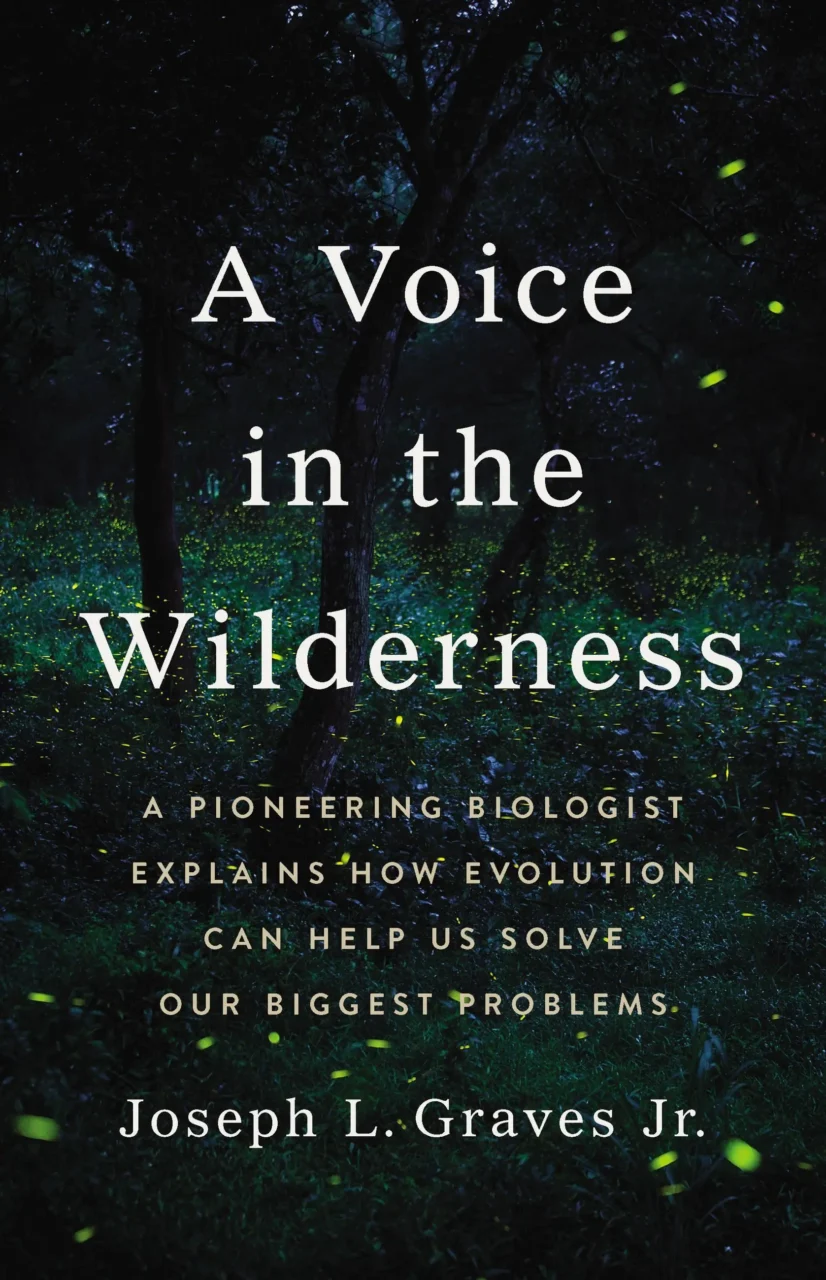
A Voice in the Wilderness: A Pioneering Biologist Explains How Evolution Can Help Us Solve Our Biggest Problems
by Joseph L. Graves Jr.
New York: Basic Books, 2022; 375 pages
ISBN 9781541600713, first edition, hardcover
AU$60
No bookshelf covering the history of evolutionary biology in the twentieth century, or the American relationship between Christianity and evolution, should be without this fine work by Dr Joseph Graves. Graves’s work A Voice in the Wilderness is part autobiography, part religious reflection on the relationship between science and religion, and part outline of how evolutionary biology is vital to dealing with some of the biggest political and cultural challenges of our time. Graves’s voice is unique as he was the first African American to earn a PhD in evolutionary biology (p. 2). His experiences will shock and awe, and his words carry the weight of those experiences and his extraordinary contribution to the field.
He states from the beginning that “the discipline of evolutionary biology is a perspective we dare not ignore” (p. 2) and warns that the “cost of ignoring evolutionary science may be the extinction of the human species” (p. 3). From first to last page, he is aware of the unpopularity of what he may say to a host of audiences, but the book reads as the work of an authority with fierce conviction who has earned the right to be heard by all.
There is more than can be said in this brief review, so aside from my commending this book to all inside and outside of the life sciences or history of science, I shall confine my focus to its value to the science and religion literature. He states early his rejection of the conflict thesis (p. 9), and throughout he calls all to build a culture that values evidence and scientific reasoning across all perspectives (p. 10). Graves credits his early “wrestling with God” as what brought him to understand science in the first place (p. 13).
The book is worth reading for Graves’s autobiography alone. Wrestling is a key theme throughout: with faith, with the immense challenges of racial injustice (especially within the sciences), with blazing a trail as the first in his field, with balancing his academic career with social activism, and, later, with standing for evolutionary biology as a Christian against the force of creationism. His journey is inspiring and will challenge all readers, who are certain to find disagreement with something, not least the force of his convictions. Dr Graves writes as an academic at peace with having stood all his life for truth and does not mind offending anyone as he has already paid cost after cost on his journey.
The book is littered with interesting and often gripping anecdotes. The role that learning chess played in his mental and social development (p. 23), the inspiration of Star Trek in his choosing science (p. 24), his return to faith, being anointed the “Black Darwin” by other students (p. 108), and his incredible journey of contributing immensely to the study of the evolution of ageing and the field of parasitism.
If you are familiar with the history of evolutionary biology, you cannot help but be struck by the lineage of Graves. His career overlapped with most of the biggest names of the second half of the twentieth century and the early twenty-first. His professional influences and collaborations see him crossing paths with Richard Lenski (p. 36), Stephen Jay Gould, Michael Rose, John Maynard Smith, Francisco Ayala, William Hamilton, Peter and Rosemary Grant (p. 61), and many others.
I wish to highlight two instances of influence. First, Richard Lewontin (p. 74) is a constant connection in the book and is famous for his atheism. His infamous quote regarding keeping a divine foot out of the door for the sake of materialism is a favourite of intelligent design apologists. It speaks volumes that Lewontin, who is held up as the poster boy for evolutionary biology being anti-Christian, is such a close ally and partner with a phenomenal Christian evolutionary biologist in Graves. It defeats the case immediately. Second, Graves illustrates his academic lineage (p. 116) of how his teachers shaped his science. Names jump off the page including Thomas Hunt Morgan, J. B. S. Haldane, Brian Charlesworth (p. 117) and Theodosius Dobzhansky. Dobzhansky, one of the major players in the birth of the modern synthesis and himself an outspoken Eastern Orthodox Christian, is given significant time in this book and his influence is profound. This book is illuminating in its clear presentation of his value to the field and his influence on those who carried on both his work and his legacy. Graves is an outstanding demonstration of this which should be greatly appreciated.
Part Two of the book deals with “Why Evolution Matters”, and it is here Graves spends most of his energy on religion. Chapter 9 “Relax: Evolution is a fact but it doesn’t tell us anything about the existence of God” (p. 173) is a gem for any researcher on the history of this matter. His frank writing style is perfect for summation of the conflict over creationism in the USA. Graves’s personal testimony of returning to faith is interesting, as is his treatment of issues such as higher criticism, church leadership on the conflict, and his experiences with atheism and creationism. He shares anecdotes which give a unique window into how a prominent religious evolutionary biologist balances the activism with personal relationships. He gives insight into dealings with creationists including Ken Ham and Kent Hovind (p. 184), the trials in Kansas, Louisiana, and Arizona over teaching evolution in schools, as well as confrontations with both Democrats and Republicans.
I am grateful for his work with Francis Collins (p. 181) and BioLogos (p. 188). Graves is a gift to the field. A Voice in the Wilderness does many things at once, but its value to the evolution–religion dialogue has a unique place that is befitting the title.