


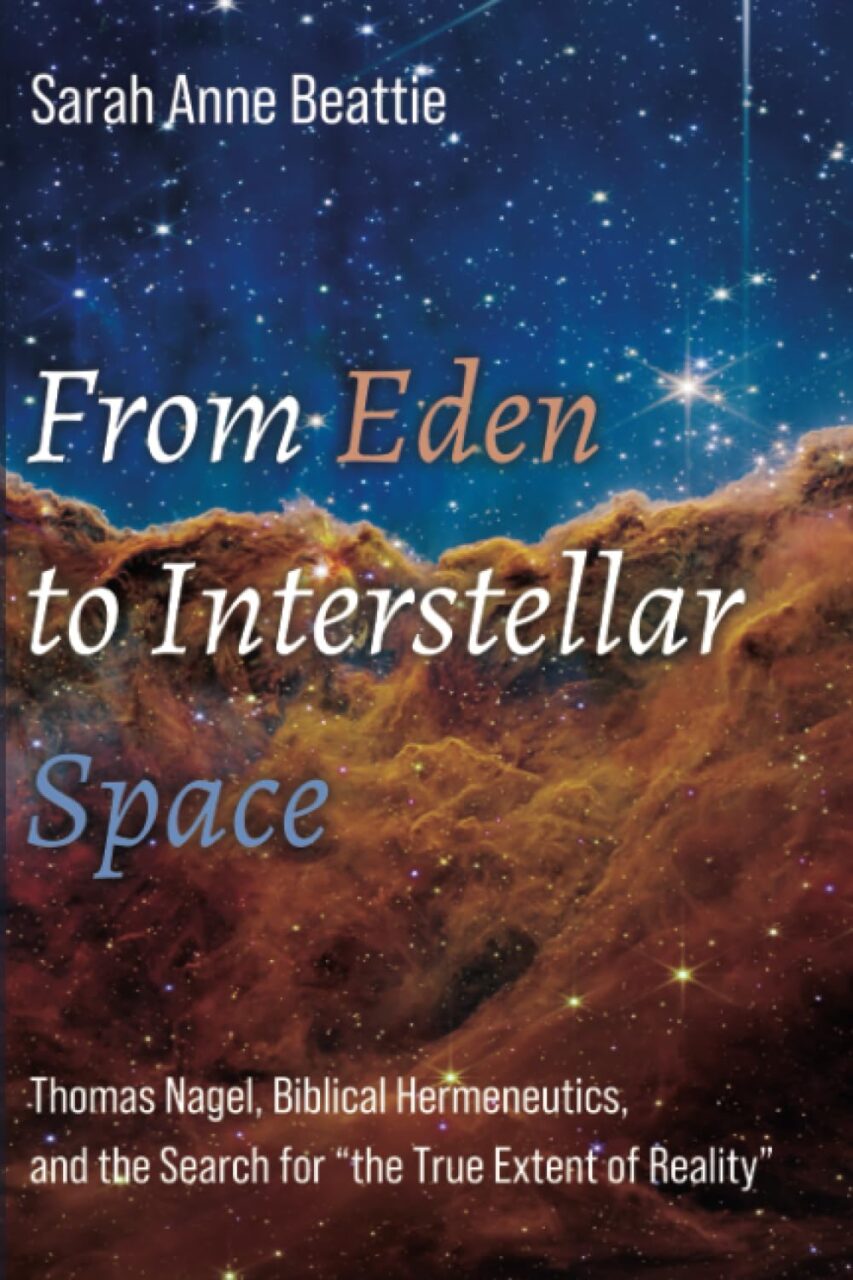
Book reviewed by Samuel McKee, April 2026
From Eden to Interstellar Space: Thomas Nagel, Biblical Hermeneutics, and the Search for “the True Extent of Reality”
by Sarah Anne Beattie
Eugene, Oregon: Pickwick Publications, Wipf and Stock, 2025, 288 pages
ISBN 9798385205394, first edition, paperback
AU$58
Thomas Nagel became a thinker for serious engagement in science and religion when his Mind and Cosmos: Why the Materialist Neo-Darwinian Conception of Nature Is Almost Certainly False was released in 2012. Like many, I was urged to read it and think through the implications of this non-religious philosopher questioning many sceptical perspectives on theism based on recent discoveries across the sciences. The intelligent design movement immediately made him its champion, and many outside the sciences hailed the downfall of materialism. A decade and a half later, the engagement continues as serious questions remain for dialogue with theology and philosophy. Sarah Anne Beattie has contributed a large, thorough volume opening many of these questions for theology, and it is a quality contribution to the Nagel discussion.
There is no denying Nagel has become a crucial interlocutor. Nagel, Emeritus Professor of Philosophy and Law at New York University, gained his doctorate at Harvard before holding positions at Princeton University and the University of California, Berkeley. Though an analytic philosopher rather than a scientist, he is a member of the American Academy of Arts and Sciences. His research focus is on philosophy of mind and epistemology, with his breakthrough work being his 1974 “What Is It Like to Be a Bat?” in The Philosophical Review. This seemingly innocuous question made a tremendous impact on the field. His position ever since has been that accounting for mind from the position of materialism is impossible. However, rather than convert to theism, he has pushed for non-religious approaches to the problem of a non-physical basis for ultimate reality. Beattie presents a deep engagement with his work for theology. Her main challenge is that there is a considerable amount of material to engage with and some of the book understandably feels like heavy wading.
From Eden to Interstellar Space is an ambitious and creative intervention in the science–theology conversation. From Nagel’s criticism of reductive materialism, Beattie develops the constructive proposal that biblical hermeneutics and modern cosmology, rather than being in competition, together disclose a richer account of “the true extent of reality.” This book will satisfy those tired of scientistic reductionism and superficial efforts at harmonising science and faith.
Beattie frames her argument around two interconnected concerns: the fragmentation of relationships between humans and the natural world, and the inadequacy of existing secular frameworks to address this crisis. Her case is that humanism, whilst ethically serious, lacks the metaphysical depth necessary to ground an adequate response. In contrast, Christian theology—understood through a revitalised hermeneutical lens—provides conceptual resources able to complement scientific accounts of the world whilst expanding their interpretive horizon.
Nagel serves as foil and dialogue partner. Beattie utilises his critique of materialism, especially his argument that consciousness, reason, and value are unable to be fully accounted for under physicalism. Nagel infamously argued in Mind and Cosmos, “the materialist neo-Darwinian conception of nature is almost certainly false” (Oxford University Press, 2012, p. 128). This was not because science is mistaken, but because it is explanatorily incomplete. Beattie uses this critique to make conceptual space for theological interpretation whilst presenting Nagel as an ally (whether this was his intention or not) in combatting reductionism. She also points to his earlier case (from “What Is It Like to Be a Bat?”) that subjective experiences resist objective reduction. This philosophical grounding is one of the book’s main strengths because it locates the conversation in mainstream analytic debates, as opposed to confining it to intra-theological discourse.
Moving on, Beattie makes her case for an expanded account of biblical hermeneutics. Holy Scripture is treated neither as a cluster of proto-scientific claims nor as myth empty of cognitive content. Rather, it is presented as a mode of truth-disclosure operating alongside (and in conversation with) scientific inquiry. Modern physics is interpreted as pointing to indeterminacy and relationality, and having epistemic limits. Beattie suggests that this resonates with theological claims about creation, transcendence, and the inexhaustibility of reality. Her claims come close to those made by the likes of Sir John Polkinghorne and Alister McGrath. Her distinctiveness comes in her explicit engagement with philosophical criticisms of materialism and her sustained attention to hermeneutics. At the centre is her case that both science and the religious text must be read with an awareness of their domains and an openness to a deeper ontological horizon.
I have only a few concerns. One is the risk of treating the complex physics of the past century in a broadly interpretive manner rather than with the technical rigour of the mathematical physicist. This is understandable, and it is a philosophical book after all. However, readers with a background in physics or philosophy of science may occasionally be frustrated with the discussion being insufficiently discriminating, especially where contested interpretations of quantum theory are employed to support theological claims. One can contrast this with the recent work of Dr Emily Qureshi-Hurst. Science may function more as a source of suggestive metaphors. However, this is occasional.
Similarly, some may have these concerns over the hermeneutical aspects. I am attracted to Beattie’s call to make the Bible “less familiar,” and her critique of reductive readings is appreciated. However, not all will love her constructive proposal. The book would have been too large if it featured more sustained exegetical case studies demonstrating how this approach reshapes interpretation of specific biblical texts. Nevertheless, there is need here for more, as without them the hermeneutical framework can appear aspirational.
Another potential issue is Nagel himself. Whilst Nagel’s criticisms of materialism are deployed effectively, more attention could be given to the numerous responses to Nagel from philosophy of mind and especially evolutionary theory. After all, there is a reason Nagel is a darling of intelligent design advocates. Consequently, Beattie’s arguments may appear to rely on Nagel’s highly contested philosophical position without sufficiently engaging his critics. Perhaps a more discursive engagement would strengthen Beattie’s case.
However, these concerns are relatively minor. Beattie’s core insight is compelling. Her insistence that science and theology are not rival accounts but complementary modes of engagement with a layered reality offers a constructive alternative to both conflict and concordist models that is a welcome addition to the conversation. Furthermore, this is framed not only as an abstract epistemological claim but also as one with ethical implications, especially in relation to ecological responsibility and the human role within creation. In this, it is timely and especially valuable.
I welcome From Eden to Interstellar Space as a strong theological and philosophical contribution advancing the conversation whilst offering serious questions for further exploration. It is a quality interdisciplinary work and a worthy addition to the science–theology space.