


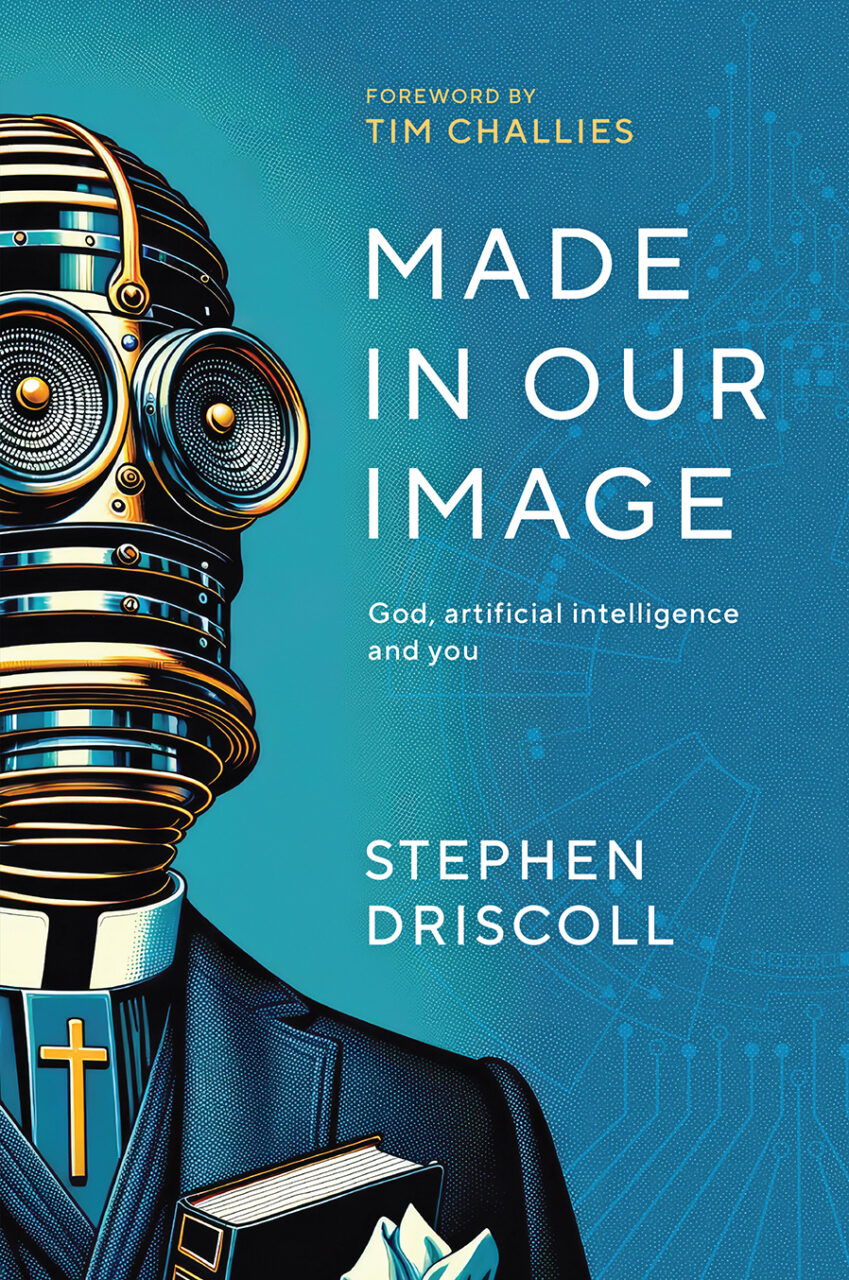
This review of Made in Our Image complements two others in Vol. 5 of CPOSAT: Michael Collie’s review and Daniel Lowe’s review.
Book reviewed by Charles Sherlock, May 2026
Made in Our Image: God, artificial intelligence and you
by Stephen Driscoll
Sydney: Matthias Media, 2024; 190 pages
ISBN 9781922980199, first edition, paperback
AU$20
This book offers a vivid picture of the power and danger of AI, and some insights for a personal Christian response. Stephen Driscoll is well-read on the history of technology and its influence on human life, as the book’s Appendix shows. The opening two chapters are a very readable introduction to the rapidly increasing influence of AI on daily life. But from there on I was frustrated reading this book. While the back blurb states that the book “shows how the deepest structures of biblical thought will equip Christians to live with AI,” I did not find this to be the case.
Four thematic chapters take up creation, sin, cross, and new creation. The first half of each outlines some aspect of current Western life in the light of AI. These are engaging, but some analyses are debatable (for example, is “identity” the actual focus of current Western culture?). Biblical texts related to each theme are then taken up in response.
By God’s grace I remain an orthodox Christian and continue to affirm the ultimate authority of the Scriptures in all matters of faith and life. But I see two major difficulties in these four chapters. On the one hand, biblical texts are dealt with too easily and read in a way that sets aside large parts of the canon. On the other, the world beyond “church” is viewed negatively, without reference to common grace, general revelation, or God’s providence. To claim that “grace is the opposite of nature” (p. 127) is too strong; it sets redemption and creation against one another. Thomas Aquinas’s famous phrase, “grace does not destroy nature but perfects it” (Summa Theologiae I,1,8,2, a phrase built on by the Elizabethan Reformed theologian Richard Hooker), immediately came to mind.
As regards biblical texts, one example is how “image of God” (Gen 1:26–28) is taken up in the creation chapter (these biblical texts are discussed in my The Doctrine of Humanity, Chapters 1 and 2). The emphasis here is placed on humans being contrasted with animals but with no reference to “sixth day solidarity” (Gen 1:24–31). And while the divine plural “us” is rightly seen as significant, that “man” (sic) is “male and female” is not discussed until the Appendix. The next chapter, on sin, has useful insights into the dangers of AI. However, is it true that “the doctrine that all people are sinful is key”? That humans generally “have sinned” is true (so Rom 3:23), but “sinful” goes too far. Likewise, is it true that “evil is infinite” (p. 120)? Such an extreme claim risks discouraging hope and fostering strongly negative attitudes towards God’s world.
Yes, the Scriptures describe God as passionate about evil and sin. Yes, the Lord Jesus was our representative and substitute in atoning for sin, an act of costly divine love. But an over-emphasis on the cross as punishment runs close to seeing God as a son-abuser. Human wisdom is indeed called to account by the cross (so 1 Cor 1:18, cited), but the treatment here misses the Scriptures’ considerable wisdom literature, from Joseph to Job—biblical reflections on the ambiguities of life. And the discussion of modernism, “postmodernism,” and “consensus optimists” reads to me as if nothing worthy is to be found in these movements, or in the long tradition of moral reflection.
The chapter on new creation is nicely entitled “Drawn together in love.” Biblical insights are taken up after 20 pages, focussed on the motif “kingdom of God,” though surprisingly little attention is given to its use by Jesus. As well, the tension in the New Testament between God’s reign having arrived and yet to come is, perhaps, resolved too easily, with a strong emphasis on “arrived.” There are wise words encouraging individual Christians to live now in the hope of being part of God’s final loving community, but little if anything is said about the hope of new heavens-and-earth, a new universe.
The final chapter sketches a number of responses to AI: have healthy cynicism, beware of cheating, invasion of privacy, and losing your job. Then come three pages of “Practical tips”: Value relationships, not just efficiency; Information is not wisdom; Don’t underestimate the new technology; Look for the positives (for church activities); and Cultivate resilience but don’t expect control. I have set out the full list, which I am glad to endorse, but I believe they are also held—and lived—by many people and institutions of good will.
Overall, my sense is that this book sees the world through “oppositional” eyes. It is as if Christians in the West live in a bubble outside of which all is lost. I have a good number of friends and neighbours who are not churchgoers but who live worthwhile and thoughtful lives; I did not recognise them in the way non-Christians are depicted.
To conclude, while the book presents a clear portrayal of both the promise and peril of AI, offering thoughtful insights for a personal Christian response, I am reluctant to recommend it to readers who are not thoroughly confident in their faith. My concern is that the theological work may de-skill some readers for living for Christ in today’s world because too much of its message is built on fear. Further, the book offers nothing to help churches, which are advised to be “restricting AI or perhaps excluding AI from our lives” (p. 112), or to assist government policy, business practice, or community groups. And, from an apologetic perspective, the negative way in which the book depicts God’s world may discourage people from following up the hints of things transcendent, which they sense in and around them.