


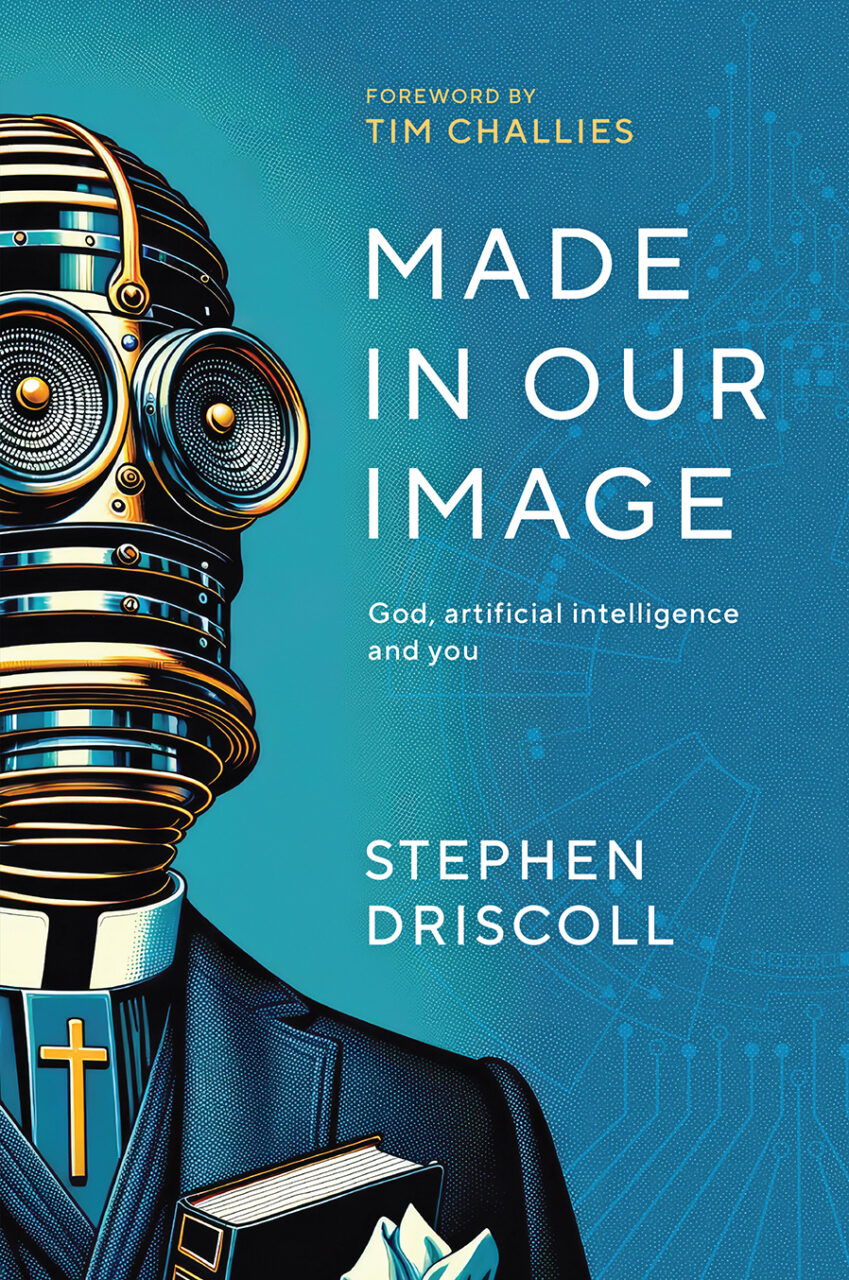
This review of Made in Our Image complements two others in Vol. 5 of CPOSAT: Charles Sherlock’s review and Daniel Lowe’s review.
Book reviewed by Michael Collie, May 2026
Made in Our Image: God, artificial intelligence and you
by Stephen Driscoll
Sydney: Matthias Media, 2024; 190 pages
ISBN 9781922980199, first edition, paperback
AU$20
Stephen Driscoll is a staff worker with the Australian Fellowship of Evangelical Students. His book Made in Our Image is an introduction to the theological and philosophical issues raised by artificial intelligence.
Reading Made in Our Image has helped me in three ways.
First, Driscoll shows that humans have an eternal and invincible identity that is not determined by what technology can or cannot do. When we position “god” as the explanation for phenomena we cannot currently explain, god occupies a negative space. As science advances, a god of the gaps shrinks. God becomes a cipher for our ignorance. The chief objection to this approach is that it creates a false dichotomy between science and faith.
Likewise, when we define humanity by what other creatures and technology cannot do, humanity occupies a negative space. As biology and technology advance, a humanity of the gaps shrinks. What makes us human? Intelligence? Wisdom? Creativity? Sarcasm? Morality? For our friends, colleagues, and neighbours who have a utilitarian view of humanity, AI brings crisis and anxiety.
Like God, we have power and agency. Like God, we want to love and be loved. However, what makes us human is not our capability, capacity, or yearning. The Bible tells us that our humanity is defined by our relationship with our Creator and Saviour. Because we are created in the image of God and are being recreated in the likeness of his Son, we occupy a place that is not determined by what technology can or cannot do. The AI revolution presents a great opportunity to proclaim the good news.
Second, Driscoll provides a realistic view of AI. The Bible tells us that we know good from evil, and that we are capable of choosing evil and inclined to do so. We are not just flawed but rebellious. Because it is made in our image, we can expect technology to make our lives both better and worse. Artificial intelligence is intelligent but it is a consensus of sinners (p. 132). Because it is made in our image, AI will be fallible. Because it is made in our image, AI will both help and hurt us.
Technological revolutions promise one thing but deliver another. Automation promised more leisure but delivered more competitive workplaces and markets. Desktop publishing promised to democratise publishing. However, the technology that enabled everyone to make a book has also enabled a single person to monopolise book distribution. Artificial intelligence will lead neither to utopia nor Armageddon. It’s business as usual. The development, regulation, and control of AI will be subject to the politics of power.
Third, while holding that technology may be morally neutral (pp. 82–83), Driscoll warns us of the inevitable harmfulness of AI. The principal harm is the threat AI poses to our relationship with our Creator, with other creatures, and with creation. Driscoll calls this degeneration and deregulation of relationships “unbundling” (pp. 158–159). AI can simulate a conversation with my mother without my mother. AI can simulate intimacy without a lover. Our alienation from creation that was initiated by the Industrial Revolution, and our alienation from the truth that was enabled by online echo chambers, and our alienation from friends that was facilitated by social media, will be made complete by sycophantic AI companions. Because it is made in our image, AI is a mirror rather than a window (pp. 14, 100). AI gives us what we want; it gives us more of who we are.
Made in Our Image: God, artificial intelligence and you delivers what it promises. This is an accessible introduction to the ways AI will change our world and our lives. A three-word executive summary? Become a plumber. “Intellectual and creative work is more directly under threat since AI is already very good at these tasks. The occupations least likely to be replaced by AI are those that are most relational or most physical. If your work requires you to show empathy or wield a hammer, you’ve got a decent chance” (p. 179).
Driscoll is entertaining and sober, but above all, reassuring. We cannot rely on market forces or human kindness to make the right moral calls about the development and implementation of AI, but we can trust the promises of God.
Michael Collie is the national director of SparkLit, which awarded Made in Our Image the Australian Christian Book of the Year in 2025.