


Book reviewed by Paul Mattiske, May 2026
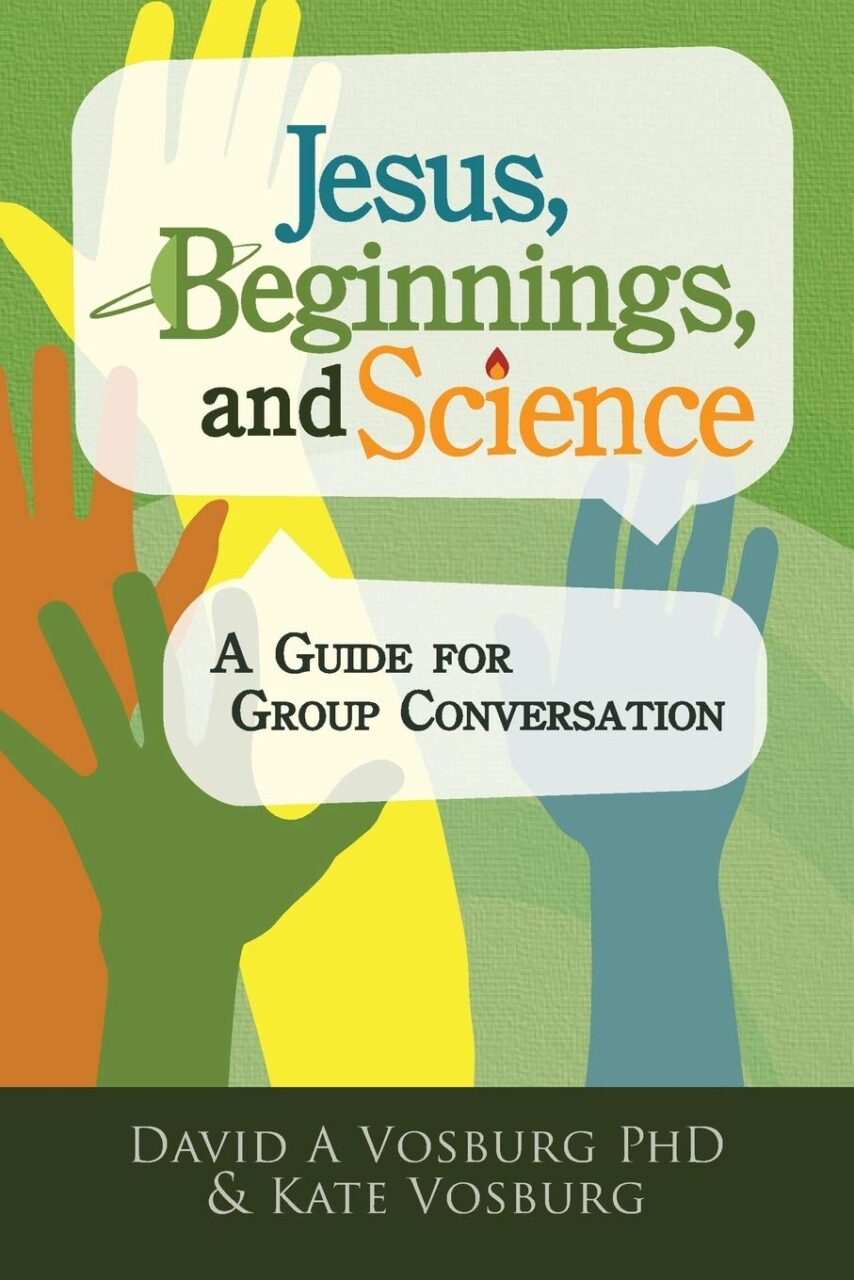
Jesus, Beginnings, and Science: A Guide for Group Conversation
by David A. Vosburg and Kate Vosburg
Farmville, VA: Pier Press, 2017; 101 pages
ISBN 9780996991513, first edition, paperback
AU$26
David and Kate Vosburg’s Jesus, Beginnings, and Science: A Guide for Group Conversation is a study guide designed to facilitate constructive, respectful dialogue about science and faith. David A. Vosburg is a Professor of Chemistry at Harvey Mudd College and an Associate of the Faraday Institute for Science and Religion. Kate Vosburg has been a campus minister since 1999 and holds a Master of Arts in Theology from Fuller Theological Seminary. The aim of the guide is for respectful conversations about the Bible and science to lead Christian university students to increased awe of God’s creation, a better understanding of the Bible, a greater appreciation of science, and confidence to talk to non-Christians. The introduction has real-life stories of Christian students freed from fear of talking to non-Christians about their faith by understanding that faith and science are compatible.
The layout of each chapter (group session) fosters understanding and respectful conversation in the group through prayer, reading selected Bible passages, and discussion. The authors have an effective way of exploring the insights from the Bible passages and the issues that are raised by the current scientific consensus. This is achieved by asking questions to help students discover and state their views, followed by a reflection from David which states important principles, outlines the strengths and weaknesses of alternatives, counters misinformation, gives evocative examples and analogies, and provides statements from respected Christians and prominent believing scientists, past and present.
The suggestions for group leaders state that the reflection from David is only read as a group if time permits, so it would be advantageous to allocate some time for discussion at the beginning of the next chapter. There is further reading at the end of each chapter and additional resources at the end of the study guide representing all points of view. Adding a glossary of terms would aid understanding. There are guidelines for participants to follow so that group leaders can minimise the conflicts that could arise while exploring the topic of faith and science. The authors have found that the concerns of Christian students are more likely to be about Biblical authority than science, so they make the Bible the starting point for discussion.
Part One is entitled “What the Bible says about creation” (Chapters 1 to 4). This part has readings about creation from the Old Testament which develop the theme that God is Creator and sustainer of all things, and worthy of praise for his creation. The biblical creation story differs from others by stating that there is one God, humans are made in the image of God with a special status, and the creation is good.
Part Two (Chapters 5 to 8, “What the Bible says about human origins”) covers the role of language, culture, and literal versus literalistic readings for interpretation. It introduces the important principle that the Bible is about life’s purpose and meaning for people rather than giving scientific descriptions. It points out that science cannot make claims about life’s purpose or about God. It tabulates the differences between young-earth creation, progressive creation, and evolutionary creation models in acknowledgement that Christians have different views about origins and need to keep an open mind to have effective dialogue about the Bible and science. A study guide is recommended with more detail about these three views of origins (Ruth Bancewicz [ed.], Test of Faith: Science and Christianity Unpacked: Study Guide [Milton Keynes UK: Paternoster, 2009]).
Part Three (Chapters 9 to 12, “What the Bible says about science”) argues that effective interpretation needs to consider the role of genre and the original audience. It consolidates the distinction between meaning and mechanism to argue that Christianity and science are not in conflict. An outline of the different views on the relationship between Christianity and science would be relevant, rather than deferring to other resources. Part Three states that human knowledge of Scripture and science is limited and warns against a God-of-the-gaps defence. The authors encourage Christians to understand more about science and the wonders of God’s creation.
To conclude, the supportive environment fostered by the guidelines for the behaviour of participants and the topics covered are effective in meeting the objective of the study guide. I would recommend this study guide to university students who have concerns about the authority of the Bible and its compatibility with science and want to have respectful conversations with non-Christians and scientists, knowing that they can have a career in science and keep their faith.