


Book reviewed by Simon Wayte, March 2026
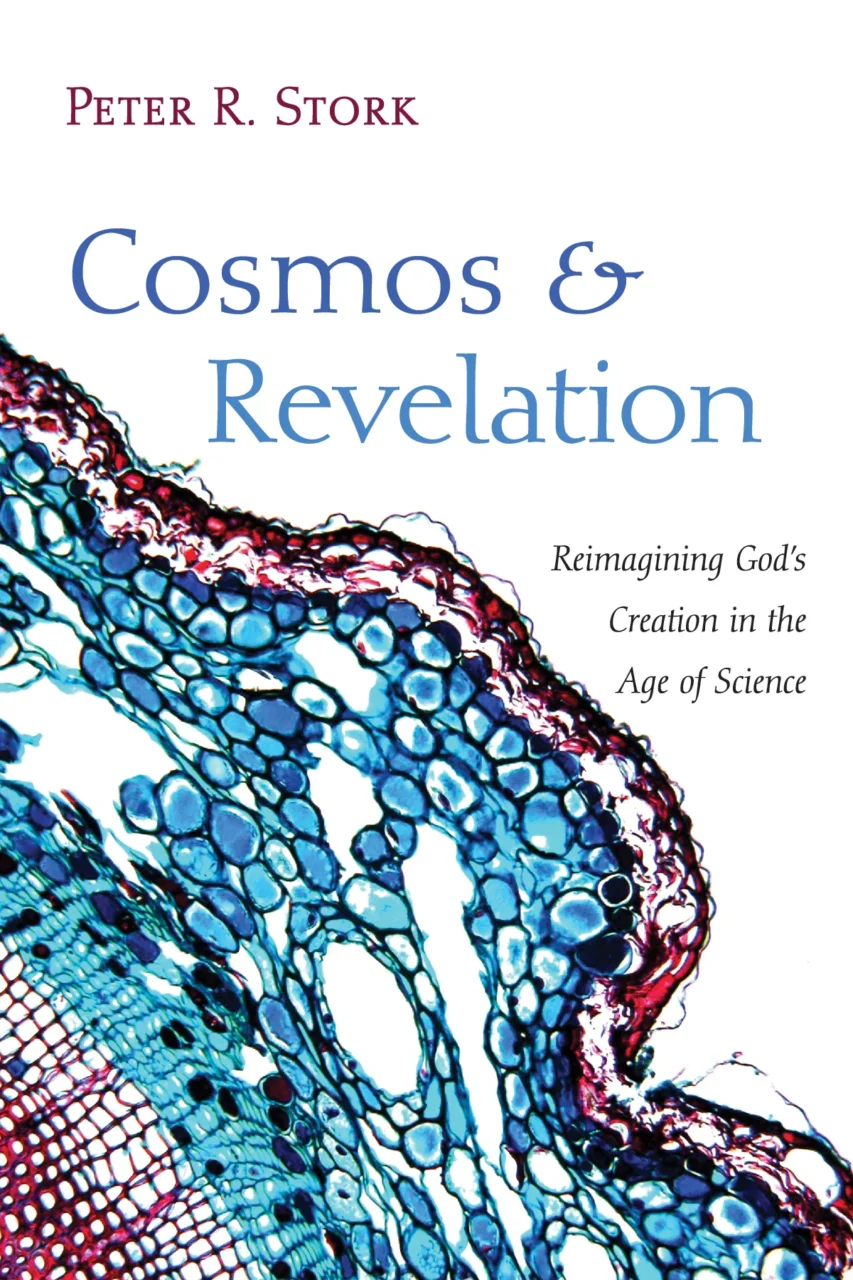
Cosmos & Revelation: Reimagining God’s Creation in the Age of Science
by Peter Stork
Eugene, OR: Wipf & Stock, 2021; 308 pages
ISBN 9781666730272, first edition, paperback
AU$57
Peter Stork has written a very helpful book that situates Christian revelation within a worldview that takes science seriously. It is written for Christians looking for “pastoral support and encouragement reassuring them that in the quest for intellectual integrity in the age of science they are not alone” (p. 6). However, a wider audience could benefit from this book as it lays out a progression of insights in the way a scientific worldview can be in harmony with Christian truths. Stork sets out his book with a single coherent narrative that makes for easy reading with summary conclusions at the end of each chapter. Nevertheless, despite the provision of well-crafted summaries the richness of each chapter should not be skipped.
After an autobiographical introduction Stork begins with the nature of God’s revelation of himself in history and humanity’s response in an evolving world in which scientific truth is progressively emerging. This leads Stork to consider the interpretation of the biblical account of creation which is more about God’s open and dynamic relationship of love with human beings (p. 63) than about any static literal account of how creation came to be. In this developing relationship life and consciousness are understood as emergent properties (p. 92) in a cosmos that unfolds at all levels as an interwoven and undivided whole (pp. 107–9). It is Stork’s contention that the human reality cannot separate itself from this whole and so theology must not neglect engagement with the natural world and its dynamism. With the emergence of the human being the cosmos awakens and starts to know itself and its own inside story (p. 138). In the Christian story, Stork sees the new creation coming about as “a cosmic awakening of love” (p. 121) in which human consciousness is both the place where God reveals himself and the inside story of the cosmos (p. 142). Hence comes the name of the book Cosmos and Revelation. In the plasticity of the brain, the seat of consciousness and our “meaning-making organ” (p. 159), Stork connects the possibility of a change of mind with repentance, connecting the physical with the spiritual. Nevertheless, Stork claims that the inside story of the cosmos is not accessible with the “tools of science” (p. 170). Stork then traverses religious symbolism, monotheism, and the biblical story to reach the heart of the inside story of the universe in the divine love manifest in the crucified Christ (p. 195). In the end, Stork turns to the mimetic theory of René Girard, and in a footnote highlights Girard’s evolutionary anthropology as “a felicitous platform for articulating Christian doctrines for the modern age” (p. 226, note 50). This is the positive heart of Stork’s book and leads him to view the awakening of spiritual realities as part of the cosmic evolutionary unfolding even as these realities “spring from the infinite” (p. 247). In this sense, Stork’s outlook has an incarnational foundation wherein Jesus Christ manifests the revelation of God emerging at the heart of the cosmos. With this narrative Stork cogently makes the case for a Christian theology that takes full cognisance of the contemporary scientific landscape.
Without getting bogged down in the exact detail, Stork mentions that “biological evolution is the organic subset of cosmic evolution” (p. 15). This resonates deeply with the thrust of Thomas Hertog’s book on Stephen Hawking’s final theory, On the Origin of Time. In this book Hertog presents biological evolution within a cosmic evolution in which, at a deeper level, “the physical laws of evolution themselves change and transmute” (On the Origin of Time [Penguin Random House, 2023], p. 144). Stork’s book was published two years before Hertog’s and, resonating with the outlook of John F. Haught (p. 27), shows a profound perceptiveness in light of this cutting edge of scientific cosmology.
Among these positives there are a few points of caution. On a number of small matters Stork gets his facts wrong. When he says, “the sun will have burned out and collapsed into a neutron star” (p. 110) he is manifestly wrong. The sun will end as a white dwarf not a neutron star since its mass is insufficient to collapse to a neutron star. On penal substitution Stork, guided by Bartlett, claims that Ambrose supported this theory of the atonement (p. 218), but that is debated and Catholic theology has always eschewed the idea of penal substitution. Such points do not ultimately detract from Stork’s overall message, but these errors and others like the mention of Herod Antipas dying in 4 CE (p. 249), rather than sometime after 39 CE, are irritating (even Herod the Great died in 4 BCE not 4 CE).
Despite these niggling points, Stork’s book provides a great service to Christians looking for a positive way to engage with the scientific world without losing a solid sense of the Christian faith. This contribution to the science and theology dialogue helpfully provides another avenue of reflection alongside the massive contributions of John Polkinghorne, Arthur Peackocke, and Robert John Russell (p. 257). It is to be hoped that Stork would continue to build upon the foundation he has developed here with a follow up volume outlining in detail further articulation of Christian doctrines along the lines he mentions. Overall, this contribution from Stork is to be highly recommended to all thoughtful readers interested in the dialogue between science and theology.