


Book reviewed by D. Gareth Jones, February 2026
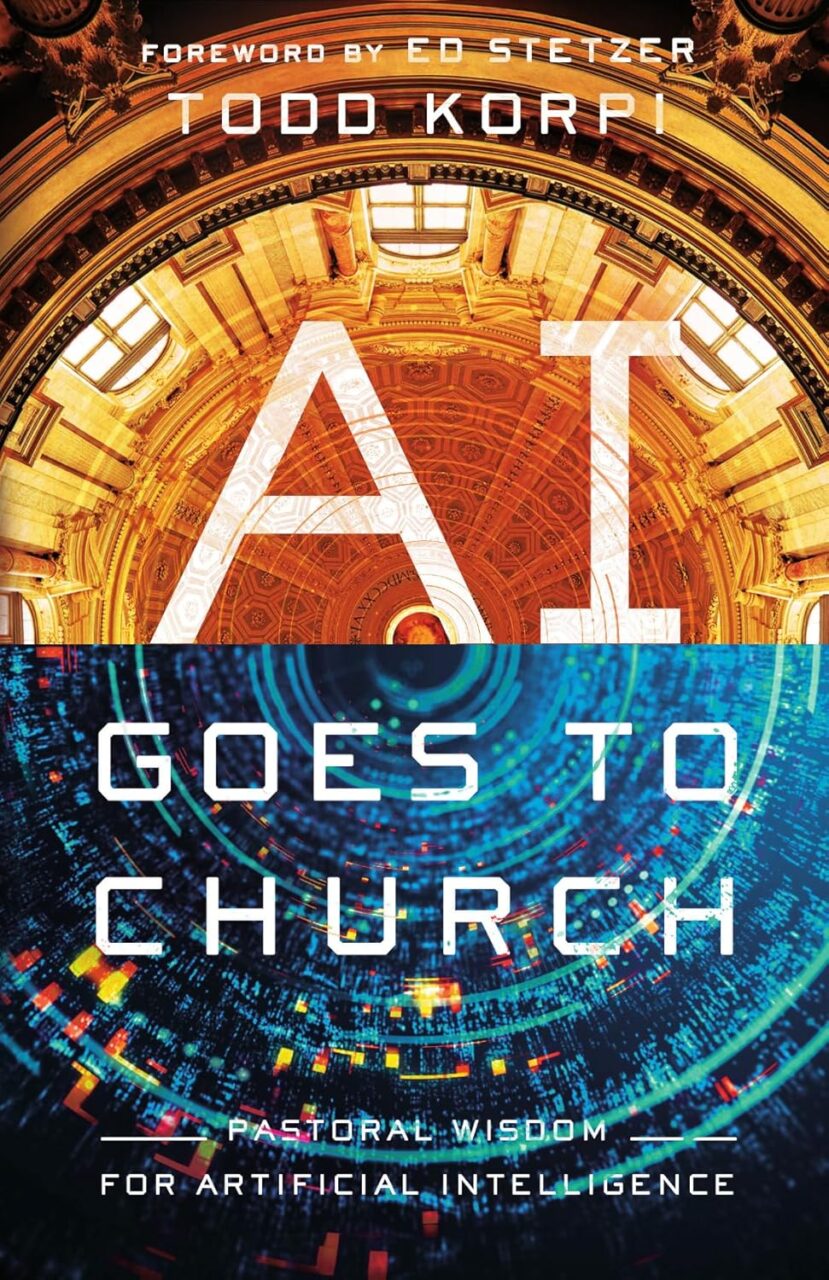
AI Goes to Church: Pastoral Wisdom for Artificial Intelligence
by Todd Korpi
Downers Grove, Illinois: IVP, 2025; 221 pages
ISBN 9781514011249, first edition, paperback
Foreword by Ed Stetzer
AU$35
It is interesting to think back a number of years to the paucity of initial responses from Christian writers when new technologies in the reproductive area came on the scene. The limited number of responses tended to be negative and dismissive. AI is different because it is everywhere, and many—including Christians—feel it is about to take over their lives, and there are no biblical references to it. Hence, what is needed are Christians with a firm theological base, a working knowledge of IT and AI, plus pastoral and educational experience.
These demanding expectations are met by Todd Korpi, the author of AI Goes to Church. Korpi is a pastor, missiologist, and church consultant, who is dean of digital ministry programs at Ascent College, and assistant professor of Christian leadership at Fuller Theological Seminary in the United States. He describes himself as a missiologist rather than an AI developer, and this enables him to consider how the church might engage with the technology for the sake of the gospel rather than dwell on how the technology is used. His profound experience with AI and his deep understanding of it in diverse contexts enable him to make nuanced theological analyses.
His background shines through in the chapter on understanding AI, where he provides very useful explanations of the scope and nature of AI in language lay people can follow. These include narrow AI (today’s AI), general AI (the next step in its evolution), and super AI (a theoretical future event). He explains the technical terms we all encounter, from machine learning to data mining and augmented reality. His theological underpinning emerges as he tracks what it means to resist and then reverse what he describes as the curse of AI. Engaging with AI should lie not just in how much it makes our lives easier but in how it impacts the vulnerable, those on the margins, the poor, and the environment. The book would be worth buying for this chapter alone.
Korpi argues that the relation of AI (and the whole of modern technology) to Scripture is fundamental, and he unpacks what he sees as fundamental dilemmas for Christians, including theological anthropology, the creator’s rule over creation, and sin. He posits no ready-made answers from Scripture but recognises a need for the collective wisdom and discernment capabilities of the whole church to tackle the dilemmas presented by AI.
In considering the image of God in the age of AI, Korpi is not afraid to ask far-reaching questions about what may happen when, and if, AI reaches a point of sentience. Outlandish as such questions may appear, they demonstrate his willingness to ask unpalatable questions, such as what it means to steward AI as God’s image bearers. This, in turn, opens the topic of AI bots, including those that involve sexually explicit “relationships.” Korpi responds by emphasising the Christian’s responsibility to steward creation well and promote human flourishing. This unfortunately is distorted when AI is dominated by social media moguls intent on profits rather than human welfare.
Korpi looks to the image of God, the goodness of creation, the mission of God, and human connection and culture care as basic ethical principles. We are not to use AI in ways that enhance our capability of destroying human life or betraying people’s rights to privacy and autonomy. But the reality is that its tremendous power enables us to build our own kingdom rather than the kingdom of God. And so we have to ask how we use it to support the marginalised rather than enrich ourselves. Despite his concerns, he is cautiously optimistic because it can free us for time to cultivate relationships (p. 83). This is a plea to utilise AI wisely by advocating for technologies that leverage clean energy and enhance human welfare.
As the title of the book suggests, the role of AI in the mission of the church is never far from the surface. God invites us to use the creative brilliance he has given us to employ AI in the work of mission, as long as we exercise cautious restraint (p. 98). For instance, AI provides the capacity to translate and bridge linguistic barriers, and to minister to visually and audibly impaired people through speech-to-text and text-to-speech functionality. For him, Christians are to be hospitable digital citizens and embrace missional digital lives (p. 107).
Korpi recognises that AI can be used in unjust ways, for instance, by being biased against women and minority racial groups. Christians need to be aware of the sources of such biases, lying as they do in training bias, algorithmic bias, and cognitive bias (p. 121). They should seek to build uniquely Christian algorithms that seek to meet ministry needs and the needs of those communities they are called to serve. He does not pretend to provide simplistic solutions, and Christians need to advocate in their workplaces against indiscriminate AI screening in hiring practices, and in the church context to use AI to steward its resources.
Korpi is unafraid to delve into possible uses of AI in areas such as premarital counselling and mental health therapy. However, he warns about the limitations of machines in bearing God’s image to the world and emphasises that AI should be strictly regarded as a complement, and not a supplement (p. 157). Nevertheless, he concedes there may be a place for an AI bot as an aid in basic counselling when a human pastor is unavailable. Ultimately, though, the needs of people require the sacred relationship between human and divine, something that cannot be replaced by AI (p. 182).
In discussing AI and higher education, Korpi pushes into what for many of us will be unfamiliar territory. He is prepared to turn traditional monologue teaching on its head as he recognises a number of shifts—from information impartation to wisdom impartation, from competency formation to virtue formation, and from high control to low control. In advocating for dramatic transformations, he argues that the use of AI will in the future not be regarded as plagiarism. Controversial as some of these points are, his goal is to empower students, especially Christian students, to thrive in a world dominated by AI by learning to use AI wisely.
Throughout, Korpi is aware that AI’s limitation is in cultivating wisdom. For those in ministry he has wise words: “If that sermon is not birthed in the deep unction of our soul, if it is not bathed in prayer . . . then why bother delivering it at all?” (p. 191). What is required is a transformational encounter with God and not with a planned schedule driven by AI. He concludes with a list of pertinent questions when deciding on whether or not to use AI and how to use it in a Christian community. For example: How can I exercise a prophetic voice in critiquing and guiding the use of an AI tool? How might such a tool influence my spiritual and moral formation, for good or for bad? (p. 198).
This book will not provide the reader with quick and easy answers to the multidimensional phenomenon that is AI. But it will raise a host of queries and possibilities that will have to be studied and thought about for a long time to come. AI with its positives and negatives is not going away, and Christians will inevitably be affected by it in their daily lives. I recommend this book wholeheartedly. You will be educated and stimulated even at those points where you may disagree with the author. It also lends itself to group study.