


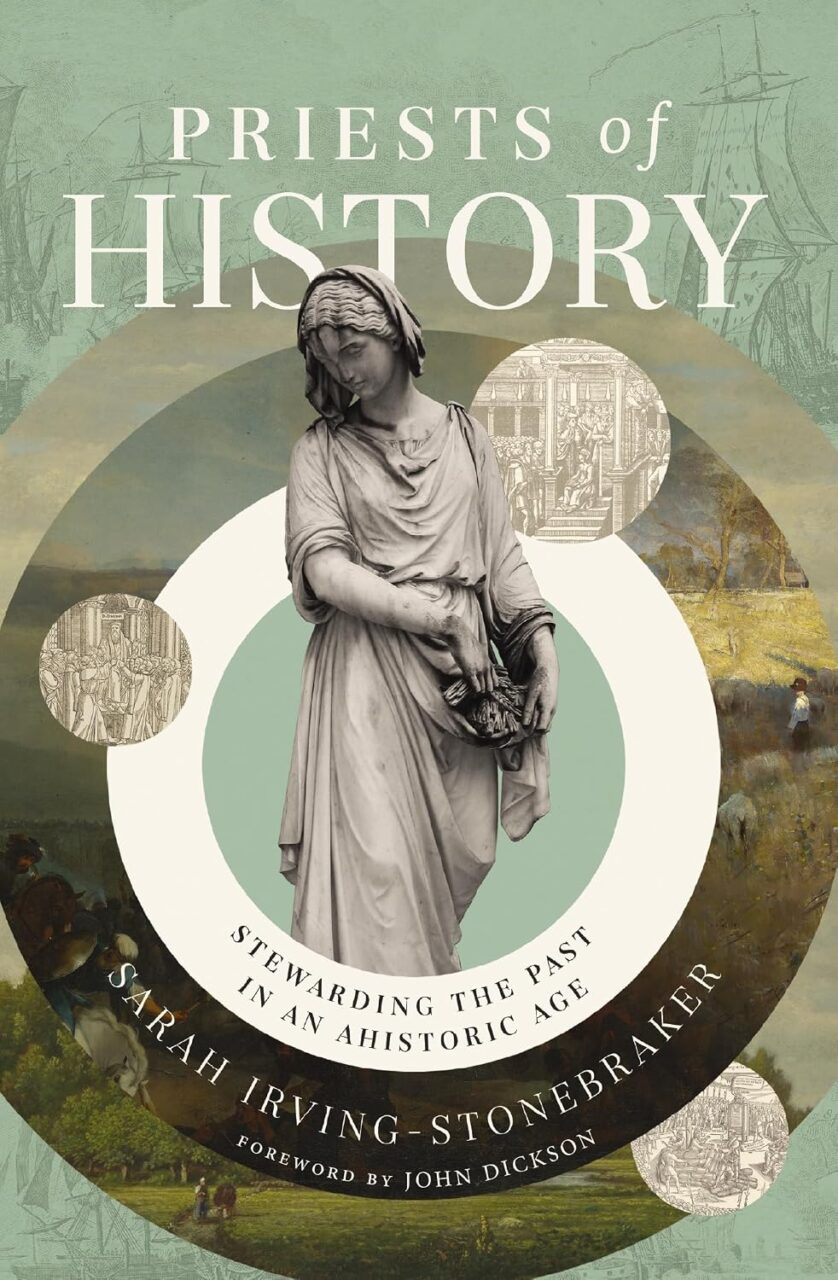
In Priests of History: Stewarding the Past in an Ahistoric Age (Zondervan Reflective, 2024), author Sarah Irving-Stonebraker gives a delightful account of how she became a Christian. She was in her late 20’s and everything was going well for her academically, but she moved from being politely hostile to the Christian faith, to committing herself to Christ. She and her household are now very disciplined and committed Christians, who draw on the traditional practices of protestant Christianity to connect to the past and so give shape to their future life. It is quite a journey, and I was left wanting more, particularly because one of the drivers was her encounter with the science and theology of Robert Boyle (1627–1691) and Robert Hooke (1635–1703). When she studied their writings, she discovered how much their Christian commitment shaped the way they saw their science. This is very different from today’s approach to people’s faith commitments. Now people’s beliefs and commitments are regarded as private affairs not worthy of inquiry or comment—taboo even. This is different from the secularity I encountered in India where people’s faith commitments were recognised and respected, even when one’s faith was different from another’s. There, faith shaped values and motives. By contrast to India, Australian secularity does not discuss faith or values easily.
Irving-Stonebraker claims we are living in an ahistoric age which ignores the past. This reminded me of when I commended a seminal paper on the biopsychosocial model of medical care by George Engel[1] to a medical registrar. It was in about 2015. The registrar looked at the paper and said that it was so dated because it was written in 1980. So last century!
However, can we describe our age with the thesis that we are ahistorical? John Hedley Brooke in his history of science and religion[2] warns us against making sweeping generalisations about history as there are always counterfactuals against any historical thesis. He was addressing the myth of the conflict between science and religion, when their relationship is much more nuanced and complicated. Likewise, Peter Harrison presents an attractive thesis: that the new hermeneutic approach to Scripture, developed during the protestant reformation, led to the development of the new approach to nature.[3] There may well be some truth to that in relation to the basic sciences, but the thesis flounders on the fact that the development of the science of anatomy and pathology started in the universities of northern Italy about half a century before Martin Luther nailed his 95 theses to the Wittenberg door. The anatomical pioneer and catholic, Andreas Vesalius, was not particularly a biblical scholar, but he was a member of The Brotherhood of the Common Life, to which Thomas à Kempis and Erasmus of Rotterdam also belonged.
But is our age ahistorical or dyshistorical? I recall representing ISCAST which sponsored a public lecture given at The University of Melbourne by George Ellis FRS (a Fellow of the Royal Society) on the origin of the universe. It was an ISCAST lecture that the physicists of Melbourne expressed interest in joining. As chair of the gathering I thought I would present Johannes Keppler’s famous prayer invoking awe and wonder that he could think God’s thoughts after him. As I addressed the 700 or so members in the audience, it felt as if I had somehow transgressed the bounds of good taste by bringing faith commitments into a physics lecture. Faith commitments. so germane to Keppler, Boyle, and Hooke, are taboo in our modern society.
I am a physician in addiction medicine. I am also a historian in that every patient tells their story of how they developed their addiction. I am interested in their faith commitments, that is their belief in the dimensions of meaning, purpose, and relationships (the Christian’s virtues of faith, hope, and love in secular terms) because these virtues drive their lives and are a valuable resource to help their recovery. Ironically, the modern corporate world spends a lot of time in governance defining their mission, vision, and core values (that is, their secular faith commitments) while there is little exploration of these virtues for individuals. When I alluded to these virtues in the case of Keppler, somehow I crossed the boundaries of good taste. Even doctors are nervous exploring these faith dimensions as they are afraid such explorations may be misinterpreted as proselytising. Such fear needs to be challenged, for humans need to be free to explore these dimensions as they reflect on who they are, what their values are, and how this impacts their approach to their physical and mental health.
Such dimensions need to be explored by historians as they study their subjects. There are a number of episodes throughout history where this did not occur, not because they did not study history (they were not ahistorical) but because the spiritual dimension was not part of their historical enquiry. For example, in Hugh Aldersley-Williams’s otherwise outstanding biography of Dutch diplomat Constantijn Huygens and his more famous son, Christiaan Huygens,[4] who was a polymath, the first non-English FRS, discoverer of the rings of Saturn, and a leading figure in the development of science in Europe, there is no mention of the family’s Calvinist background. This happened despite the fact that Constantijn, Christiaan’s father, mentored William, the future king of England, king Billy of Irish infamy, a staunch protestant who rescued England when the Catholics threatened to transform the restored monarchy to a Catholic state. Their faith commitments must have mattered, as Constantijn attended the notorious Council of Dort (1618–1619). However, the biography is silent in this area. Likewise, in researching the very accessible stories of the rise of anatomy and pathology—biographies of stalwarts of anatomy like Antonius Vesalius, Felix Platter, Jean Fernel, and William Harvey—it required some digging to find out what faith commitments motivated these pioneers. Some, like Thomas Sydenham, Hermann Boerhaave, and Ambrose Paré were overt in their commitment to Christ; others, like Charles Darwin, were ambiguous, and later in Darwin’s life, agnostic, but these dimensions, worth exploring, are either glossed over or are footnotes to their story.
Thus, there is a history, but the stories are selective, seen through our modern, empty, secular lens.[5] This dyshistory calls on Christian historians to tell histories that position people’s faith commitments much more front and centre. It is not just restoring history but telling a truer, richer history. That work needs to take place not in a Christian echo-chamber but in the secular marketplace of ideas as a corrective for distorted stories. This, I think, Irving-Stonebraker does. For instance, in examining some Christian stories addressing slavery in the UK and US, and the aboriginal story in Australia.
I am surprised that Irving-Stonebraker, who cut her historian teeth on Boyle and Hooke, did not include the history of the sciences in her book. I strongly commend Tom McLeish’s Faith and Wisdom in Science[6] and his later The Poetry and Music of Science.[7] Both profoundly explore a bridge between the great divide of the arts and the sciences, pointing out that by resurrecting the old appellation of science as natural philosophy, the love of the wisdom of nature, not only do we discover a much longer and richer history of what we now know as science, but we also discover the need to encase the sciences within the values and stories found in the arts. Thus, the pursuit of beauty (p. 164–9) is not just the domain of the arts but is a necessary dimension in the exploration of scientific frontiers. Her encounter with Boyle and Hooke points the way forward.
I was disappointed by Irving-Stonebraker’s treatment of the question of slavery. The story she tells is a very partial one and somewhat idealistic. The heroes she describes, Mary Prince, Anna Hart Gilbert, and Elizabeth Hart Twaites, were wonderful people and committed Christians who struggled to abolish slavery. But the stories here are one-sided. I was recently in Newburyport MA where I visited the First Presbyterian Church. The great evangelist George Whitfield, who founded that church, is buried there in a crypt below the pulpit. Whitfield advocated humanity in the treatment of slaves but also lobbied the government of the state of Georgia to allow slaves. Whitfield believed his orphanages there needed slaves to stay financially viable. So, slavery became legal in Georgia. Ironically, about 40 years after Whitfield’s death, William Garrison, the famous abolitionist, was born in the house next door to the church. I could not find a clear account of Garrison’s faith commitment, but he is now eulogised for his leadership in the abolitionist movement. His good friend, John Greenleaf Whittier, author of the famous hymn “Dear Lord and Father of Mankind,” came from the neighbouring town of Amesbury MA. Whittier was a well-known Quaker and staunch abolitionist. He also chronicled in poetry the sad story of the cruel mistreatment of Quakers by the Puritans of New England. The story, as Irving-Stonebraker admits, is complex, but that is only alluded to rather than explored in her book.
Diving more deeply into the nature of history, Irving-Stonebraker has avoided the thorny issue of the difference between her modern, scientific approach to history and the way history is recorded in the Bible. Thus, for example, in the biblical book of Joshua, God is not just active in history, but he speaks his intentions in the first person. Likewise, my colleague Dr Luke, in both his gospel and the book of Acts, describes God or God’s Spirit as actively speaking participants in the narrative. What sort of history is this? Why have we a different, more “scientific approach” now? How is our approach justified?
Similarly, the Swiss minister and theologian J. H. Merle d’Aubigny’s The Reformation in England[8] has a much more lively, almost novelistic approach to history. It is a vivid read but the biases and judgments of the author are much in evidence. The review of d’Aubigny’s book in The Reformer’s Bookshop laments that since this 1962 reprint there has been strong decline in biblical literacy: “Biblical illiteracy is the norm, secularism now dominates the Continent that witnessed the reforming work of Luther, Zwingli and Calvin, Tyndale, Cranmer and Knox. In this hostile climate … ”[9] However, the style of writing history has changed, and Irving-Stonebraker represents the new approach—more objective and detached, which I agree with. But on what basis is this approach justified? It is an approach foreign to the historians described above. The basis of the new is not found within Scripture; from this angle it seems an unbiblical, yet properly objective, approach to history.
How do we not just preserve our stories, but pass them on to the next generation? Irving-Stonebraker tells us that the daily, weekly, and seasonal liturgical rhythms shape her family’s practices. I was surprised that she drew on protestant divines but did not draw on the First Testament’s strong comments for parents to pass on the traditions to their offspring; for instance, in the exposition of the Torah and the wisdom literature. Her strategies of cultivating and keeping our histories are of necessity rooted in traditional practices, but are there not more modern ways to do the same thing? New songs set to new music, however difficult for traditionalists, are a way of re-incarnating the gospel into new idioms. The challenge of the Internet or Zoom meetings can be made into exciting new ways to pass on our traditions. Likewise, there are now historical novels and even historical comic strips like the adventures of Asterix which can also enrich our past.
These are mere caveats to what has obviously been a very stimulating read. Irving-Stonebraker has provided a motivating account of a better, more Christian approach to history. This serves as a light on how the virtues (like meaning, purpose, and relationships described above) might shape everyday practice to the glory of God, so that people, like Irving-Stonebraker, are motivated to ask why scientists do what they do, and how she can explore her own virtues as a result.
[1] Engel, G. The Clinical Application of the Biopsychosocial Model. Am J Psychiatry. 1980; 137:535–544.
[2] Brooke, J. H. Science and Religion: Some Historical Perspectives (Cambridge University Press, 1991).
[3] Harrison, P. The Bible, Protestantism and the Rise of Natural Science (Cambridge University Press, 1998).
[4] Aldersley-Williams, H. Dutch Light: Christiaan Huygens and the Making of Science in Europe (Picador, 2020).
[5] I call Western secularism empty because it is silent on faith commitments, unlike Indian secularism which acknowledges and respects faith commitments as part of public discourse; with Karl Barth: “Where difference is understood and respected, and yet commitments are neither hidden nor diluted.”
[6] McLeish, T. Faith and Wisdom in Science (Oxford University Press, 2014).
[7] McLeish, T. The Poetry and Music of Science: Comparing Creativity in Science and Art (Oxford University Press, 2019).
[8] d’Aubigne, J. H. M. The Reformation in England (Banner of Truth, 1962).
[9] Anonymous reviewer of d’Aubigne’s The Reformation in England. https://reformers.com.au/products/9781848716506-the-reformation-in-england-daubigne-j-h-merle?srsltid=AfmBOoomDYeCzVvWXPfIy9BGocjk0HZDM8hsmvF5CKA8yDaMTRiqA8c4.