


Book reviewed by Malcolm Buchanan, November 2025
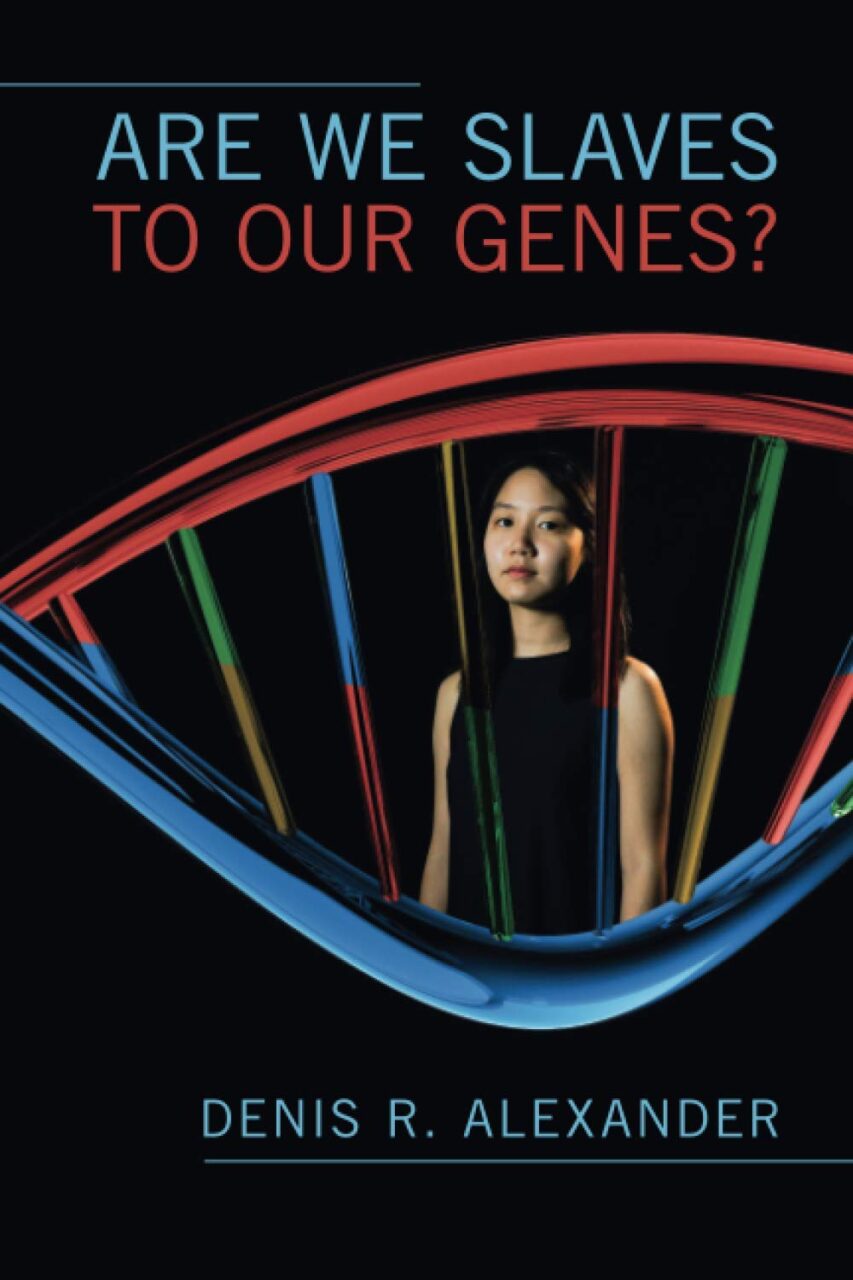
Are We Slaves To Our Genes?
by Denis R. Alexander
Melbourne, Australia: Cambridge University Press, 2020; 252 pages
ISBN 9781108445054, first edition, paperback
AU$47
Can our genes truly dictate who we are—or do we retain the freedom to shape our identity? In Are We Slaves to Our Genes?, Denis Alexander interrogates this question through behavioural genetics, blending rigorous science with philosophical inquiry. A British molecular biologist with four decades of research experience, Alexander draws on his academic and professional background to explore whether genetic determinism genuinely threatens human free will.
To understand the book’s academic roots, it helps to note that it originated from the Gifford Lectures delivered at St Andrews University in 2012 and was later published as Genes, Determinism and God in 2017. This current edition was prompted by a request for a version more accessible to general readers. In my view, however, it remains somewhat academic and assumes at least a basic understanding of genetics and philosophy. To support readers, the book includes a “Notes” section and a “Definitions of Technical Terms” section. The book contains twelve chapters and a useful “References” section, which highlights the breadth of research engaged throughout the discussion, including Alexander’s own research contributions. The first ten chapters primarily lay the groundwork for addressing the book’s central question: “Are we slaves to our genes?” Chapter 1 explores common misconceptions in genetics. Chapter 2 introduces foundational concepts, leading to an understanding of genetic information and how it flows. Chapter 3 builds on this by examining the interaction between genes and the environment, and how this shapes human development. Chapter 4 delves into behavioural genetics—highlighting both its potential and the challenges involved in interpreting its data. This is made clear by looking at a number of practical examples in Chapters 5–10, including mental health, educational attainment, weight, levels of religious and political commitment, and sexual orientation. This leads to the titular question of the book in Chapter 11 and enters the area of free will and determinism. The closing chapter (Chapter 12) focuses on the role of genetics in human identity in relation to two competing worldviews: Judaeo-Christian imago Dei and transhumanism.
The idea of genes as “difference makers” is a central theme in the book, especially within the context of complex polygenic systems. Alexander explains that most traits result from the combined influence of many genes, each contributing a small effect. Occasionally, a single gene variant can trigger a cascade of biological changes that significantly alters the outcome. A trait’s phenotype typically emerges when the cumulative genetic influence exceeds a threshold and is shaped by epigenetic regulation and environmental factors. Some traits show continuous variation, forming a spectrum rather than discrete categories (for example, sexual attraction—discussed in Chapter 10). Thus, genes are best understood as contributors to variation within a probabilistic framework, rather than as deterministic agents.
For example, Chapter 5 illustrates the idea of genes as “difference makers” by examining neurodevelopmental and psychiatric conditions such as autism, schizophrenia, bipolar disorder, major depressive disorder, and Alzheimer’s disease. While each has distinct genetic risk factors, some variants are shared across disorders, suggesting common biological pathways—particularly in gene networks regulating early synaptic development. These conditions arise from the cumulative effect of many genes, each contributing modestly to overall risk. Although the chapter is titled “Genes and mental health,” the inclusion of Alzheimer’s—primarily a neurodegenerative disease—indicates a broader focus on brain-related disorders.
Personal choice is another important concept in the book, particularly in how it interacts with genetic predisposition. For example, Chapter 8 discusses body mass index (BMI), noting that individuals with risk variants—such as those in the FTO gene—are not deterministically bound to higher BMI. Instead, maintaining a healthy weight may require greater effort through lifestyle choices like diet and exercise. Notably, regular physical activity can influence the epigenome, helping to mitigate genetic risk. While the concept of personal choice is present throughout the book, its role within the broader mix of genes, variants, epigenetic regulation, and environment could be more clearly defined. Alexander’s focus on specific variants, including FTO for BMI and ApoE for Alzheimer’s (Chapter 5), added clarity and interest to the discussion.
This sets the stage for Chapter 11, where Alexander tackles the concept of emergence in relation to free will and determinism. Alexander acknowledges that brain processes follow the laws of chemistry and physics yet argues this does not negate free will. To understand how genetic variation influences human behaviour—typically in non-deterministic ways—we must consider how the mind emerges from the brain. This relationship exemplifies strong emergence, where mental properties —such as reasoning, reflection, and decision-making—cannot be reduced to or predicted from the brain’s physical components alone. In contrast, epigenetic regulation, synaptic changes from learning, and lifestyle factors like diet and exercise represent weak emergence—complex outcomes traceable to molecular interactions. Free will, as presented, arises from a dynamic interplay of genetic, epigenetic, environmental, and behavioural factors, best understood along a continuum between determinism and free will. However, I felt that while Alexander introduces emergence as a conceptual framework for understanding free will, he does not fully integrate it into his broader argument. Its explanatory function remains underdeveloped, which slightly weakens the coherence of the chapter’s discussion.
Finally, the book turns to the question of identity. In Chapter 12, Alexander contrasts the Judaeo-Christian concept of imago Dei with transhumanism. While Alexander compellingly argues that worldviews exert a powerful causal influence on human behaviour and engagement with the world, the chapter would have benefited from connecting this discussion with genetics and his earlier treatment of emergence into a more unified explanatory model of identity. The chapter emphasizes the top-down impact of worldview on identity—suggesting it may outweigh the bottom-up effects of genetic inheritance. The discussion on healing and enhancement acknowledges a blurred boundary, yet the two worldviews diverge sharply in their conclusions. Christian enhancement centres on virtues cultivated through the Holy Spirit within community, while transhumanism envisions individual perfection through technology and genetic modification, detached from a relational context. This last chapter concludes nicely by stating that only when suffering from severe genetic pathology are we slaves to our genes. We are also not slaves to our worldviews, but they significantly shape how we interpret genetic applications—especially those aimed at human enhancement.
As a science educator, I found the book’s framing of genes as “difference makers” rather than absolute determinants particularly insightful. By emphasizing the interplay of genetic influence with personal choice, epigenetics, and worldview, it offers rich material for classroom discussions—covering health and behaviour alongside deeper questions of free will and identity. The book is highly recommended for anyone seeking a thought-provoking exploration of human genetics, particularly those interested in bioethics, philosophy of science, or science education.